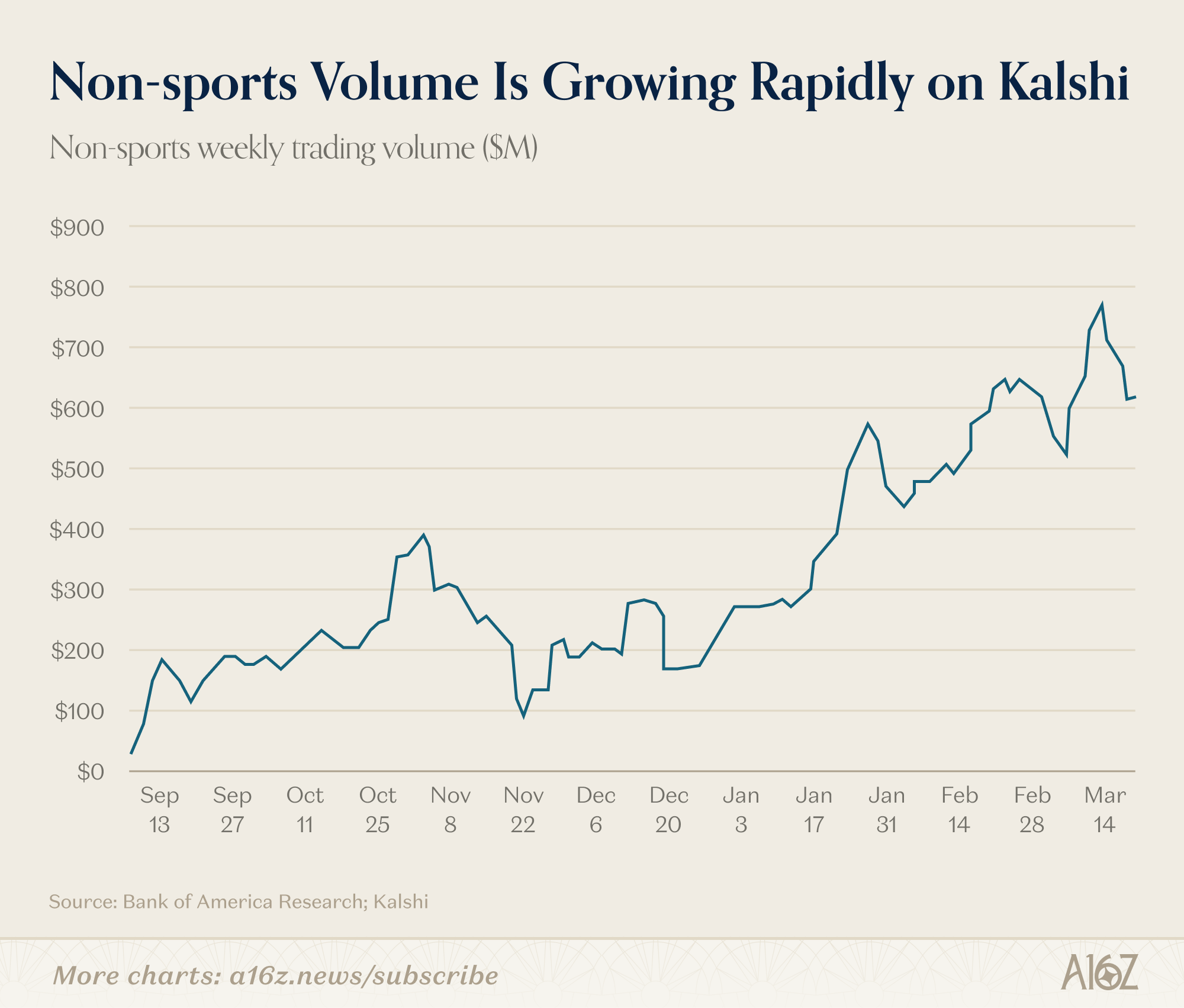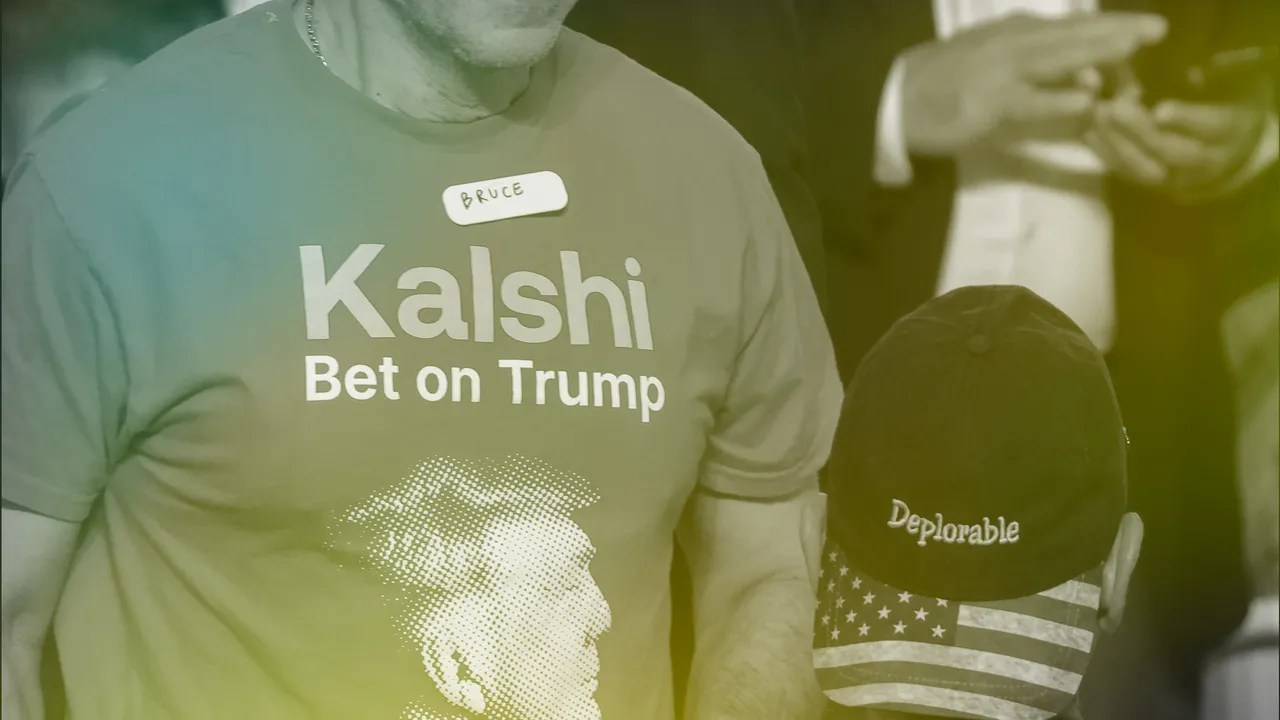
In recent months, higher prices and sagging consumer sentiment have caused the U.S. economy to slow on an over-all basis. But one industry is growing at an astronomical rate: online prediction markets, where millions of Americans wager on almost anything, including the outcomes of sporting events, when traffic will return to normal in the Strait of Hormuz, and how many times Elon Musk will tweet in a certain week. Between this past September and this April, according to the Pew Research Center, trading volume on prediction platforms, such as Polymarket and Kalshi, virtually quintupled, from about five billion dollars to about twenty-four billion dollars.Opinions are divided on whether this is a healthy development, but it has already led to a bitter power struggle between the Trump Administration and the states over who has the authority to regulate (and tax) the prediction platforms. The Trump Administration is currently considering guidelines that would place the platforms under the supervision of the Commodity Futures Trading Commission, a small agency previously best known for regulating futures markets where professional traders exchange contracts to deliver commodities like crude oil and pork bellies. Traditionally, gambling by ordinary Americans has been regulated at the state level. In April, Letitia James, the New York attorney general, sued Coinbase and Gemini, two crypto firms that have expanded into prediction markets, claiming that they were carrying out illegal gaming operations. (Both companies have denied the claim, arguing that prediction markets are federally regulated national exchanges.) The same month, J. B. Pritzker, the governor of Illinois, signed an executive order banning state employees from betting on prediction platforms on the basis of confidential information. And a couple of weeks ago, Tim Walz, the governor of Minnesota, signed the country’s first ban on prediction markets from operating in an individual state. Some Republican states and prominent Republicans, including Chris Christie, the former governor of New Jersey, have also called for restrictions of various kinds.It just so happens that the Trump family has close ties to Polymarket and Kalshi. One of the investors in Polymarket is the venture-capital outfit 1789 Capital, where Donald Trump, Jr., is a partner. Trump, Jr., is also a “strategic adviser” to Kalshi. So it perhaps wasn’t entirely surprising when, last week, Trump took time out from building his East Wing ballroom and trying to extricate himself from his disastrous Iran war to weigh in on the dispute with the states. On his Truth Social account, he wrote, “It is critically important that the CFTC’s exclusive authority over Prediction Markets is maintained, and that they will thrive. . . . We cannot have SCUM like Chris Christie, Letitia James, Tim Walz, and JB Pritzker setting the rules!”This intervention comes as the C.F.T.C. is expanding its supervisory role in another fast-developing industry, one in which the Trump family has even bigger financial interests: crypto. According to the watchdog group Public Citizen, World Liberty Financial, a new-age finance firm that issues crypto tokens and stablecoins, and which Trump co-founded in 2024, has created more than a billion dollars for him in equity and cash inflows. Trump’s two oldest sons are co-founders of American Bitcoin, a company that mines bitcoins and accumulates them in its treasury. Under the CLARITY Act, which is awaiting Senate approval, the C.F.T.C. would be granted exclusive jurisdiction over all “digital commodities,” a category that includes Bitcoin, Ether, and Solana. “Likewise, and even more importantly,” Trump went on in his Truth Social post, “where we are currently the Crypto (Bitcoin, etc.) Capital of the World, other Countries are trying diligently to replace us in that capacity, but we won’t let that happen. It is a major Industry, and we must protect it. Mike Selig, C.F.T.C. Chairman, and respected by all, is doing a great job.”The C.F.T.C. is now facing challenges on two fronts: not just from the states but also from media revelations about how its enforcement division has been neutered since Trump came to office. A couple of days before the President posted his online screed, the Times published a barn burner of a story that described how, since the start of last year, the C.F.T.C. has “shrunk its work force, purged career officials, sharply curtailed crypto enforcement and helped out prediction markets at virtually every turn.” One veteran employee of the agency who rose to acting chief of its enforcement division, before retiring last year, was quoted as saying, “This is really the first time that politics have affected the C.F.T.C. in such a dramatic way.”In the legal battle with the states, the central issue is whether buying or selling an “events contract” on Polymarket, say, one based on whether Novak Djokovic will win his next match, is the same as betting on a site such as DraftKings or FanDuel, or with your neighborhood bookie. The states argue it is. The prediction platforms and the Trump Administration say that the wagers are events contracts, which are subject to the jurisdiction of the C.F.T.C. So far, courts in various parts of the country have issued clashing rulings. The dispute seems certain to go all the way to the Supreme Court, and some independent observers expect the prediction markets to end up with a loss. “We continue to give the advantage to the states in this fight, as the states have long been in charge of regulating sports gambling,” Jaret Seiberg, an analyst at the investment bank TD Cowen, wrote in a note to clients last week. “Litigation could still take two years or longer to fully play out.”In the meantime, what’s happening at the C.F.T.C. looks like a classic case of what economists refer to as regulatory capture, where vested interests effectively seize control of a government agency, which then advances their interests. The Biden Administration had expressed concern about how prediction markets were running: in January, 2022, the C.F.T.C. forced Polymarket to pay a $1.4 million penalty for operating an unregistered “contract market.” Subsequently, the agency, along with the Justice Department, investigated whether Polymarket had violated this settlement by accepting bets from people in the United States. In November, 2024, F.B.I. agents raided the apartment of Polymarket’s young founder, Shayne Coplan. After Trump came to power, the C.F.T.C. reversed course, closing its investigation this past July without bringing any charges. A month later, Polymarket announced that 1789 Capital had made a strategic investment in the company, and Trump, Jr., joined its advisory board.Some career officials at the C.F.T.C. have tried to exercise some independence. Last year, two senior officials in the enforcement division queried the steps that Polymarket had taken to prevent fraud. But, per the Times account, these officials were eventually purged.These events took place when the C.F.T.C. was under the leadership of an acting head, Caroline Pham. Michael Selig took over as the permanent chair last December. Selig is a thirty-six-year-old lawyer who has described prediction markets as “truth machines” rather than betting platforms. Before joining the C.F.T.C., he worked as a chief counsel and legal adviser at the Securities and Exchange Commission. Prior to that, he worked for a corporate law firm, where he represented clients including crypto firms. Now he is in an unprecedented position. Since the C.F.T.C. was created in 1974, its key decisions about enforcement have been determined by five commissioners, who, by tradition, have come from both parties. At the moment, however, Selig is the lone commissioner—the other four spots are vacant—which gives him immense influence over the agency.Earlier this year, Selig told Congress that it would “have a zero-tolerance policy when it comes to fraud, insider trading and manipulation in our markets.” In April, the C.F.T.C. charged a member of the U.S. Special Forces with insider dealing for placing wagers on Polymarket, in January, that Nicolás Maduro, the President of Venezuela, would be removed from power. (According to the agency’s complaint, the defendant was involved in the planning and execution of the operation.) However, Selig has also criticized the Biden Administration for being overly aggressive in its regulatory actions. He has singled out the raid on Coplan’s home, but his critique has been a broader one, and the agency’s recent actions have reflected that.In January, 2025, just before Trump entered the White House, the Biden-era C.F.T.C. levied a five-million-dollar fine on Gemini, a crypto exchange owned and operated by the Winklevoss twins, a pair of Trump-supporting billionaires, for allegedly misleading the agency’s staff about a bitcoin auction. During the run-up to the 2024 Presidential election, the Winklevosses donated about $1.7 million dollars directly to Trump’s campaign, and, since then, tens of millions of dollars to pro-crypto, pro-Trump super PACs. More recently, they have appeared on a list of donors that the White House said had agreed to finance Trump’s ballroom. They have also invested in American Bitcoin.Despite agreeing to pay the Gemini fine, the Winklevoss twins didn’t admit any wrongdoing. Months after Trump started his second term, their lawyers alleged, in a letter to C.F.T.C.’s inspector general, that the agency’s enforcement staff had “selectively and unfairly weaponized” the law to bring charges against Gemini. According to a social-media post this past September from Brian Quintenz, a former C.F.T.C. commissioner and Trump’s initial choice to head the agency, the twins lobbied him to put the Gemini case among its highest priorities and complained to the President after he balked. Subsequently, the White House withdrew Quintenz’s nomination and tapped Selig as a backup. Lo and behold, last week, the Selig-led C.F.T.C. asked a judge to vacate the 2025 judgment against Gemini, saying it relied on the non-credible account of a whistle-blower and “should not have been filed.”It certainly looks like the agency is now the creature of the Trumps and their wealthy pals. To be sure, the Administration insists that everything that has happened at the C.F.T.C. is above board and beyond question. “President Trump only acts in the best interests of the American public. There are no conflicts of interest,” a White House spokesman told the Times. A representative for Donald Trump, Jr., told the paper that he didn’t have any involvement in Polymarket’s dealings with regulators. After news emerged that the C.F.T.C. had asked a court to reverse the 2025 Winklevoss settlement, a White House spokesman told the Journal, “The media’s continued attempts to fabricate conflicts of interest are irresponsible and reinforce the public’s distrust in what they read.” Was that a sly reference to Orwell and “1984”? It’s hard to know. But, just in case you’ve forgotten it, here is the famous passage: “The Party told you to reject the evidence of your eyes and ears. It was their final, most essential command.” ♦
Why Donald Trump Cares About Prediction Markets
The power struggle over regulating crypto and prediction markets offers a window into how the President enriches his family and his wealthy supporters.
1,767 words~8 min read