India which accounts for 17.5 per cent of the global population and 11.6 per cent of the world's livestock, could see its irrigation water demand rise to 807 billion cubic metres (BCM) by 2050, according to estimates cited by the Ministry of Jal Shakti.The ministry noted that agriculture accounts for 80-90 per cent of water use in rural areas, adding to pressure on the country's water resources.According to the Central Water Commission's study, "Reassessment of Water Availability in India using Space Inputs, 2019", India receives average annual precipitation of around 3,880 BCM. After accounting for natural losses such as evaporation and other factors, average annual water availability is estimated at 1,999.20 BCM.Against this backdrop, the Ministry of Jal Shakti has stressed the need for water budgeting and said India must move away from a supply-driven approach towards demand-based and planned water management systems.Water budgeting enables communities to assess water availability and demand, and supports informed decision-making across agriculture, domestic use, livestock and industry, the ministry said."Water budgeting has emerged as a significant tool for sustainable development in water-stressed regions where scarcity and uneven distribution threaten economic stability, food security and climate resilience," it said.The National Commission for Integrated Water Resources Development has estimated that irrigation water demand could reach 807 BCM by 2050 under a high-demand scenario."These projections indicate growing pressure on water resources and highlight the need for improved planning and demand management," the ministry said.According to the 2019 livestock census, livestock numbers increased from 51.2 crore in 2012 to about 53.6 crore in 2019, while the cow population rose by 18 per cent."This increase in livestock population implies a corresponding rise in water demand for drinking, fodder production and related activities," the ministry said.It said increasing stress on limited water resources has resulted in declining groundwater levels, seasonal shortages and growing conflicts over water allocation.Water budgeting involves assessing water availability and demand within a defined geographical unit such as a village, watershed, block or district, with the objective of balancing water use with renewable availability.The ministry said the exercise can be undertaken from individual farms and villages to entire watersheds and river basins, enabling location-specific water management plans based on local conditions, resource availability and demand patterns."It enables informed crop planning, supporting crop selection based on local water conditions and optimised irrigation and sowing to reduce stress," it said, citing evidence from participatory water budgeting initiatives supported by NABARD.Highlighting government initiatives, the ministry said programmes such as the Atal Bhujal Yojana and the National Water Mission recognise water budgeting as a key tool for sustainable water management.Launched in 2019, the Atal Bhujal Yojana promotes water budgeting for decentralised water governance at the Gram Panchayat level and is being implemented on a pilot basis in 229 blocks across seven groundwater-stressed states.According to the ministry, assessments conducted during 2023-24 and 2024-25 showed measurable improvement in groundwater levels in 180 of the 229 blocks.The scheme also promotes revival of traditional water conservation systems such as Gokatte, Bawdi, Johad, Tanka, Kalyani and Diggi."As of March 2026, approximately 81,700 water conservation and recharge structures have been created or restored. The scheme mandates annual preparation and updating of water budgets, with 8,203 budgets completed across participating gram panchayats," it said.The ministry also highlighted women's participation in water conservation under the "Nari Shakti se Jal Shakti" initiative. In Udham Singh Nagar district of Uttarakhand, around 1,645 women have been trained under the Jal Jeevan Mission, while 300 women-led Village Water and Sanitation Committees are operational, it said.The ministry also highlighted the "Varuni" web application developed under the Indo-German project "Water Security and Climate Adaptation in Rural India (WASCA)"."The Varuni web application employs a scientifically robust yet user-friendly methodology to generate block-level water budgets," it said.The application integrates government data on rainfall, land use, cropping patterns, population and water resources to generate structured water budget assessments.The WASCA project is being implemented by the Ministries of Jal Shakti and Rural Development with technical support from NITI Aayog.Published on May 30, 2026
India's irrigation water demand may reach 807 BCM by 2050; ministry pushes for water budgeting
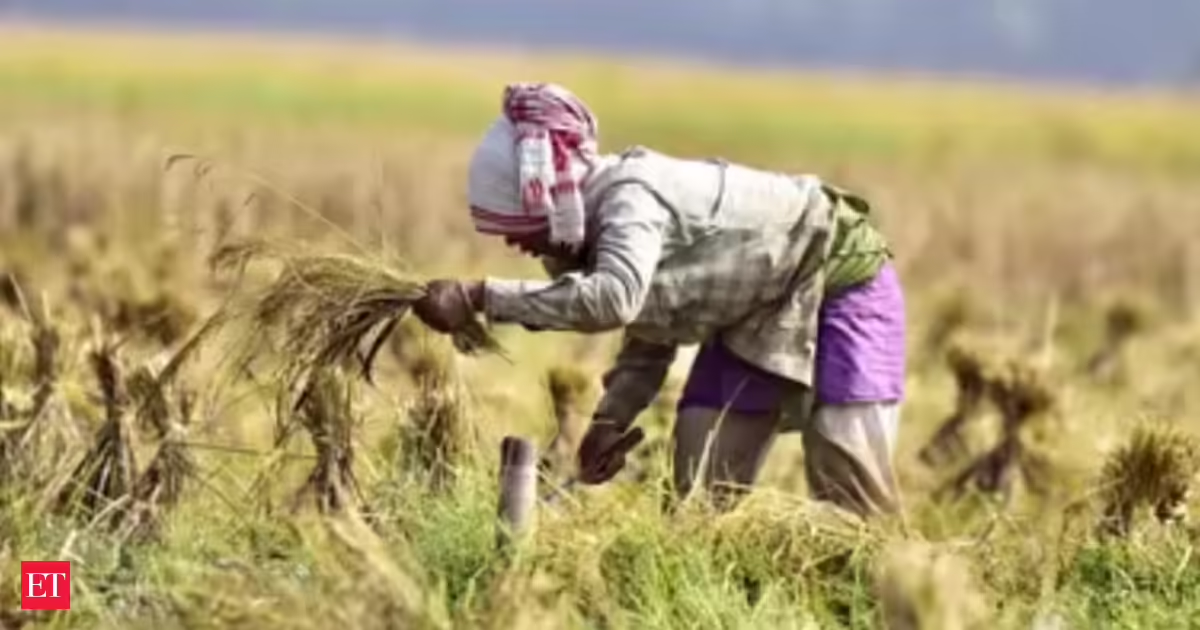
The ministry noted that agriculture accounts for 80-90% of water use in rural areas, adding to pressure on the country's water resources
664 words~3 min read