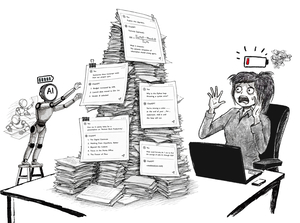
Australians are being forced to work even harder as the rollout of artificial intelligence (AI) tools create unrealistic expectations among bosses, despite the technology’s limitations.A white paper into “high performance” culture in Australian workplaces has found that instead of the promised productivity gains, AI was among the biggest drivers of employee burnout. “I’m yet to meet the people who’ve significantly reduced a workload off the back of anything like that,” Said Cherie Clonan, founder of marketing agency The Digital Picnic.“In fact, it just feels like people are more exhausted than ever.”Ms Clonan, whose agency released digital marketing philosophy The Performance Paradox, said AI was being dropped into already “broken” workplace systems and becoming a “force multiplier for burnout”.Experts claim that businesses have already started to cut back on hiring and are replacing some entry level jobs with AI products – and existing employees are having to pick up the slack.“I think in this AI era, we’re probably going to find out which leaders actually see these AI tools as something that should and could free people,” she said.“But unfortunately, I feel like we’re still at this sort of spot where folks are figuring out, ‘how can we squeeze our people even harder?’“I feel like we’re still at that point where the expectation is still that, ‘well, you’ve got the tools, so why can’t you do more and faster and with fewer people?’Melbourne creative Marion Piper told news.com.au a company she recently worked at was being pushed by clients to use AI tools in the belief it would produce cheaper and faster results.But she ended up spending time “cleaning up other people’s AI slop”, despite being expected to deliver content faster than before.“Not even a year-and-a-half ago, you would have two, three hours to produce a piece of content,” she said. “Whereas now it’s expected it’s done in an hour, sometimes even half an hour. “But where are those productivity gains going? Because the workload is increasing. “I’m not getting paid any more for my expertise. But I’m being expected to do even more work.”Costs ‘harder to justify’However, one expert said the much-hyped technology was now facing a “crossroads”, following the revelation that major companies were actually cutting back on AI use.Uber’s president revealed the company had burned through its annual AI token budget in just four months, and that the expense was becoming “harder to justify” based on its output.“If you’re not actually able to draw a direct line to how (many) useful features and functionality you’re shipping to your users, that trade becomes harder to justify,” Andrew Macdonald said.The Verge also reported that Microsoft had been cancelling Claude Code licenses due to high costs, while AI supremos Sam Altman (OpenAI) and Dario Amodei (Anthropic) have begun walking back claims of a looming jobs apocalypse.Axios reported corporate American was experiencing a reckoning, with one unnamed company spending US$500 million ($698 million) in a single month on its coding bills.There was also a dramatic foray into the debate surrounding AI and job losses by none other than Pope Leo, who recently wrote a 42,000 word essay in which he called for the technology to be “disarmed”.It comes as news.com.au revealed this month that Australian employment lawyers were dealing with cases involving white collar workers being replaced by AI weekly.Employment law specialist Roxanne Hart said it was now “fairly common” for her to take on cases involving office workers being made redundant due to AI.Shahriar Akter, a professor at the University of Wollongong, warned any company that believed AI was the answer to its problems was wrong.“There is no doubt that AI is contributing to innovation, efficiency and productivity (and) is basically transforming all the routine tasks,” he said.“But at the same time, we have to acknowledge that there is a gold rush going on with regard to artificial intelligence, and everyone is trying to apply AI in everything. “And this is creating workplace fatigue and also burnout because employees are under constant pressure to re-skill and upskill.”AI is ‘Nokia, not an iPhone’Prof Akter said corporations were at a “crossroads” as it was unclear which tools worked and which did not, with no guidelines for their use.Katrin Leifels from RMIT University said AI could cause additional demand on employees who are often already under pressure and mental stress.“I think if it’s just implemented without any conversation … and without considering the damages for the additional demands that they can create, that there is certainly the risk of harm,” Dr Leifels said.“And for instance, they expect that everybody is able to use technologies immediately, but that’s often not the case.”Ms Clonan said she was not anti-AI, but was against what she called AI “extraction”, where humans were replaced by the technology – something which she said was “absolutely not possible at this point in time”.“It’s like the next Claude bro saying, ‘I replaced this whole team by doing one quick thing on Claude’ or something like that, but it’s just not true,” she said.“In fact, the coding alone costs more than that full team that they flex on and brag about (replacing).“So that’s just … trying to find ways to quite literally replace an entire team, departments with AI.“We’re not there yet. We’re still in a Nokia 3210 era for AI, and we’re acting as if it’s the latest iPhone.”
‘Broken’: Aussie AI move backfires
Australians are being forced to work even harder as the rollout of artificial intelligence (AI) tools create unrealistic expectations among bosses, despite the technology’s limitations.
887 words~4 min read