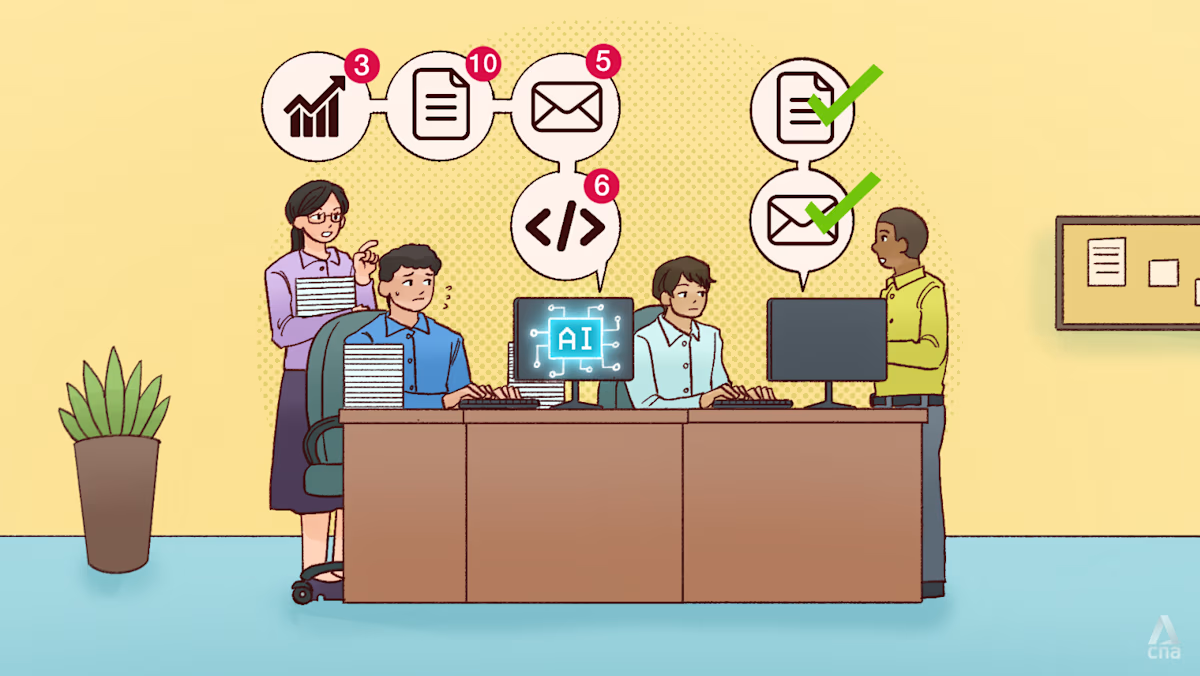
Asian woman using artificial intelligencegettyFor decades, strong performance at work was often measured by effort, hours worked, and the ability to complete assigned tasks. Today, AI is changing that equation. As intelligent tools become part of everyday workflows, employees are being evaluated less on how much work they do manually and more on the value they create. This shift doesn’t mean people are becoming less important. Instead, it means the skills that define high performance are evolving. Understanding these changes can help you stay relevant, increase your impact, and position yourself for long-term career success.Shift From Effort-Based Work to Outcome-Based EvaluationOne of the biggest changes AI is driving is a move away from measuring effort toward measuring results. In the past, employees were often rewarded for being busy, staying late, or handling large volumes of work. In the present day, AI can automate many time-consuming tasks, making it easier to complete work faster.As a result, employers are paying closer attention to outcomes. The question is no longer how long something took but whether it delivered value. Employees who can improve processes, solve problems, and contribute to business goals are becoming more valuable than those who simply stay busy. To adapt, focus on understanding how your work contributes to larger objectives and look for opportunities to improve results rather than just increase activity.MORE FOR YOURise in Expectations for Faster and Higher-Quality OutputAI tools are enabling employees to complete tasks more efficiently, which is naturally raising expectations around speed and quality. Work that once took hours can sometimes be completed in minutes with the right tools and prompts. This doesn’t mean employees are expected to work nonstop, but it does mean organizations are rethinking what productivity looks like.According to a recent global survey by the consulting firm McKinsey & Company, 88% of organizations reported regularly using AI in at least one business function in 2025, up significantly from previous years. As AI adoption becomes more widespread, employees are increasingly expected to use these tools effectively to improve efficiency and outcomes.Rather than viewing this as pressure, view it as an opportunity. Learning how to use AI tools strategically can help you produce higher-quality work, reduce repetitive effort, and free up time for more meaningful contributions. Employees who embrace these tools are often able to create more value without working longer hours.Redefinition of High Performance Beyond Task CompletionCompleting assigned tasks is no longer enough to stand out. As AI handles more routine activities, high performance is increasingly defined by qualities that technology cannot easily replicate. These include critical thinking, creativity, collaboration, emotional intelligence, and sound judgment.Employees who thrive in this environment don't simply execute instructions. They ask better questions, identify risks, challenge assumptions, and contribute ideas that improve outcomes. If you want to strengthen your performance profile, spend less time focusing solely on task completion and more time developing your ability to think strategically and contribute insights that help teams make better decisions.Decline in Value of Routine and Repetitive ResponsibilitiesMany repetitive activities are becoming automated, from scheduling and data entry to content summarization and basic reporting. While these tasks still exist, they are no longer the primary source of value for many knowledge workers.This means employees should think carefully about where they spend their time. If a large portion of your work consists of repeatable processes, explore how AI can help streamline those activities. Then use the time you save to develop skills that are harder to automate. Problem-solving, stakeholder management, communication, and innovation are becoming increasingly important because they require human judgment and context.The goal isn't to compete with AI on efficiency. It's to focus on the areas where people continue to provide unique value.Growth in Demand for Strategic Thinking and Decision-MakingAs AI takes over more operational work, strategic thinking is becoming a defining characteristic of high-performing employees. Organizations need people who can interpret information, connect ideas across functions, evaluate trade-offs, and make sound decisions in uncertain situations.Developing this capability requires moving beyond your immediate responsibilities. Pay attention to how your organization makes decisions, what challenges leaders are trying to solve, and how different teams contribute to broader goals. Look for opportunities to participate in planning discussions, process improvements, or cross-functional projects that expose you to bigger-picture thinking.The employees who stand out in the coming years will not necessarily be the ones who know the most about AI. They will be the ones who know how to use AI while applying strong judgment, business understanding, and strategic insight.AI is not eliminating the need for strong performance. It's redefining what strong performance looks like. As routine work becomes easier to automate, the value of outcomes, judgment, creativity, and strategic thinking continues to rise. The employees who adapt successfully will focus less on proving how hard they work and more on demonstrating the impact they create.The good news is that these are skills anyone can develop. By embracing new tools, strengthening uniquely human capabilities, and staying focused on meaningful outcomes, you can continue to thrive in a workplace that is evolving faster than ever. The future belongs not to those who resist change, but to those who learn how to grow alongside it. Rooting for you!
How AI Is Quietly Redefining What Good Performance Looks Like At Work
With AI automating routine tasks, employees face heightened expectations for faster, higher-quality output.
861 words~4 min read