Behind AI’s promise of efficiency, workers describe a faster office culture where easier tasks disappear and judgment-heavy work expands AI made work faster
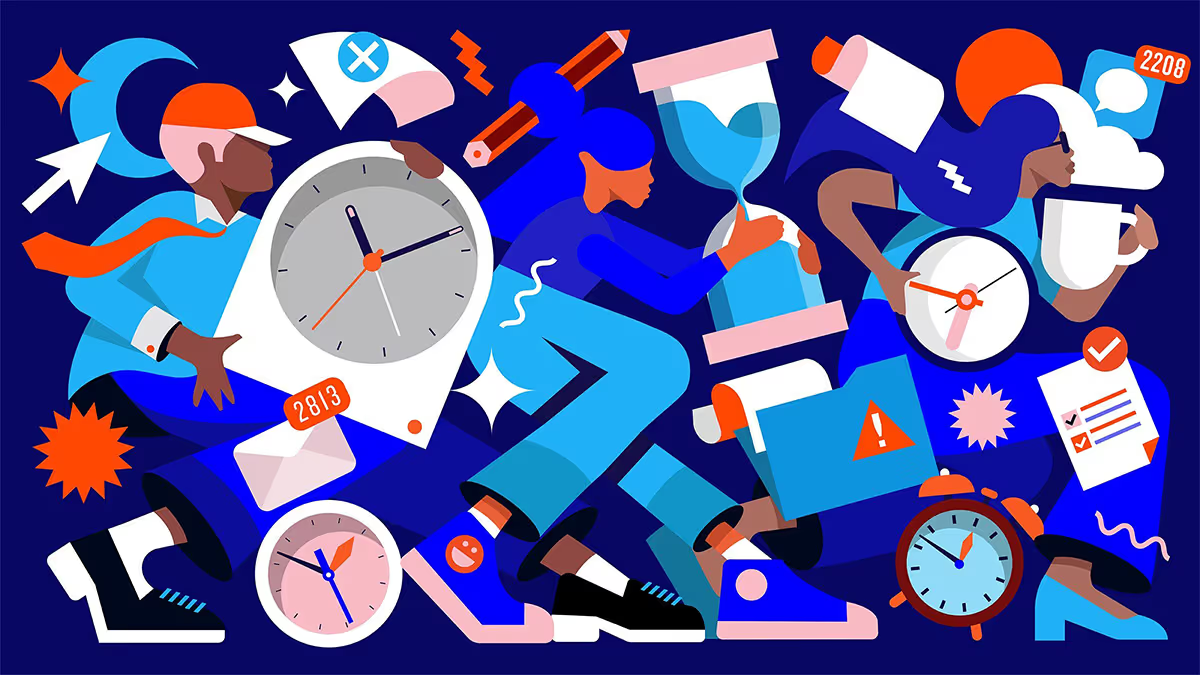
Illustration by YuDooho/Korea Herald For years, artificial intelligence was imagined as the ultimate workplace liberator, a tool that could remove repetitive tasks, shorten working hours and leave people with more time to think.But now that the tools are part of daily office life, many workers say the opposite is happening.Rather than easing workloads, they say, AI is speeding up the pace of work to exhausting levels.The pressure may be especially acute in South Korea, where long hours and fast-response office culture are already deeply embedded.According to a report released last month by the Korea Institute for International Economic Policy, South Korea recorded the highest rate of workplace AI use among the four surveyed countries, at 51.1 percent, surpassing Japan and Taiwan.“At first, AI felt magical,” said Kim, a data engineer at a major Korean search platform company who has worked in data engineering and machine learning for more than a decade. “But now I think this is the main cause behind my fatigue these days.”“Now the tempo of work has become unbelievably fast,” Kim said.Tasks that once required three or four engineers working for a week can now be completed by a single worker in half a day using AI coding tools, he said. But that has not necessarily made work feel lighter.“Because everyone is using AI now, expectations changed immediately,” he said. “The easier parts of work disappeared, and the hardest parts multiplied.”Today, Kim spends less time writing code and far more time reviewing AI-generated output, coordinating with other departments, assessing service risks and validating results, tasks he describes as mentally draining.“Coding was often easier than communication, judgment and verification,” he said. “Now those are the parts taking up most of the day.”When productivity becomes pressureAI tools can increase productivity. But instead of giving workers more breathing room, many companies are using those gains to demand more and faster output.According to a recent survey by Upwork Research Institute, 81 percent of managers in the US and UK said AI had increased expectations of worker productivity. At the same time, 71 percent of employees reported burnout, while 65 percent said they were struggling under growing productivity pressure.Many workers now juggle multiple AI systems at once, using one tool for research, another for summarizing documents and another for drafting presentations or analyzing data.The Boston Consulting Group recently used the term “AI brain fry” to describe cognitive overload caused by excessive interaction with multiple AI systems in a study published in Harvard Business Review.Unlike traditional burnout, which is associated with emotional exhaustion and cynicism toward work, brain fry resembles mental gridlock: chronic headaches, reduced concentration, slower decision-making and what some workers describe as “brain fog.”Researchers found that productivity improved when workers used one or two AI tools, but declined sharply once workers began juggling four or more systems at once.“The brain is constantly switching contexts,” said Hyun Myung-ho, a psychology professor at Chung-Ang University. “Workers are prompting, reviewing, comparing, correcting and fact-checking outputs nonstop. That level of cognitive monitoring creates enormous mental strain.”Rise of invisible laborPart of the exhaustion comes from AI's tendency to create entirely new categories of work.Lee, a marketing analyst in Seoul, said she often spends hours correcting AI-generated reports that executives assume are already nearly complete.“My boss thinks AI can finish a week’s worth of work in a day,” Lee said. “But in reality, the editing work doubled because the output still needs human judgment.”Jeon, a content creator in her 20s, said the explosion of AI-generated videos and images has also intensified pressure inside creative industries.“There’s now an endless flood of content,” she said. “Algorithms no longer pick up my work the way they used to, and competing against an indefinite amount of AI-generated content makes me feel powerless.”Workers say one of the biggest problems is that AI often produces outputs that appear polished and convincing, even when they contain errors.Kim, the engineer, described what he called an explosion of “fake productivity.”“Even weaker performers can now generate huge amounts of plausible-looking code,” he said. “But somebody still has to verify whether any of it actually works.”That burden often falls on senior employees. Reviewing flawed AI-assisted work, identifying errors and repeatedly correcting colleagues consumes not only time but emotional energy, he said.“In the past, if someone lacked skills, they at least worked slowly,” Kim said. “Now they can produce enormous amounts instantly, and seniors have to review all of it.”“Employees are becoming managers of machines, and managers of each other’s machine-assisted outputs,” he added.No room to slow downThe speed of AI has also reshaped workplace psychology.Several workers interviewed said they felt unable to slow down because AI has permanently raised expectations around responsiveness and output.A reporter based in Seoul, who wished to remain anonymous, said AI tools had changed what editors and managers considered a reasonable workload.“Before AI, people understood certain tasks required time,” she said. “Now if something takes more than a few hours, people start asking why.”Experts warn that companies may be underestimating the long-term human costs of this model.Researchers from the University of California, Berkeley Haas School of Business found in an eight-month study that employees using AI ultimately worked faster, longer and handled more tasks than before.Harvard Business Review has warned that such increases in productivity could eventually lead to declining work quality, higher turnover rates and deteriorating decision-making.“Human cognitive capacity is finite,” Hyun said. “AI can operate endlessly, but humans cannot maintain high-level judgment nonstop.”For some workers, the exhaustion is not only about today’s workload, but also about the fear of falling behind in a workplace where speed has become the new baseline.Because AI can amplify the productivity gap between high performers and low performers, some employees fear becoming obsolete faster than ever before.“People feel like they are constantly being evaluated against the speed of AI,” Kim said. “And even those surviving now are afraid they could someday become the slower group.”