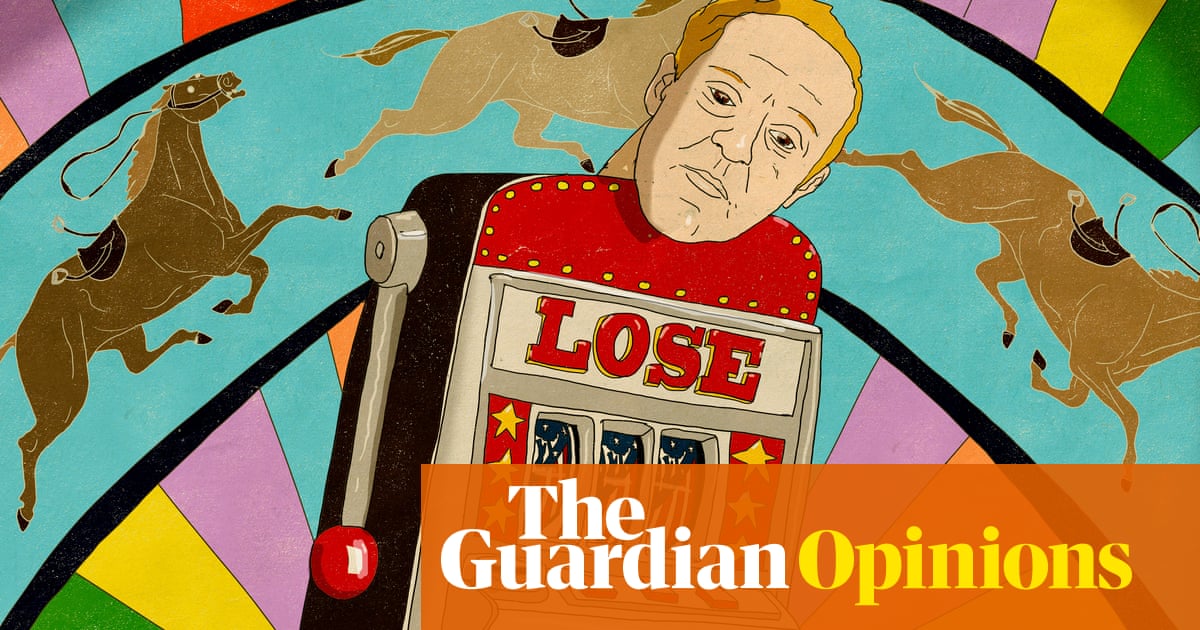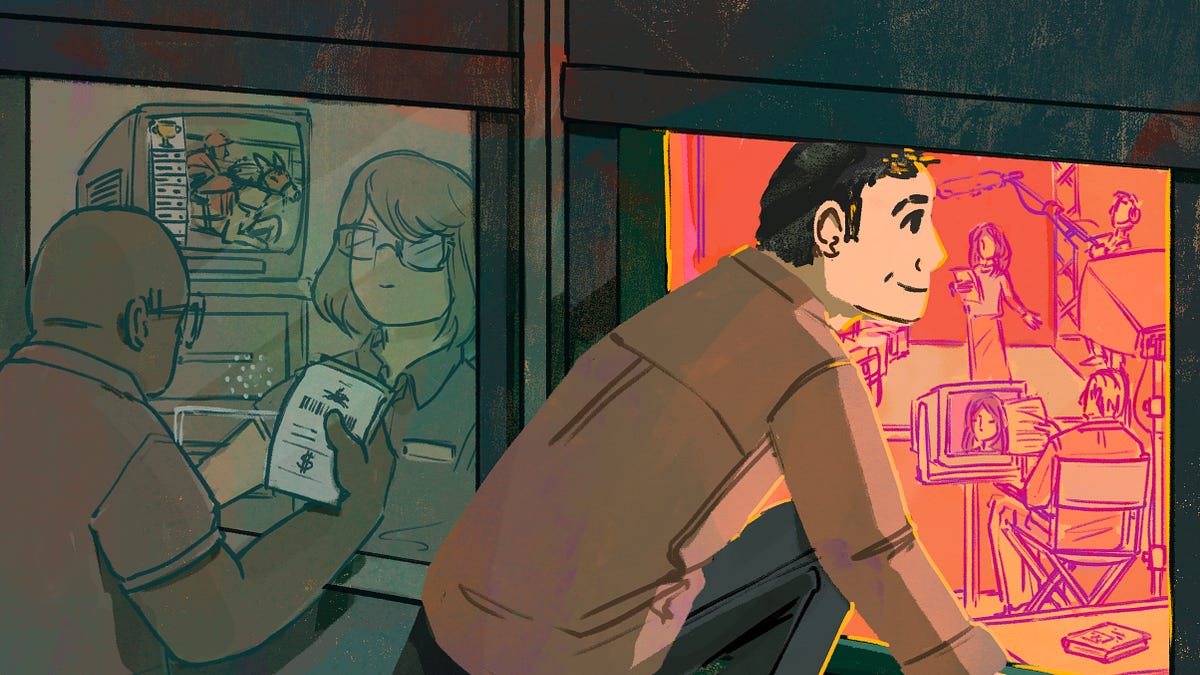
Illustration by Molly MagnellJames McSherry’s essay — one of three 2025 Memoir Prize finalists — was among our favorites from the very beginning. His heartfelt tale about falling into gambling at a young age and the years he spent making his way out of that world and moving onto better things is a story for the ages — it’s one about hope, determination and perhaps even a bit of luck. We hope you enjoy this one as much as we do. Congrats again, James!I was bitten by the gambling bug even before my first real kiss. When kids my age were flipping for baseball cards, I was practicing cheating with real cards. I could cut the deck with one hand, shuffle the aces to the top and deal from the bottom before I was 12.When my mother asked what I was doing in my room, I told her I was practicing magic tricks. She was relieved. After all, my older brothers were already smoking pot, and Tommy was even popping pills. His addiction would eventually cripple him. So, magic was the better alternative, even if the deck was stacked.When my mother threw my father out of the house, I was 10.“You can’t be drunk around the kids anymore,” she said.He left.I realized then that addiction was more powerful than love.But this is not a textbook, pathological study of what makes a person a drug addict or a drunk or a compulsive gambler. Nor is it about the myriad ways to combat disease, attending meetings, participating in interventions and surrendering oneself to a higher power.This is a diary, because even before I romanticized being a gambler, I dreamed of being a writer.David Milch was a hero of mine. He created the television series NYPD Blue. While studying English Literature at Yale, he was mentored by poet and novelist Robert Penn Warren. But that’s not why he was my hero.He was my hero because he was a degenerate gambler who was able to conquer his demons.I had a New York Times article taped above my writing desk chronicling the story arc of Milch’s life. The highlights for me were his heroin addiction, his compulsive gambling and his penchant for outbursts. He once shot out the lights on a police car. He was expelled from Yale Law School. He won the Emmy Award for his spec script for the cop drama Hill Street Blues; lore is that the executives had to send out a search party to find him and bring him back to the office to finish the required rewrites. But it wasn’t hard to locate Milch. He was often found at the $50 window at Santa Anita racetrack.Well, that article was taped over my desk for years. I was teaching high school and writing in spurts, but mostly discovering new ways to self-destruct. If David Milch could conquer his demons, maybe I could, too.When I felt the first real rush of gambling, I was barely 13. My grandmother Nanny Suzy brought me to Aqueduct racetrack in Queens. Uncle Ed and Uncle Al were with us, and so was my cousin John, who was 18 and able to make my bets for me. Trips to the racetrack were a glorious outing for me, but my mother hated gambling.Nanny pulled two singles out of her purse and gave them to me with a warning, “Don’t bet to win,” she said. “Bet to place or show. Being greedy never works out.”I turned to my cousin John. “I want to bet a triple,” I said.The odds of hitting a triple were the highest. Even I knew that at 13. You had to pick the first three horses to cross the finish line in order.John took the money and smirked, “What about place or show?”“I’m sending it in,” I said.“OK,” John said, smiling. “We’re partners, right?”“Yes,” I said. Then I told him the numbers: “9-6-2, straight.”“And they’re off!” the track announcer yelled.The pounding of the horses’ hooves kicking up dust, the screams of the bettors in the stands, and the thoroughbreds barreling toward the finish line made my pulse race. I wanted to grab John and ask him if his heart was beating out of his chest, too.“Can you feel that?” I said, but he was screaming so loudly that he didn’t hear me.I looked up and my heart raced even faster when I saw the numbers glide in formation across the finish line like an equine parade: 9-6-2.My cousin slapped me on the back. “I don’t believe it!” he yelled. “You hit it!”The triple paid $600. In 1975, for a teenager from the Bronx whose mother was on welfare, $600 was like a million bucks.I stood behind John on the line as he cashed. Then he turned to me and counted off three crisp hundred dollar bills and placed them in my palm gently, as if they were sticks of dynamite that could explode at any moment. I didn’t know then that they were. James second from left, along with his high school guidance counselor, Joe Demas, third from left, and others hanging out in the Winner's Circle at Yonkers Raceway, 1981. (All photos courtesy the author)On the way to my Uncle Ed’s car, he pulled me to the side. “Can you loan me 50?” he asked.The winnings were already cut in half by John, and now my uncle wanted a piece. “Sure,” I said, feeling important. “You got change of a hundred?”“What are you, a wise guy?” he said. “I’m tapped out.”I asked John for change and handed my uncle a 50.On the car ride home, I stayed quiet but I was screaming inside. I kept my hand in my jeans pocket and felt the money there. It felt powerful, even though it was just paper.“Hey Nanny,” I said. “You want 20?”“No, James,” she said, turning toward me slowly. “Give it to your mother, she’s the one who needs it.”“In that case, loan me another 50,” my uncle said.“Leave him alone,” Nanny said. “It’s bad enough he won big.”“Bad enough he won big?” I thought to myself. “How could winning be bad?”Droop-Along Donny* got his name because he was a dope addict.“Hey, Donny,” I said, dying to tell anyone how lucky I was, “I won at the track today. You want to know how much? C’mon, take a guess.”Donny just looked at me with glazed eyes and a string of snot running down his nose.“Six hundred bucks!” I said. “It was wild. You had to be there. My heart is still racing.”“I feel sorry for you, kid,” he said.“What?” I said. “Weren’t you listening to me?”“I heard you,” he said. “I feel sorry for you.”I watched the snot dripping down his chin and thought, He feels sorry for me?“It’s in your blood,” he said. “You’re hooked just like me.”I ran away. When I got home, I placed most of the money on the kitchen table and told my mother it was a gift but not like in that O. Henry story. She didn’t even look at it.“Put it away,” she said. “If you keep going the way you’re going, you’re going to need it.”If I had a crystal ball, I would’ve taken the money and stashed it away, not for a rainy day but for a monsoon.Then my mother turned away from me and looked at the wall. It was not her way to turn her back on anyone. That’s why I felt something inside of me like a grenade going off.“Take your gambling money before I burn it on the stove.”So I sprinted out of the house, slamming the screen door behind me. My Uncle Ed was leaning on his blue Pontiac Catalina smoking a cigar.“Where are you rushing off to?” he asked.“Nowhere,” I said.“You had a great day,” he smiled. “But you look like somebody just died. What’s the matter?”“Nothing,” I lied.“You want to take a ride to Yonkers Raceway with me?” he asked.I looked back at the screen door and pictured my mother sitting at the kitchen table smoking a Chesterfield cigarette blowing smoke rings of regret.“I better not,” I said.“Listen, kid,” my uncle said. “There’s only one worse thing than dying.”“What could be worse than dying?” I asked.“Dying with money in the bank.”Between The Gospel of Matthew and my Uncle Ed, it was my destiny to have zero respect for money.“Blessed are the poor in spirit…blessed are the meek…blessed are those who hunger…”The beauty of the Beatitudes simplified my life, sort of like what nature did for Thoreau in Walden. This self-imposed vow of poverty, also called losing, elevated my gambling addiction to martyrdom. I was no longer a loser, I was touched by God.But I knew in my heart, even when I was younger, that I was never going to wind up like my neighbor who argued with his wife every day.“I put food on the table, I paid for this house, I take care of everything!”“Yeah,” his wife yelled back. “But you pour Budweiser in your Cheerios in the morning. You drink at the job, you come home drunk. You haven’t been sober in 17 years!”“I take care of everything,” he mumbled.“Except yourself,” she said, slamming the door.Eventually, he died of cirrhosis of the liver.I was on my lunch break from teaching at Herbert H. Lehman High School one afternoon around 2008 when the sun drooped in the sky like a junkie on the nod, disappearing slowly behind a bunch of gray clouds. I decided to take my car to Westchester Square for a fish sandwich at Manuel’s, but I couldn’t find a parking spot. There were movie trailers and “Filming Today” signs all around.I finally found a spot in front of the Off-Track Betting parlor and waved at a few of the gamblers who knew me as a regular. It didn’t matter that we didn’t know each other by name. We nodded like distant relatives at a wake, mourning the loss of a loved one. A gambler’s nod was rarely cause for celebration. It was more mutual devastation.I poured more money into the OTB than some people deposit into their Roth IRAs. An old-timer with beat-up Nike sneakers held the door of the OTB open for me, but I skated on by in the direction of the movie trailer.I walked up to the Italian guy guarding the door of the set. “What’s going on?” I asked.He pointed toward the sign.“I can read,” I said. “What are they filming?”He looked annoyed. “Pilot,” he said.I could tell that this was a man of few words. So, I adopted his pose. “Title?” I asked.He shook his head as if to say, “Don’t bother me.”But I ignored the body language and just stood there. When he saw that I wasn’t going away, he opened his mouth slowly, as if he were ready to yawn.“Last of the Ninth,” he said.“Cop show,” I said. “Who’s the writer?”He frowned. “David Milch.”My heart started to race. “You’re kidding?” I said. “Any way I can get to meet him?”Finally, he did his job, which was to keep idiots like me away.“Closed set,” he said. “You can’t hang around here.”I ran back to my car and got a copy of the book I had written as a graduate student at Columbia University. There’s always a backstory, and mine started out one drunken night while I was working as a bartender in the Bronx. My then-girlfriend and future wife, who knew I wanted to be a writer, asked me a critical question: “What’s your accomplishment going to be, that you made an empty glass full?”“No,” I answered, pouring myself a shot and then downing it. “It’s going to be that I made a full glass empty.”She was the one who made me apply to the writing program. She was the one who screamed with delight when I got in. And when my fellow classmates were working on their future books, networking and attending literary soirees, I was rushing off after class to make the daily double. That’s how my life had been spiraling downward for the previous decade.I grabbed a copy of the book off the back seat of my car and tucked it under my arm. I wasn’t going to leave without seeing David Milch. Maybe I could give it to him as a gift. You know, fellow writer type of thing. Mutual devastation but in a different way.As I got closer to the set, I saw a guy coming out of a trailer. He was unassuming and walked slowly, clocking his surroundings. I knew right away who he was. It was Bill Clark, the cop who wrote NYPD Blue with Milch and gave David many of the storylines for the series. His picture was in the article taped above my desk, too, standing beside David Milch and producer Steven Bochco.“Hey, Bill,” I yelled out. “You got a minute?”He stopped and turned around. “Do I know you?” he asked.“No,” I said. “But I’m a big fan. This is my book. I wanted to give it to you.”He took my memoir from my outstretched hand and immediately started examining it like it was evidence in a criminal investigation. Typical cop, I thought.“If you brought this for me,” he said, “why isn’t it inscribed, ‘To Bill Clark, Warm Regards, James’”?I smiled.“Well, Mr. Clark,” I said, “If I didn’t get to meet you and I inscribed the book, I just burned 20 bucks.”He nodded slowly, stared down at the book and then back up at me. “You want to meet David Milch, don’t you?”“Absolutely,” I said.“Come on.”When we reached the door, the security guard didn’t budge.“Everything OK, Mr. Clark?” he asked.“Fine,” he said. “This is my friend.”When I stepped inside, I immediately thought about all the times I came here to pay my parking tickets. Now, the bureaucracy of the building was humming with actors dressed as cops. It was transformed into a police precinct. This was the first time I had ever been on the set of a television series, and I was trying to take it all in.Bill and I made our way past a group of actors hired as background, assorted crew members and others in blue jeans and T-shirts who I assumed were production assistants. In the back of the make-believe Hollywood precinct, sitting off to the side, wearing a headset, was David Milch. He was talking to a woman, who I would later find out was the vice president of HBO.“David,” Bill said, as we approached, “this is James. He’s a writer. He brought his book for you.”David took the book, studied the back and front cover and nodded his head.Someone called to Bill, and he turned and walked away.“So, you’re a friend of Bill’s?” David asked.It was less than five minutes that I’d known Bill.“Yes,” I lied.“Can I talk to you about your book?” he asked.“Of course,” I said.David stood up from his chair, took his headset off and yelled out, “OK, everybody, let’s take 10.”“Let’s take a walk,” he said, grabbing me by the arm as we slipped out the side door.I had been on this block 100 times before, but it suddenly looked different to me. I was a stranger in my own world.“Tell me about your book,” he said.“Well, it’s the story of my family,” I said. “You see that street right there, Fink Avenue?”I pointed down the block. “Well, it’s appropriately named. My father was murdered on that block when I was 14.”“Murdered?” Milch said. “How?”“He was burned alive in an abandoned car.”“Oh my God,” he said, shaking his head.“Yeah,” I said, staring down the block now, too, as if my father would turn the corner any minute and wave hello.There was an awkward silence. “But the book is really about my mother,” I said, rejecting pity. “It’s mostly her story.”“What do you do besides write?” he asked, as if writing was not enough and never would be.James at Garden State Park racetrack in New Jersey holding his program and sporting his gambling threads, circa 1983. I wanted to say gamble, waste time, ruin friendships, borrow money, never pay it back, get divorced, go to the bar Fiddler’s Elbow. Repeat. I was still drinking back then. It was before I had that moment of clarity that for so many comes far too late — like my neighbor who had Budweiser and Cheerios for breakfast.“I teach,” I said.“Really?” he asked. “Well, do you think you can do what I’m doing right now?”“I was born to do it,” I said, trying to convince myself more than him.David turned around, and for the first time I noticed that his assistant was tailing us up the block.“Scott,” he yelled out. “Get James a script.”Scott ran back inside and then returned just as quickly, handing David a script, which he in turn handed to me. It felt heavy like the weight of unrealized dreams, but surprisingly light too.David led me to a folding chair in the back, handed me a headset and then walked away.Holy shit, I thought, I just came to get a fish sandwich and now I’m sitting on the set of a pilot for HBO with a writer I idolize.I thought about that worn newspaper article still taped above my desk and smiled. I put the headset on. When action was called, I tried to concentrate on the words and not on some of the talented actors I had seen on television before. The writing, I kept telling myself, drowning out all the rest. The writing.I marked up the script. When we wrapped, David walked straight over to me and grabbed the script from my hands.“These are really good notes,” he said. “What are you doing tomorrow?”I was teaching.“Nothing,” I said.“Great,” David said. “We’re moving to Kaufman Astoria Studios tomorrow. You know where that is, right?”I knew it was in Queens but nothing more. “Sure,” I said.“OK, call time is 9 a.m.,” he said, “but just get there whenever you can.”His handler led him outside and I followed, watching David Milch enter a limo, clutching my book in his hands. But as the limo pulled away, I realized I had nothing but David’s invite to get inside Kaufman Astoria Studios. I started to panic. I saw Bill Clark being led to a car by his driver.“Hey Bill,” I yelled out.He stopped and waved me over.“David invited me to the shoot tomorrow, but all I have is this script,” I said.Bill grabbed the script from my hand, took a pen out of his pocket and wrote something down.“Listen, that’s my number,” he said. “If anybody breaks your chops, just call me and I’ll come outside and get you, OK?”“Hey, thanks for everything,” I said.“No problem,” he said, sliding into the car. “But you still owe me a book.”I never thought to call my job, but I did reach out to my girlfriend, Iris, and I told her to get down there right away. She arrived just as the cars were pulling out and I was standing on the sidewalk in a daze.“What happened, babe?” she asked.“You’re not going to believe this.”Just before I graduated from St. Frances de Chantal grammar school in 1976, the principal brought in a guest speaker. The graduating eighth graders fidgeted in the painful wooden chairs in the school auditorium and waited, as we did in religion class, for the answers to life. A formidable man in blue jeans and a flannel shirt strode onto the stage with authority. Sister Mary Clare stepped aside and pointed to the lectern, where the man took his place, as if God had ordained it.“Good morning,” he said.We answered in unison right back. “Good morning.”Then he got right to it. “How many of you have gambled on anything?” he asked.Chris, Smiley and a few of my friends swung their heads around abruptly and stared straight at me.“Raise your hands, please.”I didn’t raise mine and waited for God to strike me down or Sister Mary Clare to pull me up on stage by the ear.“Well, hopefully, for the ones who have already gambled, what I tell you here today will change your life for the better. If you don’t hear what I’m saying, it’s going to be a long, painful journey. How do I know? My name is Larry and I’m a compulsive gambler. And I lost everything because of it. Eventually — c’mon, keep your hands up — all of you will, too.”I pulled my beat-up 1978 Cadillac into the parking lot of Kaufman Astoria Studios. The Cadillac’s exhaust made a wheezing sound like a chain-smoker struggling to catch a breath. Then the car backfired. I laughed and Iris, who was sitting in the passenger seat, buried her head in her hands.When we got inside the studio, there was a young guy in his early 20s holding a clipboard.“I don’t do well with guys holding clipboards,” I said.“Relax,” Iris said.“Can I help you?” clipboard guy said.“I’m here to see David,” I said.He started thumbing through the papers.“I’m not going to be on that list,” I said.“Well, if your name isn’t here, I’m sorry, you can’t go in,” he smirked.Iris noticed my face getting red. Just when I was about to call the cell phone number on the script that Bill gave me, I heard a voice calling out, “James! James!” I thought there was a production assistant or a gaffer named James working on the set.When I looked up, I saw David standing on a huge silver ladder, not the kind you lean against a wall but the kind you climb in Home Depot. David was trying to get a shot as he stood by a cameraman perched on the ladder with him.David waved me up frantically.“I’m sorry, sir,” clipboard guy said. “Go right ahead.”Iris waited down below as I climbed the steel, silver ladder.When I got to the top, David leaned in and said, “I read your book last night, it was great.”“Don’t lie to me,” I said. “You’re shooting a pilot and you had time to read my book?”He looked at me intently. “You ever have insomnia?” he asked, not waiting for my answer. “Well, I’m staying in the Plaza Hotel. I had insomnia and I couldn’t sleep. You want a drink?”I stayed with David on that set for as long as I could, until the series pilot wrapped.“Look,” he said to me on the final day. “I know you want to be a writer, serious novels and films. But listen to me: Write for television. If you write for the movies, they throw you off the set. Writers get no respect in Hollywood. Novelists, even tougher. In television, the writer is king.”Right before we parted ways, David said, “Listen, if you’re ever in California, look me up.”“C’mon, David,” I said. “You’re not even going to remember who I am.”About a year or so later, I read in the trades that David Milch had just shot a pilot for a new show about gambling. It was called Luck.I phoned Bill Clark who I had stayed in touch with since the Last of the Ninth pilot. “Bill,” I said. “I need a favor.”Iris, Bill Clark and James on the set of James’ film Poetry Man in 2009.“What is it? You in trouble?”“No, nothing like that,” I said. “I saw that David has a new show in the works. Any way you can send me a copy of the pilot script?”“Why?” he asked.“I’d like to write a spec script,” I said, “and send it over to David. I’m going to California in a few weeks.”My short film Poetry Man was screening at the Burbank Film Festival, hence the trip.“No problem,” he said. “Give me your email and I’ll have my assistant send it over today.”I couldn’t believe it. Maybe my luck was changing. I could write this in my sleep.After I got the pilot from Bill and studied the story arcs of the main characters in the first episode, I wrote the spec script in three days. David doesn’t do emails, so I sent the script Federal Express to his offices at Redboard Productions ahead of my visit to California.As soon as I got off the plane, Iris and I took a car to Milch’s office. Within moments of our arrival, David appeared out of his back office with a beautiful Labrador retriever who immediately rushed to me. I grabbed the animal and we wrestled like long-lost friends.“My dog likes you,” David said. “That’s a good sign. I’m glad you finally made it. Let’s go into my office.”I petted the dog one more time and followed David. Iris stayed sitting on the couch.“Aren’t you coming?” Milch asked her.“Am I allowed?” she asked.“Of course,” he said.Iris and I sat on a couch while David folded his hands on his desk, tilting his head to one side.“How did you do it?” he asked.“Do what?” I asked.“The script,” he said. “I want to know how you did it. I have 10 writers in the writers’ room whom I give notes to every day, and your script is better. How did you do it?”I thought about Droop-Along Donny, Nanny Suzy, Leo the loan shark, Iris, my father who succumbed to his alcohol addiction, my brother Tommy in rehab, my mother scolding me for winning at the track, Larry the gambler who shared his story at St. Frances de Chantal so many lifetimes ago, Dostoevsky’s The Gambler, which I had read so many times the cover fell off. I thought of all the losing, the missed opportunities, the things I never owned, the savings I didn’t have, the times I lost big. Maybe my true rock bottom was not writing for so many years; it was all those blank pages.“So, how did you do it?” he repeated.“I was born to do it,” I said.But this time I didn’t have to convince myself.“Well, what do you think about what your husband did here?” David asked Iris.“I’m proud of him,” she said.“You should be. He got into my office. He’s got my attention. His life is going to change.”He stood up. “I’m going to need you to move out here,” he said. “HBO has its own stable of writers. And when you win an Emmy Award, you’re going to be one of them.”“I can’t move out here right now,” I said. “I have my daughter in New York, and I’m still teaching.”He scratched his head and frowned as if he couldn’t believe what I was saying.“Look,” I said. “I wrote this spec script in New York and you said it was great. Why can’t I keep doing that until I absolutely have to move out here?”“Come with me,” he said.We stopped at his intern’s desk. “Listen,” David said to him. “Put James on the email blast with all of the writers. I want him to get all my notes, rewrites…everything.”Then he turned to me.“We’ll do it this way for a while,” he said. “But eventually you’re going to have to relocate.”I no longer had to imagine myself as a writer.“You want to come back into my office and watch the pilot with me?” he asked.“But I thought you were busy?”“C’mon.”As we sat down, before he clicked the button on the disc player, David Milch looked at me and smiled. “You know something,” he said. “If this show is a hit, I’ll get back all the money I lost gambling my whole life.”“So will I,” I said.Luck was cancelled after the first season. The People for the Ethical Treatment of Animals boycotted the show because some thoroughbreds had died during the filming.I quit gambling, not right away, but thousands of dollars and years later.David Milch was diagnosed with Alzheimer’s in early 2015, and his beautiful brain began misfiring.Years earlier, during the production of Luck, David had sent me philosopher William James’ writing to study and apply the principles therein to the psychological profiles of the characters he had created for the series. It wasn’t just about the words the characters spoke, but their inner lives. Inner life? When you’re a gambler, it disappears as fast as the money. When that happens, you lose everything.Larry the gambler who showed up that day in St. Frances was right. My high school guidance counselor, Joe Demas, who was also a horseplayer, once told me that most gamblers want to lose. It wasn’t about winning at all. It was the adrenaline rush. And Milch had said in a New Yorker interview that there was really no satisfaction in gambling. It was just a release of anxiety. A release.I am walking down Tremont Avenue and the yellow Lotto sign beckons me. The Mega Millions jackpot is now over $900 million. I stop outside the store window and contemplate a future without constant anxiety, borrowing and bankruptcy. I reach into my pocket, as I did when I was 13, and feel the power of the money inside my jeans. I know it’s only paper, but I feel compelled to send it in. Always the possibility.Suddenly, I turn away and think about this story I’ve been meaning to write. It’s about gambling. I think I’ll bet on myself.*Some names have been changed to protect privacy.James McSherry is a writer, filmmaker, educator and creative mentor based in New York. His work spans memoir, fiction, short film and teaching, and it is always grounded in honesty, grit and a deep respect for human stories.Molly Magnell is a freelance illustrator living in New York City.
Diary of a Degenerate Gambler Turned Hollywood Writer
The lure of racetrack betting came early and hit hard, but before that, I dreamed of becoming an author. A chance encounter with one of my all-time heroes—and his belief in me—changed my luck forever.
4,904 words~22 min read