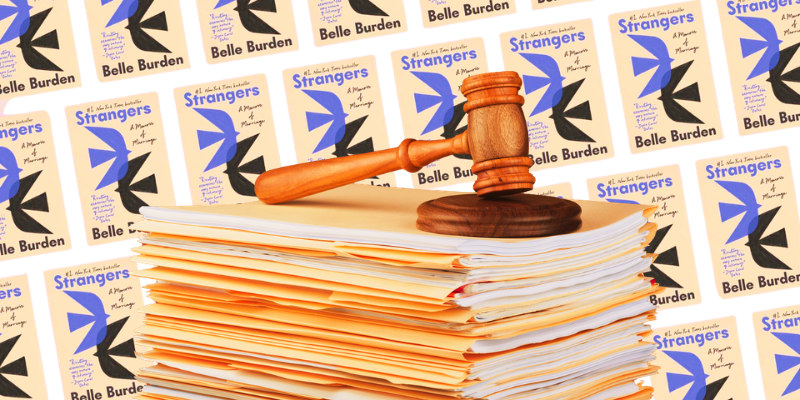
OpinionJune 1, 2026 — 2:54pmBack in the 1980s, Australian writer Clive James wrote a rollicking series of stories from his youth called Unreliable Memoirs. American humorist P. J. O’Rourke wrote of these bestsellers, “Honesty comes in various types and the best is exaggeration ... Clive exaggerates to wonderfully honest effect.”Fast forward to our own times, and any memoir deemed unreliable is soon at the end of an investigative hatchet job. Take Belle Burden’s runaway bestseller memoir Strangers, about a tragedy that is both ordinary and extraordinary.Belle Burden whose bestselling memoir Strangers has attracted scrutiny.Victor Llorente/The New York TimesOrdinary, because it’s the all-too-frequent tale of a woman whose husband walks out on her and their children after 20 years of what she believed was a happy marriage. A Boston Globe review described it as a “brutally resonant, clear-eyed portrait that strikes universal chords”.Extraordinary, because both Burden and her husband were mega-rich. She was an heiress from a wealthy family. Yet the impression from her book and in interviews was that she had been dudded out of a fortune and had completely lost her financial security. As one commentator said, “If it can happen to her, it can happen to anyone.”What exactly did happen to her? Writer Jessica Winter decided to follow the money. Her article in the New Yorker is a forensic investigation of the book, the publicity trail, expert opinion and the court documents around the couple’s divorce. It goes into eye-watering detail, but the conclusion is that Burden was never going to lose her two homes for herself and her children, as she feared, and that she was always financially secure.So, is Strangers an unreliable memoir? Not everyone feels the take-down is deserved. New York Magazine columnist Emily Gould has leapt to Burden’s defence. She says Winter’s article “hinges on a narrow reading of the text and a cherry-picked selection of quotes” and she asks, “Does knowing that Burden has a great deal of money coming to her, none of which was accessible during the time period she describes in the book, really complicate the narrative all that much?”Belle Burden (centre) with Henry Davis at a fund-raising event in New York in 1999. They married that year and divorced in 2020.Bill Cunningham/The New York TimesOther bestselling memoirs where the story has been questioned have suffered. When an Observer investigation last year cast doubt over key aspects of Raynor Winn’s 2018 blockbuster The Salt Path, publisher Penguin Michael Joseph delayed publication of Winn’s next book, On Winter Hill.Like Burden, Winn has stood by her story, a moving and redemptive tale of a marathon walk around south-west England after she and her husband Moth had been left destitute and homeless. The Observer has continued to investigate and more apparent discrepancies have arisen. Perhaps the most disturbing was the doubt cast by some medical experts on whether Moth was indeed suffering from a terminal illness, as the book claims.The most notorious unreliable memoir is James Frey’s 2003 book A Million Little Pieces. Oprah Winfrey branded Ley a fraud on her TV show for his mix of truth, exaggeration and downright lies. But Ley was back 20 years later with a new novel. In a defiant New York Times interview, he admitted his memoir anecdotes were about 85 per cent true. He lied, he said, just like every other memoir writer has lied.The memoir has been the subject of book world debate.A cynical view, but there’s some truth in it. All memoirs are based on memory, which is inherently selective and unreliable. Moreover, memoir writers use narrative techniques to build a tale that will captivate the reader. They may not deliberately lie, but they may distort or omit some things in the pursuit of what they see as their emotional truth.Some memoirists, such as Ley, are insouciant in the face of challenges or criticism. Others already exposing fragile feelings may feel deeply wounded.English writer Terri White, author of the 2020 memoir Coming Undone, has never been accused of lying. But she wrote in The Guardian that “you’ll receive opinions, observations and criticisms from others. And when it’s a story of your life, it’s impossible to take them constructively. It feels less an objective evaluation of art than a subjective takedown of you as a person.”Emily Gould claims “sharks” circle around any successful memoir written by a woman. “This sort of fact checking is just one way of puncturing credibility, of finding a reason … why this particular woman doesn’t deserve to describe her own experience … It’s a wonder anyone still subjects herself to the ritual humiliation that publishing a memoir entails.”Some observers offer a shrug instead of outrage, pointing to the lies and distortions all over social media, sometimes coming from the most powerful people on the planet.But the heart of a memoir is trust. The writer trusts the reader to accept her story, the publisher does all due diligence but ultimately trusts the writer’s story, and the reader trusts the writer is being honest in all the most fundamental matters. If that trust is broken, it can’t be mended.Jane Sullivan is a writer and literary journalist.Jane Sullivan is a books columnist and reviewer for The Sydney Morning Herald and The Age.From our partners
A divorce, a fortune and a bestseller: The memoir everyone is arguing about
A literary scandal has reignited an old question: How much truth does a memoir owe its readers?
TL;DRAI
A New Yorker investigation finds Belle Burden's memoir Strangers overstated her financial jeopardy post-divorce. Disputed memoirs face real costs: Penguin delayed Raynor Winn's next book after fact-checking cast doubt on The Salt Path's core claims.
872 words~4 min read