Skip to Content News Archives Economy Energy Oil & Gas Renewables Electric Vehicles Mining Commodities Agriculture Real Estate Mortgages Mortgage Rates Finance Banking Insurance Fintech Cryptocurrency Work Wealth Smart Money Wealth Management Investor Personal Finance Family Finance Retirement Taxes High Net Worth FP Comment Executive Women Puzzmo Newsletters Financial Times Business Essentials More Innovation Information Technology FP500 Podcasts Small Business Lives Told Tails Told Shopping Financial Post Store Obituaries Place a Notice Advertising Advertising With Us Advertising Solutions Postmedia Ad Manager Sponsorship Requests Classifieds Place a Classifieds ad Working Profile Settings My Subscriptions Saved Articles My Offers Newsletters Customer Service FAQ News Economy Energy Mining Real Estate Finance Work Wealth Investor FP Comment Executive Women Puzzmo Newsletters Financial Times Business Essentials HomeNewsEconomyIs a technical recession enough to spur the Bank of Canada to cut interest rates?Markets are still calling for a rate hike this year, but economists say the GDP miss makes a hold or cut more likely You can save this article by registering for free here. Or sign-in if you have an account.Despite the negative GDP surprise, markets are still pricing in a Bank of Canada rate cut in 2026. Photo by HYUNGCHEOL PARK/PostmediaCanada’s gross domestic product unexpectedly contracted for the second consecutive time to trigger talk of recession, but some economists don’t think the situation is as dire as the headline number suggests.Subscribe now to read the latest news in your city and across Canada.Exclusive articles from Barbara Shecter, Joe O'Connor, Gabriel Friedman, and others.Daily content from Financial Times, the world's leading global business publication.Unlimited online access to read articles from Financial Post, National Post and 15 news sites across Canada with one account.National Post ePaper, an electronic replica of the print edition to view on any device, share and comment on.Daily puzzles, including the New York Times Crossword.Subscribe now to read the latest news in your city and across Canada.Exclusive articles from Barbara Shecter, Joe O'Connor, Gabriel Friedman and others.Daily content from Financial Times, the world's leading global business publication.Unlimited online access to read articles from Financial Post, National Post and 15 news sites across Canada with one account.National Post ePaper, an electronic replica of the print edition to view on any device, share and comment on.Daily puzzles, including the New York Times Crossword.Create an account or sign in to continue with your reading experience.Access articles from across Canada with one account.Share your thoughts and join the conversation in the comments.Enjoy additional articles per month.Get email updates from your favourite authors.Create an account or sign in to continue with your reading experience.Access articles from across Canada with one accountShare your thoughts and join the conversation in the commentsEnjoy additional articles per monthGet email updates from your favourite authorsSign In or Create an AccountorThe economy shrank 0.1 per cent annualized in the first quarter following a contraction of one per cent in the fourth quarter last year, Statistics Canada said on Friday.Economists and the Bank of Canada had expected the economy to expand 1.5 per cent in the quarter.Get the latest headlines, breaking news and columns.By signing up you consent to receive the above newsletter from Postmedia Network Inc.A welcome email is on its way. If you don't see it, please check your junk folder.The next issue of Top Stories will soon be in your inbox.We encountered an issue signing you up. Please try againDespite the negative GDP surprise, markets are still pricing in a rate cut in 2026.Here’s what the GDP data mean for the economy and the Bank of Canada.“This was not just back-to-back real GDP contractions, but three quarters in the past four and taking the year-over-year trend slightly into negative terrain,” David Rosenberg, president of Rosenberg Research & Associates Inc., said in a note on Friday.Recessions typically arrive alongside year-over-year negative growth, he said, and job losses and rising unemployment are adding to the economic headwinds.“It was particularly disappointing to have seen that negative headline given the consensus forecast was 1.5 per cent annualized (GDP),” he said.Rosenberg singled out the big declines in business investment, the housing sector and consumer spending on durable goods. Government of Canada spending fell 2.4 per cent.The “only silver lining,” he said, was an increase in business capital expenditures and Statistics Canada’s forecast for GDP in April to rebound from March.“Interest rate cuts and not hikes should be foremost on the Bank of Canada’s mind,” he said. “From a demand standpoint, there was nothing at all inflationary about this broad economic report.”“While there will be plenty of debate over whether this constitutes a recession (we would say ‘no, not really’), there is little debate that the economy has struggled to make any headway over the past year amid the ongoing trade conflict,” Douglas Porter, chief economist at BMO Economics, said in a note.He said much of the first-quarter decline was due to a 2.4 per cent drop in federal government spending, which is something he doesn’t expect to continue.He said consumer spending rose 1.5 per cent quarter over quarter and was up two per cent quarter over quarter, but it’s hard to say if that will hold up in the second quarter given the elevated price of gasoline.Porter also said much of the GDP weakness can be traced to a 4.1 per cent drop in exports, a 3.6 per cent decrease in business investment in manufacturing and equipment and a 3.3 per cent decline in housing, with the first two areas feeling the effects of the trade war with the United States the most.He said he is looking for a rebound in business investment if Canada gains some clarity on the trade.“There’s no sense sugar-coating this sour result, as the economy has clearly been struggling to grow since the start of the trade war,” he said. “Overall, this should really throw a wet blanket on rate-hike talk, as the economy is in no condition to deal with higher rates.”Canada’s economic growth was downgraded from the second quarter of 2025 through the fourth quarter, signalling it “was worse off in the post-tariff environment than thought,” Katherine Judge, an economist at CIBC Capital Markets, said in a note.For example, annualized GDP was revised down in the final quarter of last year to minus one per cent from minus 0.6 per cent.She said the sharp fall in spending on services can be attributed to higher gasoline prices and a weak job market. Spending on durable goods such as appliances and furniture also fell, as did spending on vehicles.Furthermore, the household savings rate dropped to its lowest level in two years, Judge said, “which doesn’t bode well for consumption in the coming quarter, along with no growth in real disposable incomes for the quarter.”She said Canada’s GDP was “very weak from most angles” and showed consumers have little “ammunition” left for future spending.However, she expects the Bank of Canada to hold rates at its June 10 meeting given Statistics Canada’s estimate for a rebound in GDP in April.“Our base case also assumes progress towards reducing some tariffs (namely, aluminum and possibly steel) in the coming months, and if the oil price shock starts to fade over that period as well, GDP will return to sustainable growth for the rest of the year,” she said. Join the Conversation This website uses cookies to personalize your content (including ads), and allows us to analyze our traffic. Read more about cookies here. By continuing to use our site, you agree to our Terms of Use and Privacy Policy.
Is a technical recession enough to spur the Bank of Canada to cut interest rates?
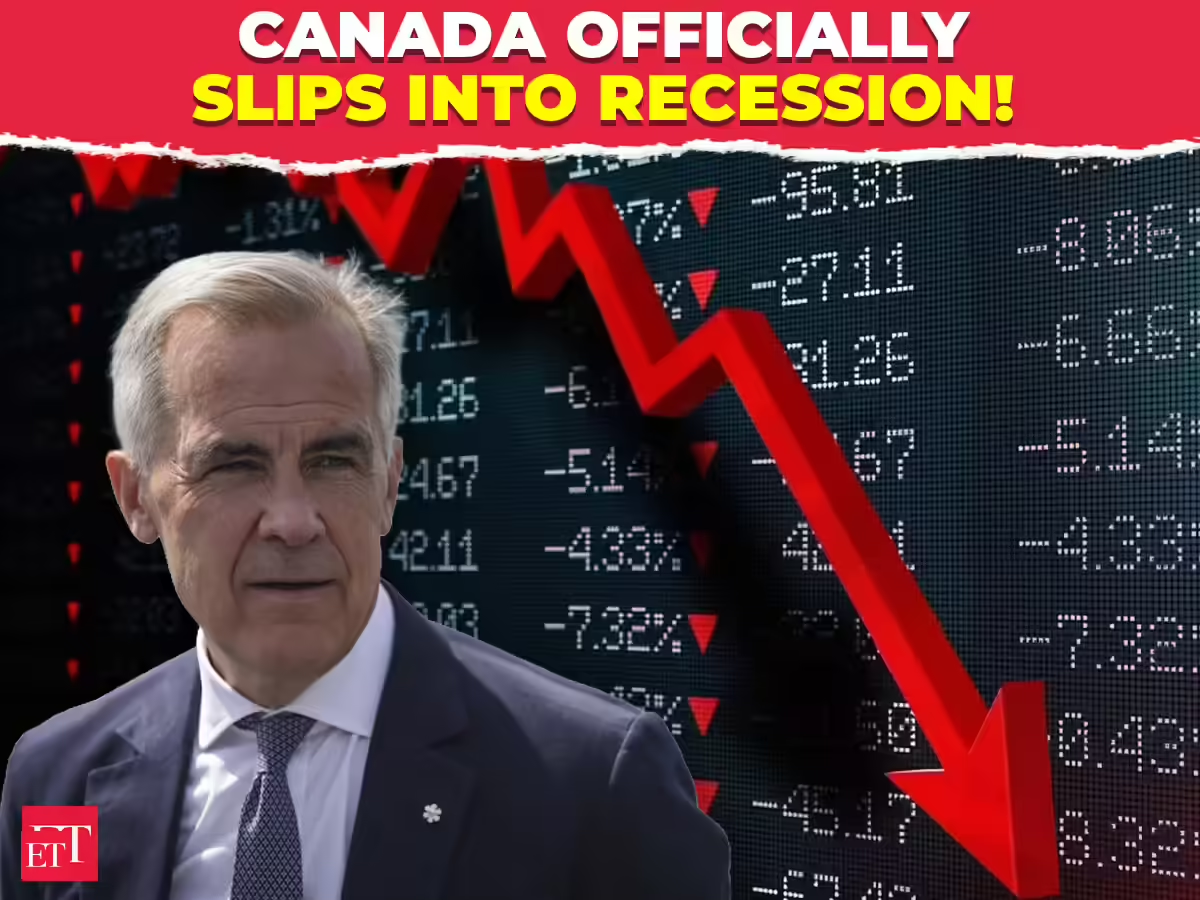
GDP contracted for the second consecutive time, triggering talk of recession, but economists it's too early to use the 'R' word yet. Read on
TL;DRAI
Canada's GDP contracted 0.1% annualized in Q1 2026, the second consecutive quarter of negative growth, missing the 1.5% consensus forecast amid drops in exports (-4.1%), business investment (-3.6%) and federal spending (-2.4%). Economists now consider a Bank of Canada rate cut more likely than a hold, signaling potential easing that CFOs and treasury teams should factor into FX exposure, debt refinancing windows and capex planning for H2 2026.
1,243 words~6 min read