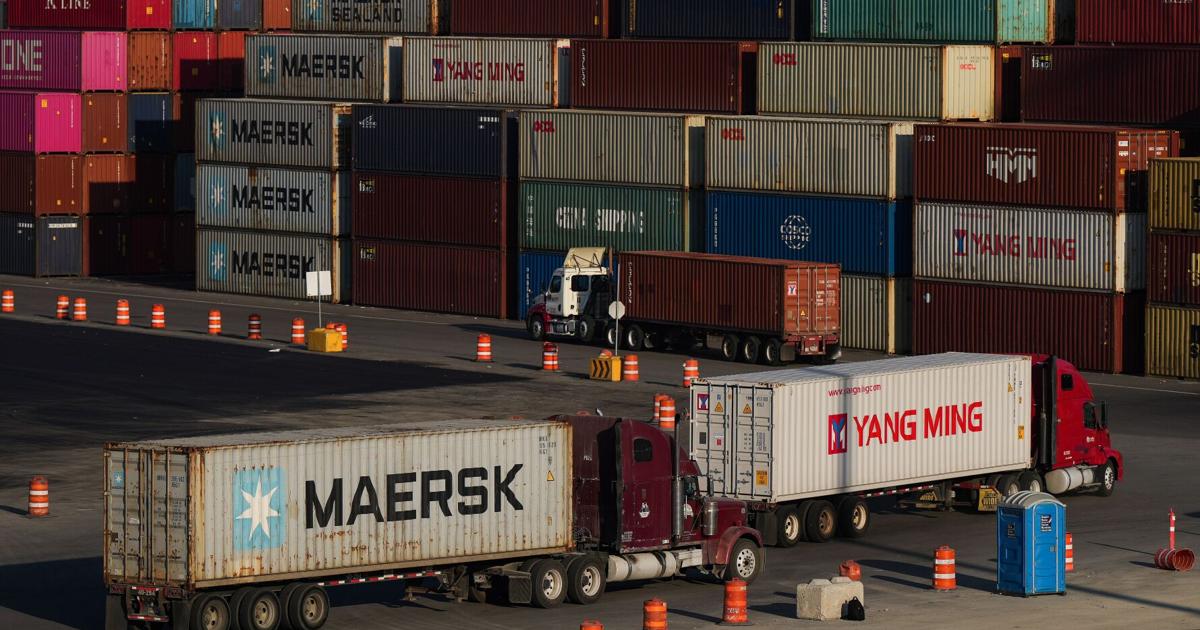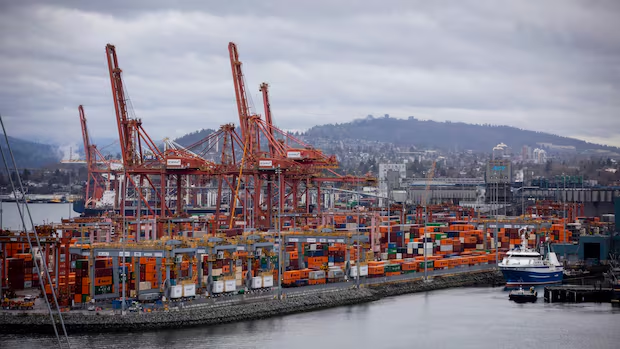
Business·UpdatedCanada's economy contracted in the first quarter of the year on an annualized basis by a slim margin, Statistics Canada data showed on Friday, making it two consecutive quarters of annualized decline, which some would call a technical recession.Real GDP has declined for 2 consecutive quartersThomson Reuters · Posted: May 29, 2026 8:49 AM EDT | Last Updated: 10 minutes agoListen to this articleEstimated 3 minutesThe audio version of this article is generated by AI-based technology. Mispronunciations can occur. We are working with our partners to continually review and improve the results.Gantries are pictured at the Port of Vancouver shipping terminal in Burrard Inlet on March 28, 2025. First quarter GDP was negatively impacted by higher imports, though that was offset by a high accumulation of inventories, Statistics Canada said Friday. (Ben Nelms/CBC)Canada's economy contracted in the first quarter of the year on an annualized basis by a slim margin, Statistics Canada data showed on Friday, making it two consecutive quarters of annualized decline, which some would call a technical recession.However, on a quarterly basis, the first quarter GDP was unchanged against a decline in the fourth quarter of last year, closely escaping the definition of a technical recession on a quarter-on-quarter basis.Gross domestic product declined at an annualized rate of 0.1 per cent in the first quarter, Statistics Canada said, compared with a downwardly revised contraction of one per cent in the fourth quarter of last year.Two consecutive quarters of contraction in economic growth is termed a technical recession.The decline comes as a surprise — analysts polled by Reuters and the Bank of Canada had predicted the first quarter growth at annual rates at a robust 1.5 per cent.The last time Canada was in a technical recession was during the start of the pandemic in 2020. Before that, it was during the oil shock at the beginning of 2015.At that time, there were two consecutive quarters of decline both on an annualized basis and quarterly basis, Statistics Canada said.Real GDP rose 0.2 per cent in February says StatsCan, marking four straight months of growthDespite the negative headline, BMO chief economist Douglas Porter points out that the dip in the first quarter is very small — meaning it, and the technical recession it makes, could be "easily revised away." An advance estimate from StatsCan also showed that growth in April was likely to be 0.4 per cent, which Porter says is a major glimmer of hope.Regardless, there are some clear signs of struggle in the economy that can't be sugar-coated."While there will be plenty of debate over whether this constitutes a recession (we would say "no, not really"), there is little debate that the economy has struggled to make any headway over the past year amid the ongoing trade conflict," Porter wrote in a note to economists.Canada's economy has largely withstood trade uncertainty and tariff impacts for over a year, but the knock-on effects of tariffs have sapped investments, hiring, expenditure and driven prices up.The Bank of Canada has said that the growth this year is likely to be at 1.2 per cent, down from 1.7 per cent last year. It will update its projections in July.The first quarter GDP was negatively impacted by a high level of imports into the country but that was largely offset by a high accumulation of inventories, the statistics agency said.Household spending grew, especially in financial services and food, adding to the GDP, but it was again mostly cancelled by a decline in business and government investments.Business capital investment fell 0.7 per cent in the first quarter of 2026, its fifth consecutive quarterly decline, StatsCan said. On a monthly basis, the GDP in March declined by 0.1 per cent, against an estimate of flat growth.With files from CBC News
Canada slips into technical recession as economic growth stalls in 1st quarter | CBC News
Canada's economy contracted in the first quarter of the year on an annualized basis by a slim margin, Statistics Canada data showed on Friday, making it two consecutive quarters of annualized decline, which some would call a technical recession.
625 words~3 min read