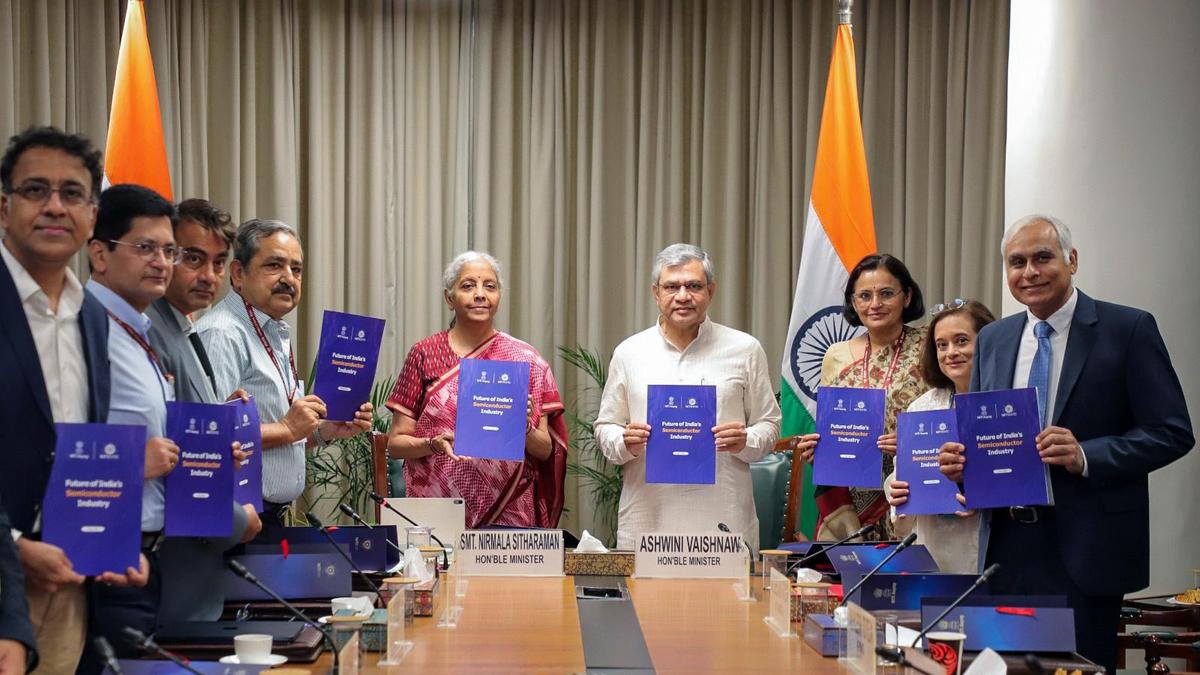
Finance Minister Nirmala Sitharaman and I&B Minister Ashwini Vaisnaw, NITI Aayog Vice-Chairman and others during the launch of NITI Aayog Frontier Tech Hub’s ‘Future of India’s Semiconductor Industry’, in New Delhi.
| Photo Credit:
Building a globally competitive semiconductor ecosystem in India will require nearly $135–180 billion in cumulative semiconductor investment over the next decade, directed toward growth capital across design, fabrication, advanced packaging, materials and supporting infrastructure, said a NITI Aayog report on Friday.The report also suggested that the government should commit at least one-third of the required investments to de-risk projects and anchor long-term investor confidence.The report titled — Future of India’s Semiconductor Industry — said building a globally competitive ecosystem is hard to achieve in isolation and therefore, deep, long-term partnerships are inevitable to build such ecosystems, owing to the scale, complexity and capital intensity of the semiconductor value chain.Strategic instruments“Partnerships are strategic instruments for India to accelerate capability building, de-risk investments and access frontier technologies. They can also integrate domestic industry into global semiconductor supply chains. What India needs is a partnership strategy that goes beyond transactional cooperation and is centred on outcome-linked collaborations,” it said.The report noted that such partnerships should be designed to strengthen design capability, manufacturing scale, advanced packaging leadership, materials resilience and talent depth, aligned with the national roadmap to 2035.According to the report, the country’s semiconductor market is projected to reach around $200 billion by 2035.However, despite the growing domestic demand, nearly 90–95 per cent of this demand is currently met through imports, leading to large foreign exchange outflows and increasing the vulnerability of critical sectors to supply-chain disruptions.“This widening gap between demand growth and limited domestic capability represents a critical strategic vulnerability and yet also a historic opportunity,” the NITI Aayog report said.“For India to become a developed nation, technological sovereignty is foundational. And that sovereignty must begin at the infrastructure layer. Semiconductors sit at the heart of this foundation, powering everything from artificial intelligence (AI), defence and manufacturing to mobility, energy systems, communications and citizen services,” Ashok Kumar Lahiri, Vice-Chairman, NITI Aayog, said.Semicon marketThe report also highlighted that the global semiconductor market grew at a compounded annual growth rate (CAGR) of 6.5 per cent between 2014 and 2024, and is expected to grow at a slightly higher CAGR of 8.5 per cent over the next five to 10 years, underpinned by next-generation, technology-led growth drivers.“Parallel to the global semiconductor industry’s rapid surge, India’s semiconductor demand is also on an accelerated growth path. It is projected to grow at a CAGR of 19 per cent, reaching around $90 billion by FY2030 and potentially expanding further to over $200 billion by FY2035 if this momentum continues,” it added.Published on May 29, 2026