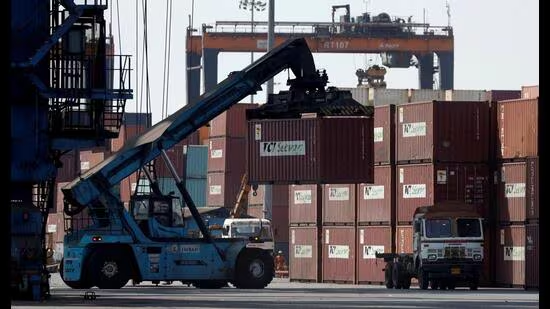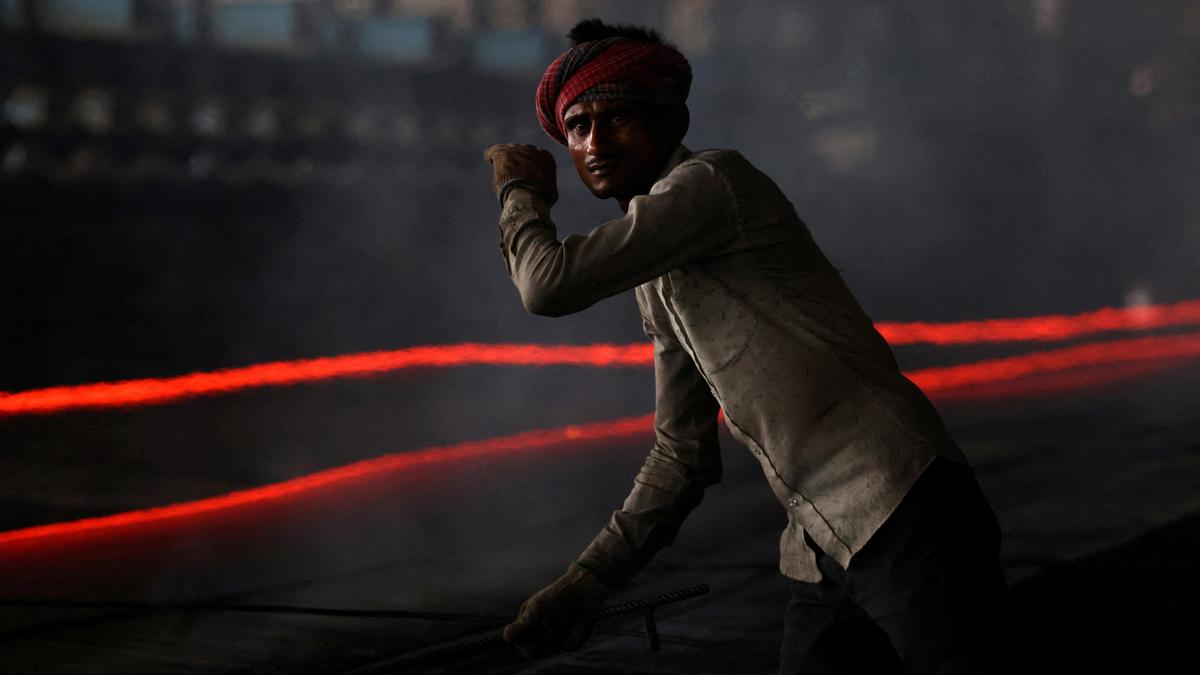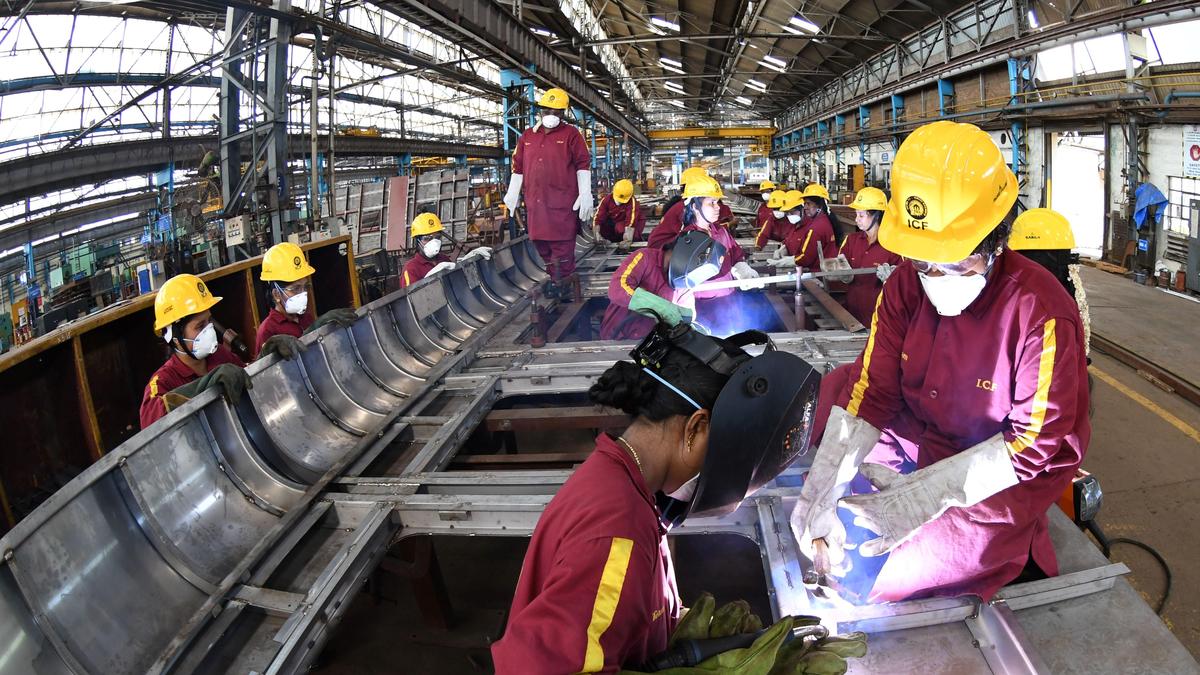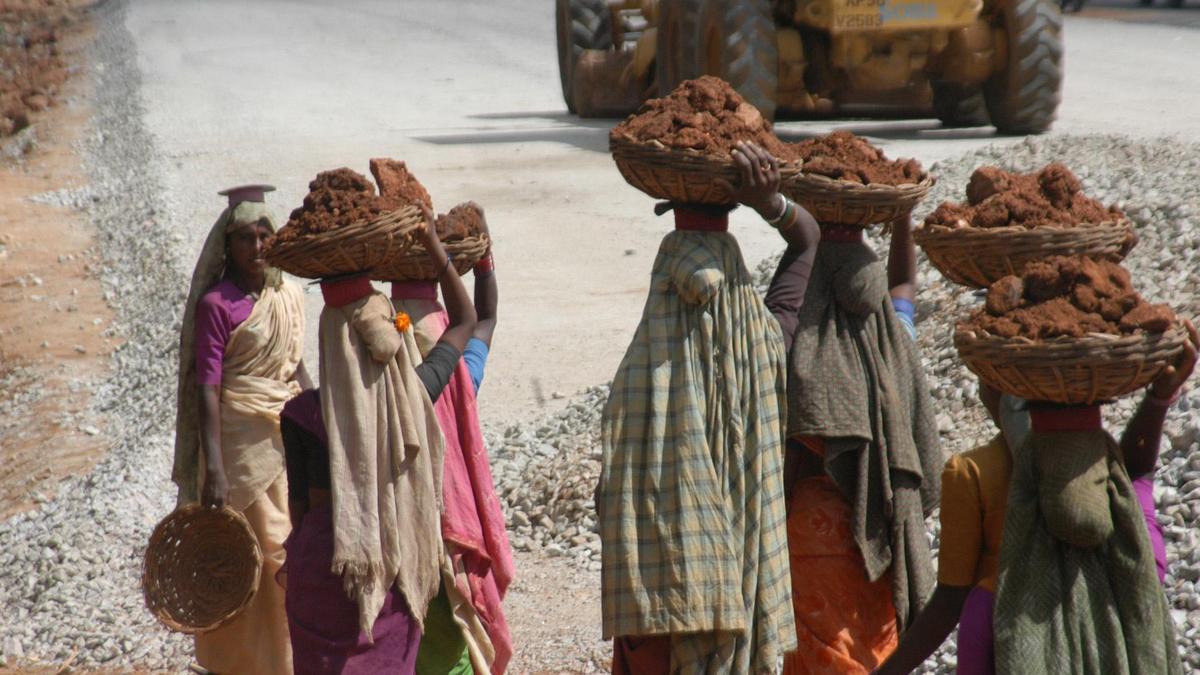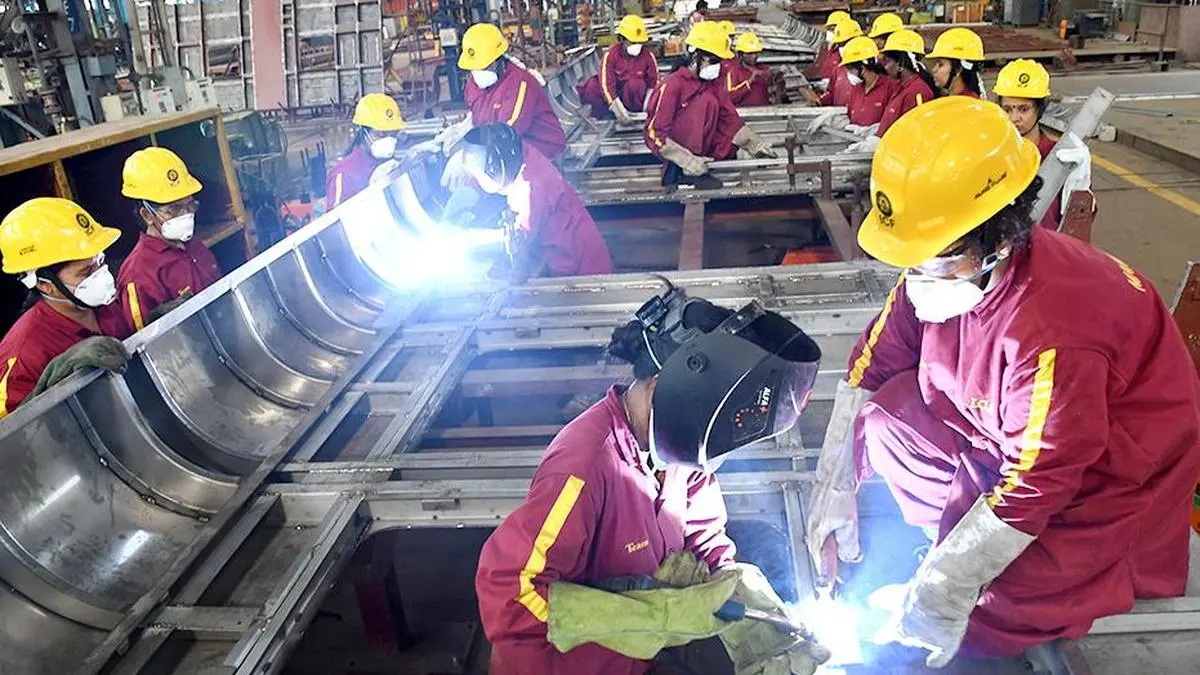
Manufacturing employment fell in India after 2015, while it had been consistently stabilised at or around 17% of GDP ever since the economic reforms began in 1991. However, self-inflicted wounds upon the economy by the government did not help. The most labour-intensive sectors, including textiles, wood products, food processing and leather/footwear, struggled until 2018 and did not recover after Covid-19 – except apparel and food processing.Manufacturing contribution to GVA (gross value added) fell consistently from 2016 onwards, did not begin to recover until 2022 and did not reach its pre-demonetisation level by 2024. The same is observable in manufacturing as a share of total employment, although in absolute terms, by 2023, the absolute number of employees in manufacturing had finally caught up to the 2012 level and exceeded it.Only the apparel sector saw significant growth, driven by changing consumer demand for casual wear, government support through the performance-linked incentives scheme and shifts in global sourcing. The sector also embraced digital marketing and e-commerce, which helped fuel its recovery. Other labour-intensive sectors continued to decline.Furniture, jewellery, musical instruments and sports goods showed modest job growth but only after 2020–2021. This growth contributed to a slight increase in total manufacturing employment, which reached 64.8 million by 2022–2023. The manufacturing sector’s contribution to the GVA also rebounded to 15.9% of GDP in 2022–2023 but is yet to reach the 17% prevailing before 2016.Between 2012 and 2021, most manufacturing sectors did not see any job growth. Manufacturing’s share of GVA at current prices falling from 17% to 13% by 2021 highlighted the structural weaknesses in India’s manufacturing sector.The sector only began to recover after Covid with employment rising to 65 million by 2022–2023, 11 years after it first hit 60 million in 2011–2012. This slow recovery reflects the deep challenges in India’s manufacturing sector, which failed to keep pace with other parts of the economy.[Amrit] Amirapu and [Arvind] Subramanian offer an important reason why manufacturing jobs and output have not grown and why (among other reasons) India has not really managed to become a manufacturing country. Because India’s pattern of specialisation is in skill-intensive industries (itself the cause of historical choices and distortions), sustained growth seems to run relatively quickly into inelastic supplies of skilled labour, leading to rising wages and declining profits. To put it starkly, China’s labour-intensive model for growth is only now – after 35 years and a 40-fold increase in productivity – outgrowing the Lewis model and encountering labour constraints. The Indian model based on skilled labour has, for the same 30–35 years, been continuously in a non-Lewis situation. This may partly explain why manufacturing has not been able to expand nor has it been able to converge to the international frontier.India’s manufacturing sector dominance in skill-intensive sectors is a reflection of a rise in both import intensity and capital intensity, echoing troubling patterns seen in Latin America and the Caribbean (LAC) and sub-Saharan Africa (SSA). During the 1980s and the 1990s, LAC and SSA embraced neoliberal policies, influenced by international financial institutions like the IMF and World Bank, and opened up their economies prematurely. These policies led to economic stagnation. For two decades, the 1980s and the 1990s, per capita incomes hardly grew at all in both regions. Both regions abandoned industrial policies and national planning, relying solely on market forces. As a result, growth stalled, and poverty and inequality soared. Meanwhile, East and Southeast Asia thrived by maintaining industrial policies and robust national planning, which fuelled industrialisation and prosperity.India followed a different path. Until 1980, India’s growth remained slow. However, two major developments sparked economic improvement. First, population growth declined, leading to a demographic dividend. The working-age population increased, while the dependent population shrank. This shift boosted savings and investment rates, accelerating GDP growth to 5.4% annually between 1980 and 1990, compared to the 3.5% growth seen from 1950 to 1980. Second, reforms initiated in 1984 fuelled further investment and economic expansion. Non-farm job creation surged during this period, particularly between 1973 and 1993.Despite these positive trends, India’s 1991 economic reforms brought new challenges to manufacturing. While LAC and SSA faced economic setbacks, India saw two critical shifts in its manufacturing sector as tariff rates fell from an average of 150% in 1990 to 40% in 1998, and further to 10% by 2002: a rise in import intensity and growing capital intensity. Increased import dependence meant that India relied more on foreign capital and intermediate goods to fuel its manufacturing industries. Simultaneously, capital-intensive production began to dominate, reducing opportunities for labour-intensive job creation in a country with a vast workforce.These changes posed significant challenges to India’s manufacturing sector. While the economy grew and reforms opened new doors, the growing reliance on imports and capital-intensive production created obstacles for sustainable job creation.One of the structural trends visible in the manufacturing sector is the rising import ratio in output. The manufacturing sector became, after 1991, intrinsically integrated into the global economy with an average trade ratio for the period 2008–2009 to 2010–2011 of 180%, a rise from 92% in 1994–1995. The integration is, however, asymmetric with import penetration almost doubling whereas exports increased by only 20%.Rising wages and other costs (rising real estate prices, taxes and tariffs, electricity) inflated the cost of India’s domestic manufacturers. This often encourages manufacturers to import final goods from China and other neighbouring countries as the costs of production at home became higher than imported final goods. Many countries in the world have witnessed a rising share of China in their import basket, and India is one of them. This is consistent with China’s efforts to diversify away from dependence on US markets for its manufactures. From 19% of US imports coming from China five years ago, that share was reduced to 14% by 2024. Meanwhile, 20 years ago, China’s share of global manufacturing output was under 10%; 20 years later, it became around 29%, that is, of all manufactures produced anywhere in the world, just under a third are produced in China. Naturally, the destinations of Chinese exports have also significantly diversified, accordingly, and are thus swamping African, Latin American and South/ Southeast Asian consumer markets.For India, the upward trend in import intensity since 2003 explains capital intensity (as the capital goods and many intermediates are mostly imported from China), to some extent. Goldar noted that starting from 2001, exports of manufactured products that rank high in terms of import intensity have grown much faster than those with low import intensity. Also, firms spending more on technology imports and/or capital goods imports, those with larger firm size and higher foreign equity holding and those with new plant and machinery have a higher import intensity of output.However, there is a structural dimension to the rising capital intensity of manufacturing, which is a global phenomenon. Rising capital and skill intensity of manufacturing, as Rodrik argues, limited the capacity of the manufacturing sector to absorb labour. According to him, it will not be possible for the next generation of industrialising countries to move 25% or more of their workforce into manufacturing, as was accomplished by the East Asian economies.Mehrotra and others also show how wages have risen between 1994 and 2012 in real terms. This phenomenon had a positive and a negative consequence: the positive one being that higher wages encouraged increasing consumption, which reduced poverty. On the other hand, the increase of wages in the lower quintiles had two effects on the labour market: the price and volume effect. The price of labour was ratcheted up in the open market in rural areas, leading to an increase in the labour cost of production in the manufacturing sector. The volume effect was seen in terms of higher consumption.Excerpted with permission from India Out of Work: Rethinking India’s Growth Story, Santosh Mehrotra and Jajati Parida, Bloomsbury India.
This book re-examines India’s economic growth through the frame of employment (or the lack of it)
An excerpt from ‘India Out of Work: Rethinking India’s Growth Story’, by Santosh Mehrotra and Jajati Parida.
1,308 words~6 min read