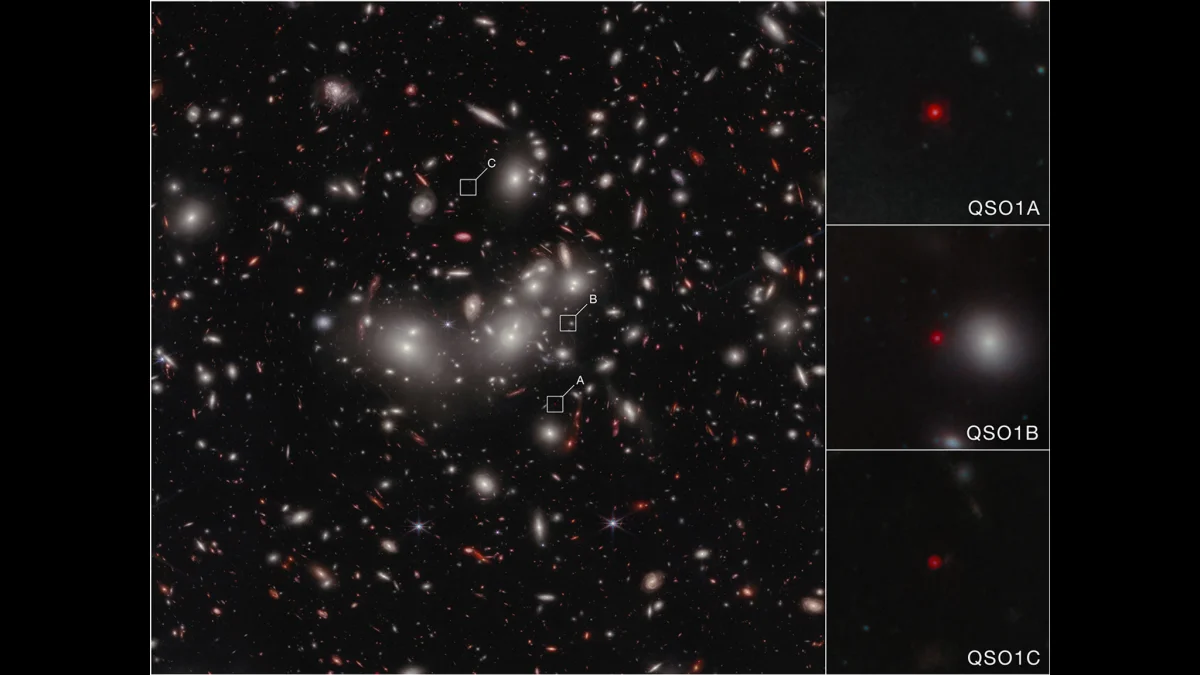
Somewhere in the future, there's a finish line in the marathon to understand supermassive black holes (SMBHs).We can't say how close we are, or what the final results will be. But astrophysicists keep going, confident that with each passing landmark, the finish draws nearer.Working with the JWST, researchers have now found a SMBH with 50 million solar masses that appears to predate its host galaxy.This discovery is a direct challenge to what we thought we know about SMBHs.This JWST NIRCam image shows Abell2744-QSO1, a prototypical Little Red Dot (LRD) discovered by the JWST. QS01 is magnified and tripled by gravitational lensing from the galaxy cluster Abell 2744. (NASA, ESA, CSA, L. Furtak (Ben-Gurion University), R. Maiolino (Cambridge), F. D'Eugenio (Cambridge), I. Juodžbalis (Cambridge), H. Übler (MPE), C. Marconcini (University of Florence). Image processing: A. Pagan)Astrophysicists understood, or thought they understood, that SMBH growth goes something like this: a massive star in a galaxy collapses into a black hole at the end of its life.This stellar-mass black hole grows by accreting surrounding material, and by merging with other stellar mass black holes doing the same thing.Galaxies also merge, driving their black holes to merge with them. Eventually, the process creates large galaxies with SMBHs that can have billions of solar masses.It was still somewhat mysterious how small stellar mass black holes could be the seeds for much more massive SMBH, but the basic process was outlined.Or so it was thought.But now that the JWST has found a SMBH that appears to predate its galaxy, new questions demand answers.
Scientists Found a Black Hole That Breaks The Rules of Astrophysics
Somewhere in the future, there's a finish line in the marathon to understand supermassive black holes (SMBHs).
930 words~4 min read