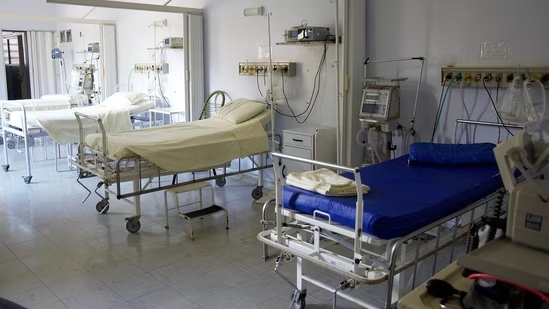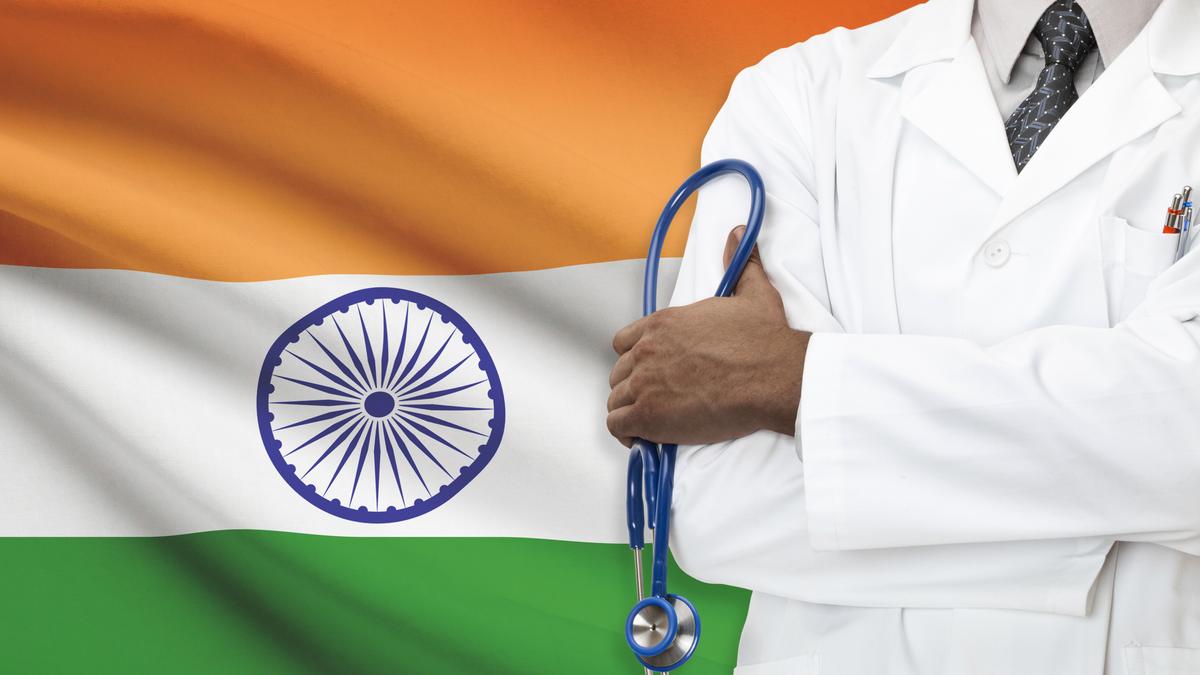
Image used for representation purpose only.
| Photo Credit: Getty Images/iStockphoto
While India has improved public financing of health care, households and individuals still bear the heaviest burden. As per the latest figures from the National Health Accounts (NHA) Estimates for India 2022-23, out of pocket expenditure (OOPE) is nearly half of the current health expenditure, and financial protection for health emergencies remains incomplete, though government and insurance spending has increased.The government’s interpretation of the NHA measures and takes credit for infinitesimal growth of public spending. According to a press release: “the share of Government Health Expenditure (GHE) as a percentage of the GDP has risen from 1.15% in 2013-14 to 1.43% in 2022-23” and as per the new GDP series, it will be 1.48% in 2022-23. “Similarly, this share in General Government Expenditure has increased from 3.78% to 4.89% over the same period, underscoring the growing prioritisation of health in public spending. In per capita terms, GHE has increased nearly 2.7 times... The decadal trend of increased Government Health Expenditure has resulted in overall reduction in the Out-of-Pocket Expenditure (OOPE) as a share of the Total Health Expenditure,” the release claims.However, claims notwithstanding, these figures are still short of the WHO Global Recommendation to dedicate at least 5% of the GDP to public health towards meeting universal health coverage targets. It also falls short of India’s own National Health Policy which recommends the combined Central and State government health expenditure reach 2.5% of GDP.Abhay Shukla, national co-convenor, Jan Swasthya Abhiyan, points out that the slight surge in public health spending seen in India during COVID has been pushed back to pre-COVID levels. “India’s Government Health Expenditure (GHE) as a share of Current Health Expenditure (CHE) has dropped sharply from 41.1% in 2021-22, to 35.6% in 2022-23, in just one year.” This indicates that even the temporary, small rise of public financing observed during COVID has not been sustained, rather the latest levels are comparable to 35.3% recorded in 2019-20 in the pre-COVID period, he explains. CHE, which measures the final consumption of healthcare goods and services excluding cap-ex, is ₹7,66,814 crore.The NHA also answers the question of who contributes to the health spend. GHE is the amount the government spends on health care, inclusive of capital expenditure, is ₹3,85,332 crore – less than half of the total health expenditure (THE). Of this, the Union government’s share is about 36%, and the State governments fund over 63% of THE. With households forking out 56.44% of health spends on CHE, an extraordinary burden remains on the people. Of this, out of pocket expenditure, accounts for a whopping 49.90% of CHE.Dr. Shukla says, the total expenditure under government-financed health insurance schemes combined was ₹26,266 crore, representing a meagre 3% of India’s THE. In contrast, now private health insurance expenditures (9.2% of THE), most of which are paid for directly by households, are three times higher than all spending through government-financed health insurance schemes. He charges that Pradhan Mantri Jan Arogya Yojana (PMJAY) and associated government health insurance schemes are failing to provide substantial protection to people from high healthcare spending.On the provider side, the NHA has revealed that private hospitals take the largest share of all current health expenditure at 30.83%, followed by government hospitals at 16.73%. This makes it clear that India’s health system remains deeply privatised, despite claims of increased public spending, Dr. Shukla says. “We know that private hospitals account for 30.8% of CHE, while pharmacies account for another 21.2% of CHE, so that just means these main private providers are drawing 52% of health spending in the country. This continued high level of unregulated privatisation is deepening major inequities in access to healthcare, linked with rising costs and frequent irrational treatment practices.”Another worrisome aspect the NHA has thrown light on is the relatively low spending on preventive care. As per the NHA, preventive care forms only 8.88% of the CHE spending, while in patient and outpatient curative care together claim over 56% as the biggest spending head, and pharmaceutical expenditure is also high. Interestingly, the government’s own recent SRS data indicated that non-communicable diseases were the cause for 60% of all deaths in 2022-2024. Neglecting this sector is bound to create huge gaps in the future for a nation that is undergoing a demographic transition and is slowly moving to a grey nation status, experts point out. Published - May 28, 2026 10:31 pm IST