Access to affordable and quality healthcare remains crucial to human development and social welfare. However, with the rising cost of healthcare, access to medical services is becoming increasingly difficult, and illness often pushes households into financial distress, thereby deepening existing inequalities. The recently released NSS 80th Round Survey on Household Social Consumption: Health (January-December 2025) offers vital details on this count involving patterns of morbidity, hospitalisation, healthcare utilisation, and medical expenditure in India.Rising morbidity in India: One of the most notable findings of the survey is the substantial rise in reported prevalence of morbidity, assessed in terms of self-reporting of ailments by individuals during last fifteen days. The survey recorded that 12.2 per cent of the population in rural areas and 14.9 per cent in urban areas reported being ailing during the 15-day reference period. This marks a significant upward shift compared with the NSS 75th Round (2017-18), when the corresponding figures were only 6.8 per cent and 9.1 per cent respectively.The rise in reported ailments may partly reflect greater health awareness, improved diagnosis, and better access to healthcare services, but it could also be indicative of growing burden of diseases in the country.This prevalence of ailments is highest among the elderly population aged 60 years and above, which is to the tune of 40.3 per cent in rural areas and an alarming 51.5 per cent in urban areas. In contrast, the lowest morbidity levels were observed among persons aged 15-29 years. The pattern suggests that illness rates decline during adolescence and youth but rise steadily with age.Stable hospitalisation rates: Hospitalisation patterns reveal another important dimension of India’s healthcare reality. The hospitalisation rate stands at 27 per 1,000 persons in rural areas and 32 per 1,000 persons in urban areas. A comparison with the NSS 75th Round shows that hospitalisation rates have remained largely stable. In rural areas, the hospitalisation rate was 26 per 1,000 persons in the earlier survey, while in urban areas it was slightly higher at 34 per 1,000 persons.Among the elderly population aged 60 years and above, however, hospitalization rates are significantly higher—76 per 1,000 persons in rural areas and 92 per 1,000 persons in urban areas—highlighting the growing healthcare needs of an ageing population.The dominance of private healthcare: The survey highlights the continuing dominance of private healthcare providers. In rural areas, two-thirds (35 per cent) of ailing persons sought treatment from government hospitals/public health facilities, while 43 per cent relied on private doctors or clinics and 21.8 per cent used private hospitals. Only 0.6 per cent sought treatment from charitable/trust-run/NGO hospitals.Dependence on private healthcare is even greater in urban India. Only about one-fourth (25.2 per cent) of ailing persons sought treatment from government hospitals or public health facilities, while 43.7 per cent relied on private doctors or clinics and 30.5 per cent used private hospitals. Overall, nearly three-fourths of the urban population depended on private healthcare facilities.A similar trend is visible in sector of hospitalisation wherein 57.9 per cent is accounted for by private hospitals as against 39.2 per cent in government hospitals. In urban areas, dependence on private hospitals is even higher, accounting for nearly two-thirds (64.6 per cent) of all hospitalisations. Government hospitals accounted for only 32.2 per cent of hospitalisations.This heavy reliance on private healthcare has major implications for household finances, as treatment in private hospitals generally involves substantially higher out-of-pocket expenditure.Slow but visible improvement in use of public healthcare: A comparison with the NSS 75th Round (2017-18) does not show any major change in the utilisation of public health facilities. The proportion of ailing persons seeking treatment from government hospitals or public health facilities remained broadly stable, at around 35 per cent in rural areas and 25 per cent in urban areas in the NSS 80th Round, compared to 33 per cent and 26 per cent respectively in the NSS 75th Round. However, when compared with the NSS 71st Round (January-June 2014), a modest improvement becomes evident. In the 71st Round, only 28 per cent of ailing persons in rural areas and 21 per cent in urban areas sought treatment from public health facilities. Although the increase is gradual, it indicates some improvement in the reach and acceptance of public healthcare services over the last decade.The burden of out-of-pocket medical expenditure: Out-of-pocket medical expenditure refers to the amount paid directly by households for medical treatment after deducting any reimbursement received from insurance companies or employers from the total medical expenditure.The average out-of-pocket medical expenditure for outpatient care during the 15-day reference period was ₹847 in rural areas and ₹884 in urban areas. In rural areas, the average expenditure was ₹304 for treatment in government hospitals or public health facilities, ₹1,130 in charitable/trust/NGO-run hospitals, ₹1,541 in private hospitals, ₹981 in private doctors’ clinics, and ₹432 for treatment by informal healthcare providers. In urban areas, the average expenditure was ₹257 in government hospitals or public health facilities, ₹1,692 in charitable/trust/NGO-run hospitals, ₹1,343 in private hospitals, ₹925 in private doctors’ clinics, and ₹557 for treatment by informal healthcare providers.The burden becomes far more severe in the case of hospitalisation. The average out-of-pocket medical expenditure per hospitalisation case (excluding childbirth) was ₹31,484 in rural areas and ₹38,688 in urban areas. In rural areas, the average expenditure was ₹6,905 for treatment in government hospitals, ₹40,203 in charitable/trust/NGO-run hospitals, and ₹47,710 in private hospitals. The corresponding figures for urban areas were ₹6,631, ₹39,530, and ₹50,508 respectively. These figures clearly demonstrate that treatment in private hospitals imposes a substantially greater financial burden on households than treatment in public healthcare facilities.Inequality in healthcare expenditure: The survey estimates further reveal that hospitalisation expenditure rises steadily with household economic status. In rural areas, average out-of-pocket expenditure gap between the poorest and the richest 20 per cent of the households is wide with rich households spending 1.5 times higher compared with the poor ones. In urban areas, this pattern is further intense with the rich spending two times of the spending by the poor.Such expenditure needs to be ideally read alongside the annual per-capita expenditure of the households to infer on its implied ill-being. According to the HCES 2023-24, annual per capita consumption expenditure of households in rural areas is ₹26,247 for the poorest 20 per cent households and ₹85,776 for the richest 20 per cent households. This means that for the poorest rural households, hospitalisation costs amount to be as much as their entire annual per capita consumption expenditure while the same for the richest households amounts to less than half of their annual per capita expenditure.In urban areas, similar assessments place the poorest 20 per cent households spending nearly 70 per cent of their annual per capita consumption expenditure (₹38,529) as against the richest ones spending only about one-third of their annual per capita expenditure (₹160,215).Way forwardThe increase in morbidity, particularly the high prevalence of illness among the elderly population, is likely to place an increasing burden on India’s healthcare system in the coming years, as the share of the elderly population is expected to rise steadily. The continued dominance of use of private healthcare services and their high treatment costs are imposing a severe financial burden on households, especially among the poorest segment of society. Hence the event of hospitalisation can push the economically vulnerable households into deep financial distress.Although the proportion of persons covered under health insurance or healthcare financing schemes has increased significantly — from 14.1 per cent in the NSS 75th Round to 47.4 per cent in the NSS 80th Round in rural areas, and from 19.1 per cent to 44.3 per cent in urban areas — reported out-of-pocket medical expenditure remains substantially high. The persistence of high out-of-pocket expenditure, particularly in private healthcare service provisioning, also reflects the limited accessibility and inadequate reach of public healthcare facilitiesTherefore, along with expanding health insurance coverage and strengthening financial protection mechanisms, India needs to focus on improving the reach, quality, and accessibility of its public health infrastructure to prevent illness from becoming a source of economic insecurity for millions of households. Building resilience to meet unexpected healthcare cost needs a two-pronged approach; protecting the vulnerable and bridging the gap in public and private provisioning of healthcare.The writer is Assistant Professor, Sardar Patel Institute of Economic and Social Research (SPIESR)Published on June 30, 2026
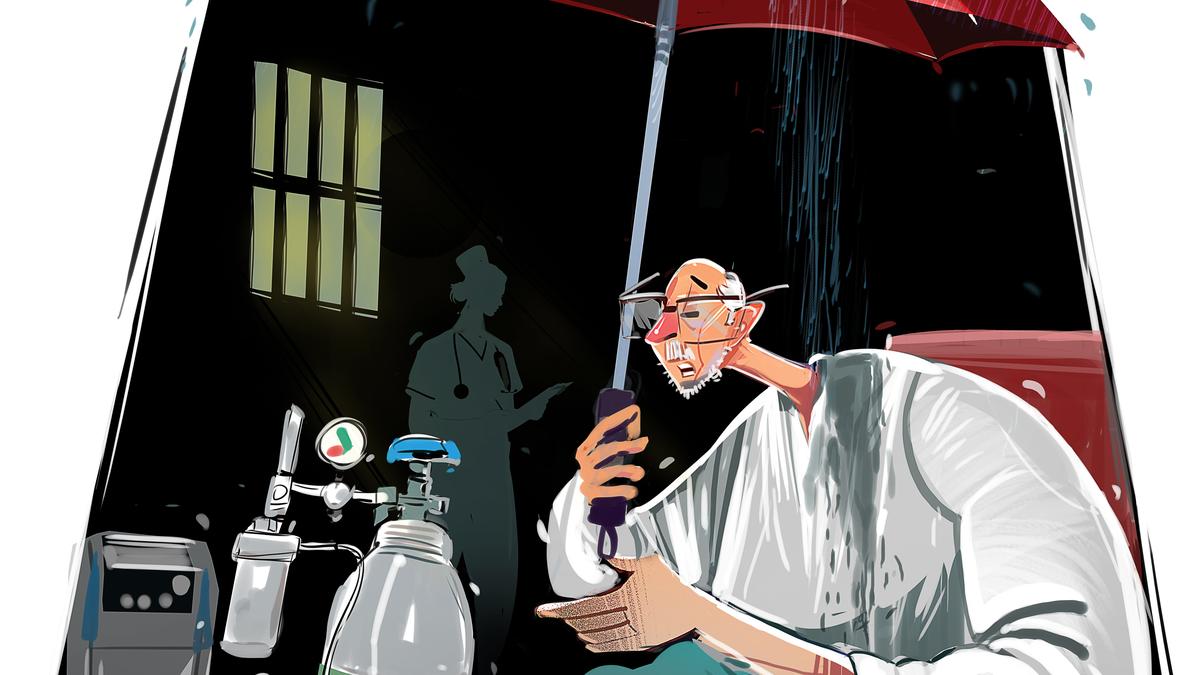
The cost of falling ill in India
The continued dominance of use of private healthcare services and their high treatment costs are imposing a severe financial burden on households, especially among the poorest segment of society
1,375 words~6 min read