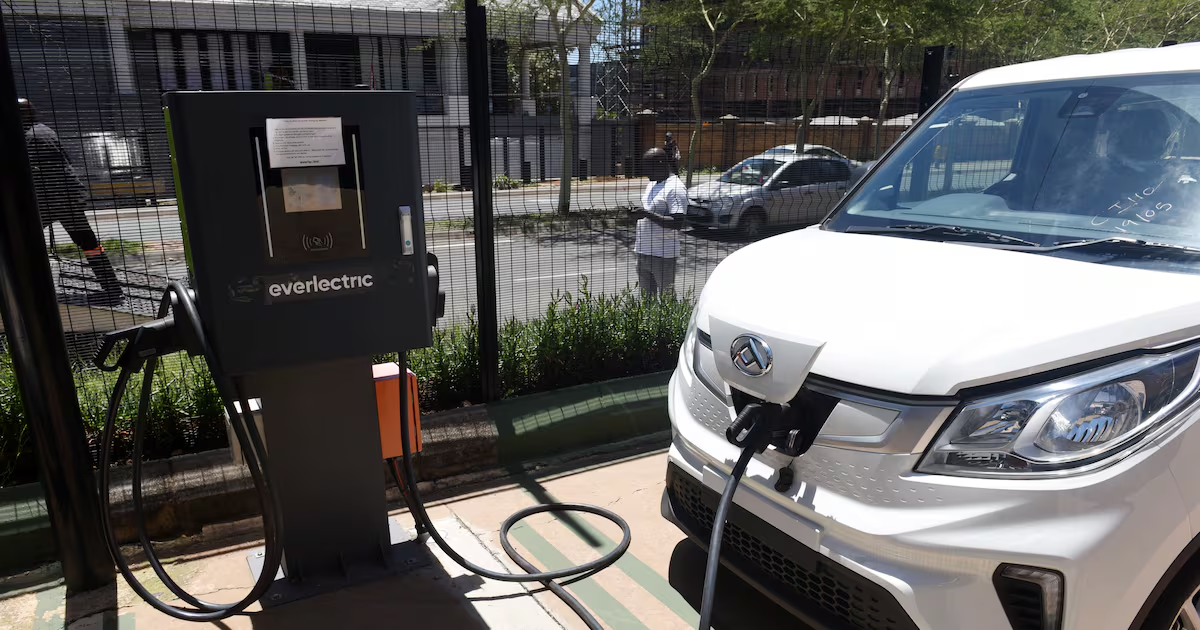
South Africa’s fledgling electric vehicle (EV) market is experiencing a significant growth spurt, driven by the launch of more affordable battery-powered models and rising fuel prices linked to geopolitical tensions, including the Iran war.Case studies from local EV fleets are showing that battery-electric vehicles are cheaper to run than their internal-combustion engine (ICE) counterparts in South Africa.“The total cost of ownership of an EV is significantly lower than an ICE vehicle, even though the purchase price remains higher,” said Ndia Magadagela, CEO of electric fleet leasing company Everlectric.Speaking at this week’s electric vehicle webinar hosted by EE Business Intelligence in association with the Electric Mission in South Africa, Magadagela said early-adopter commercial fleets had “done the maths” and found EV operations become more efficient over certain distances.In one case study, she compared a diesel-powered one-tonne double cab bakkie priced at R380,000 with a R750,000 double-cab EV. Over five years and 240,000km, the total cost of ownership for the diesel vehicle was R1.26m versus R860,000 for the EV — a 27% saving.In another example, she said a four-tonne truck reaches a crossover point at about 2,500km, beyond which it becomes cheaper to operate than a comparable ICE vehicle.Range-extended electric vehicles (REEVs) such as the Changan Hunter double cab help address range anxiety. (CHANGAN) Her findings were based on early-adopter EV fleets in South Africa, including DSV, FedEx, Woolworths, Vodacom, Nightwing, Sanitech, Scatec, UPD and Waco, which have collectively covered more than 12.5-million km locally and avoided about 2,750,000kg of carbon emissions.Recent fuel price increases are also pushing more South African motorists to consider switching from petrol and diesel vehicles to EVs.At the same webinar, Volvo Car South Africa MD Grant Locke cited a case study of a Volvo EX30 owner’s running costs over two years and 28,000km. The driver reportedly charged mostly at work for free and at home using solar power, resulting in a total cost of R970, or about 4c/km, compared with an estimated R48,000 for a petrol equivalent — excluding the cost of solar installation.Locke said interest in EVs had surged recently, with online vehicle marketplace Autotrader reporting a 220% increase in EV searches between March 2025 and March 2026.Despite this momentum, fully electric vehicles still account for a tiny share of South Africa’s new-car market. Figures from automotive body Naamsa show 1,088 battery-electric vehicles were sold in 2025, up from just 92 units in 2020 — but still only about 0.2% of total new vehicle sales. These figures excluded brands such as BYD, Geely and Dongfeng, which did not report to Naamsa, though BYD has subsequently started revealing its sales numbers.The recent sales performance of the BYD Dolphin Surf, one of the country’s most affordable EVs, suggests South African motorists are ready for EV adoption when the price is right. In April, the model sold 302 units, making it the top-selling EV and outperforming petrol hatchback rivals such as the Honda Fit and Kia Picanto.However, South Africa still lags far behind other emerging markets in EV adoption, said Hiten Parmar, executive director of the Electric Mission. He noted there are about 4,500 EVs on local roads, compared with more than 100,000 in India and over 70,000 in Indonesia — both of which began from near-zero levels in 2018.He added that countries with stronger policy support tend to see faster EV uptake.High prices remain a key barrier, driven largely by battery costs and import duties. EVs attract duties of up to 25% in South Africa, compared with as little as 18% for some ICE vehicles depending on origin. Government’s expected tax and cashback incentives on EVs to make them cheaper — as in several other countries — have not materialised.Even so, prices are falling sharply. In 2022 the cheapest EV available locally was the Mini Cooper SE at R709,400. Today several models are available for under R500,000, including the Geely E2 (R339,900) and BYD Dolphin Surf (R341,900).Other challenges such as range anxiety, long charging times and the reliability of Eskom’s electricity supply continue to affect consumer confidence. However, charging and range capabilities are improving rapidly. Some newer EVs now claim ranges exceeding 600km, comparable with ICE vehicles and sufficient for most weekly commuting needs.The introduction of range-extended electric vehicles (REEVs) such as the Changan Hunter double-cab bakkie and the Leapmotor C10 SUV has also addressed range anxiety. These cars have petrol engines that work as generators to keep the electric motor batteries charged, delivering driving ranges exceeding 900km. Parmar added that South Africa now has one of the higher EV-to-charger ratios globally, and the network continues to expand.On long-distance routes, a growing network of DC fast chargers is reducing charging times significantly. Recently a Volvo ES90 reportedly achieved a charging record of 20 minutes from 9% to 79%, at a peak rate of 321.9kW, at the solar-powered charge station at Tugela along the N3 corridor. The site forms part of two new fully off-grid charging stations between Johannesburg and Durban, supported by a R100m investment from the Development Bank of Southern Africa. The second station is located at the Reitz interchange in the Free State.Business Day
INSIGHT | Is South Africa’s EV market hitting a tipping point?
Battery-powered vehicles can slash ownership costs despite their higher purchase prices
848 words~4 min read