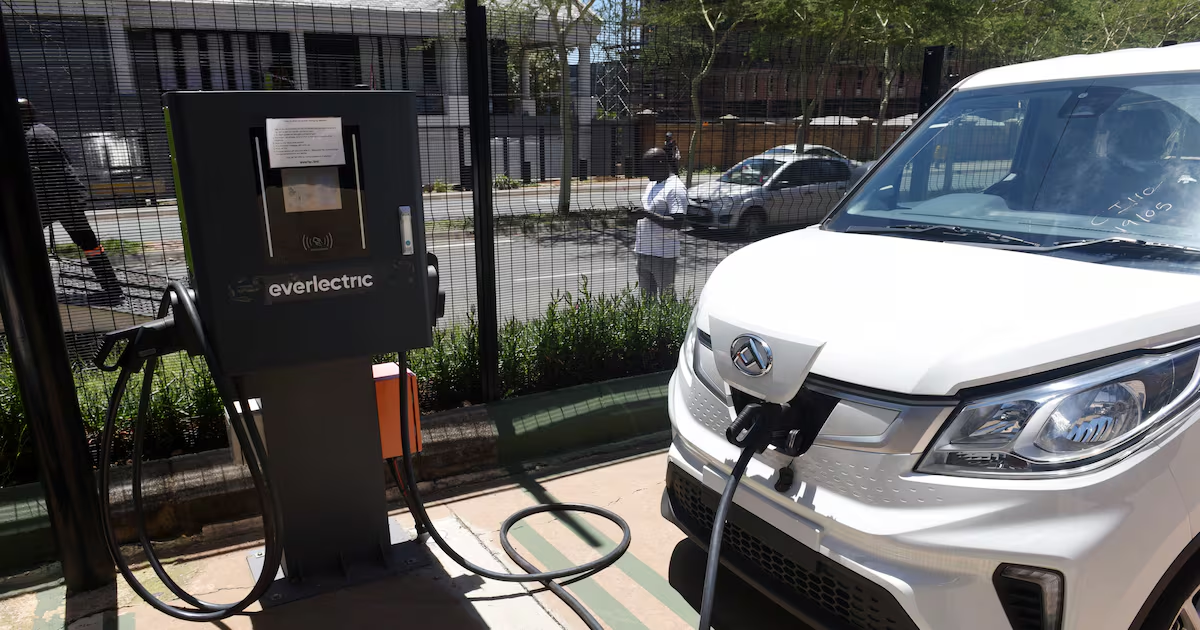
A sharp spike in fuel prices has driven up sales in electric vehicle sales this year, including a five-fold leap in plug-in hybrid electric vehicles, signalling a small but notable shift away from internal combustion engine (ICE) cars.The latest data from the Automotive Business Council, previously known as the National Association of Automobile Manufacturers of South Africa shows that demand for these vehicles has gathered pace this year due to higher petrol and diesel prices as the US-Iran war keeps global oil markets volatile.The council’s latest report shows that sales in new energy vehicles (NEVs) — all types of electric vehicles from battery-powered fully electric vehicles (BEVs) to plug-in hybrid electric cars (PHEVs) — were up 120% in April compared with the same period last year. Sales in electric vehicles for the first three months of this year nearly equalled sales for the whole of 2025 at 947 units versus 1,088 units.“Purchasing decisions are increasingly informed by value, financing affordability, fuel efficiency, vehicle utility and long-term ownership considerations, reflecting a more measured and informed consumer,” the council said.The market is still relatively tiny in South Africa, accounting for about 3% of all new car sales last year. But industry officials expect this to ramp up to nearly double this year as motorists baulk at steeply higher fuel prices. Added to that, auto companies are now bringing in a wider variety of cheaper-priced cars after initially focusing on luxury vehicles.“The petrol price increase has changed people’s attitude completely to EVs. It’s now a serious prospect, whereas a year ago it was a really hard sell,” said Alan Quinn, chief product and innovation officer at leading online automotive marketplace Cars.co.za. He likened this to how the Opec crisis of 1973 heralded a shift from petrol guzzling vehicles to more fuel-efficient models.“The choice today [in new energy cars] versus a year ago is very different, and the choice again in a year’s time and in two years’ time will be very different. You’ll be going into showrooms, and you’ll see an even spread of hybrid vehicles and ICE vehicles,” Quinn said.“That 3% will increase simply because consumers are getting more choice. I think you’ll be looking at 5% to 6% in 12 months’ time.”The choice today [in new energy cars] versus a year ago is very different, and the choice again in a year’s time and in two years’ time will be very different. — Alan Quinn, chief product and innovation officer at Cars.co.za.On the local market, hybrid cars — which combine an electric motor with an internal combustion engine and have a small battery that is only charged from the engine — still outsell plug-in hybrid vehicles, which have a bigger electric motor and a bigger battery and can run purely as electric for about 80km, but are limited to fewer brands.However, drawing on data from the Automotive Business Council, Cars.co.za calculates that sales in plug-in hybrid cars jumped 430% year on year in the first quarter of this year.“When you have a very low base, any figure seems astronomically high. A year ago, you were really only looking at the BMW X3 and cars that were over R1m that were plug-in hybrids,” Quinn said, adding that this changed with the entrance of Chinese brands within reach for higher middle income earners.“These came in at the R500,000 to R700,000 price range and our market is very different in that price range from the over R1m cars. Growth in plug-in and pure hybrid vehicles has got great growth prospects over the next few years,” Quinn said.The country has seen more EVs launched in the past few months than the previous two years combined, including Chinese maker BYD’s Dolphin Surf and the Geely E2, which are cheaper to run than petrol and diesel cars.The country’s limited network of charging stations for electric vehicles is still a deterrent on demand, but Zero Carbon Charge, which is building a nationwide network of solar-powered charging stations, believes momentum is shifting.Recent market data showed that EV searches increased by 45% year on year between February and March while engagement rose by more than 200%, it said in a statement.“The data signals that electric mobility is no longer a future trend in South Africa, it is becoming a market reality,” said the company, which last month launched two sites along the Johannesburg-Durban N3 corridor, backed by a R100m investment from the Development Bank of Southern Africa.
Fuel price spike drives SA electric vehicle sales
More affordable electric vehicles enter market as consumer preferences change
TL;DRAI
SA fuel spike drives EV sales +120%; plug-in hybrids +430% YoY as Chinese brands (BYD, Geely) launch R500k-700k models. Emerging-market shift from ICE to electric signals structural demand change; charging infrastructure gap is critical barrier to adoption growth.
737 words~3 min read