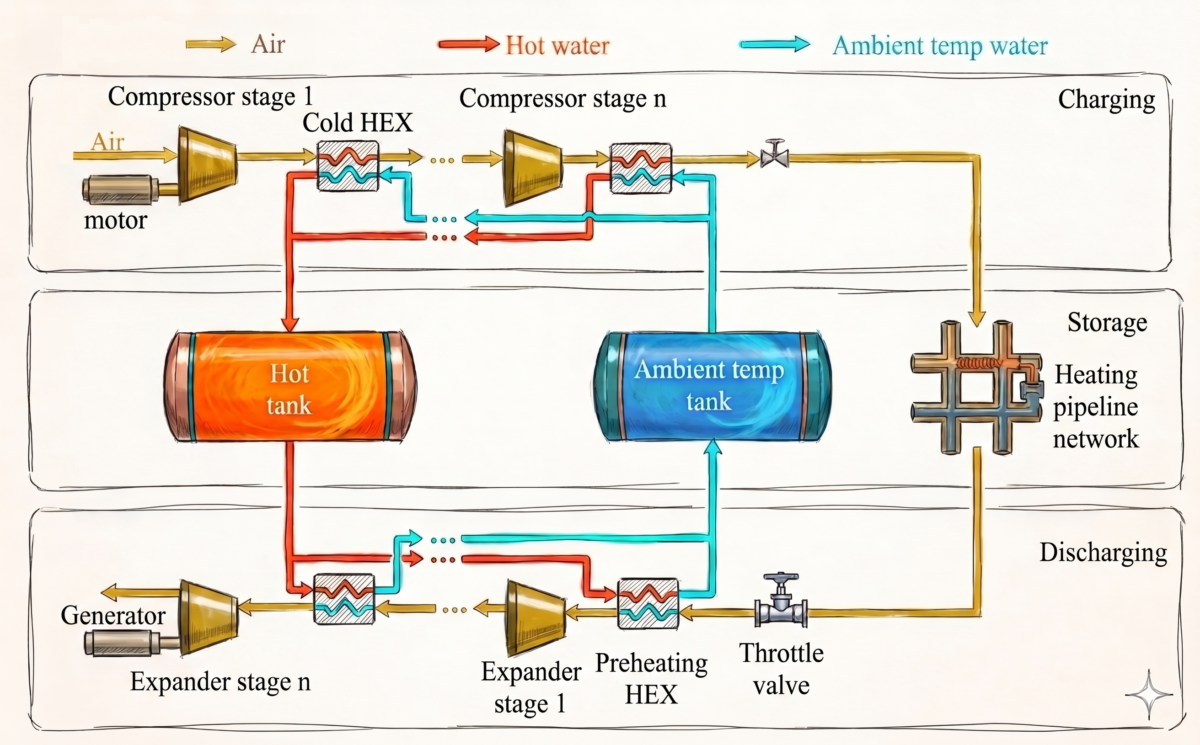
Researchers in China have developed a heating pipeline compressed-air energy storage (HP-CAES) concept that repurposes urban district heating networks as large-scale storage vessels for surplus renewable electricity. The system stores compressed air and recovered compression heat within existing pipelines, enabling both energy storage and heating functions with improved efficiency and lower infrastructure requirements compared to conventional tank-based CAES.
May 26, 2026
Researchers in China have proposed a novel method for storing surplus renewable energy by converting it into compressed air and integrating it into urban district heating pipelines. In this concept, existing infrastructure used to circulate hot water or steam for building heating is repurposed as an energy storage medium. The system operates on an adiabatic principle, in which the heat generated during air compression is captured and reused rather than dissipated, improving overall efficiency.
“This method does not require complex structural modifications and does not affect the original heating functionality,” the researchers said. “In addition, it enables gas storage during periods when the heating system is idle, thereby overcoming geographical constraints and allowing for widespread application in various urban heating networks. Furthermore, because the system can serve both heating and energy storage functions simultaneously, it does not require the heating pipeline to be abandoned.”