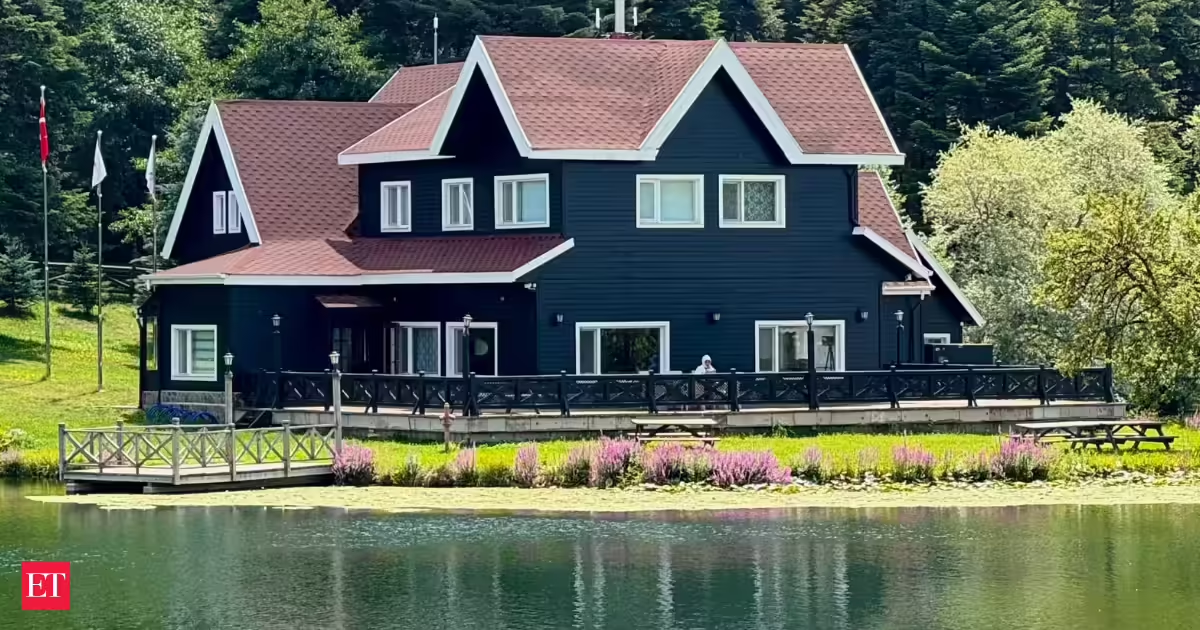
What if the lake you paddle on in the summer could help pay your heating bill in the winter? This isn’t some far-off “what if” scenario. It’s an energy technology known as aquathermal energy, and researchers say it could revolutionize how millions of homes heat and cool themselves.According to a WaterWarmth project assessment by sustainability researchers Sara Brogaard and Barry Ness at Lund University, who are examining opportunities and challenges for a transition towards surface water heating, some 18% of homes in Europe could eventually be heated with this technology, a significant increase from the current low level of less than 1%.But the research is focused on Europe, and the fundamental argument applies equally to the US, where natural gas remains the principal heating fuel in 47% of American homes as of 2024, according to the US Energy Information Administration. That’s a lot of carbon emissions, a lot of pipeline dependence, and a lot of monthly bills a lake might one day help reduce.How does heating a home with water actually work?It’s easier than it sounds. According to the WaterWarmth project at Lund University, aquathermal harnesses thermal energy from surface water, drinking water, or wastewater, which is captured by pump systems, and uses the temperature difference to heat or cool buildings, either as part of a district network or as a standalone household system.The reason water beats air comes down to physics. A study published in Applied Thermal Engineering in 2024 found that surface-water heat pumps can save more than 35% of energy compared to traditional systems, whereas air-source heat pumps typically save only about 15%. Water holds heat more consistently than air, particularly during winter, so the pump doesn’t have to work nearly as hard. There is no need for a bulky outdoor unit next to the house either.The same lake you'd fish in could one day keep your home warm all winter. Image Credits: PexelsAccording to research published in Energy and Buildings, there are two types of these systems: open-loop systems that draw water directly from a river through inlet pipes, and closed-loop systems that use submerged piping coils in lakes or ponds, circulating fluid without removing water.The numbers back it upAccording to a 2023 study by Eggimann et al. , published in Energy Conversion and Management, thermal networks using lake sources might meet 17% of the cooling demand around European lakes with cooling-only systems, and that combined heating and cooling networks could save as much as 0.78 TWh of electricity per year. Those are meaningful numbers, and Europe’s lakes are not uniquely suited for this. The continental US has vastly more surface water. The US already has a proof of concept that’s been quietly operating for over two decades. Cornell University engineering records show that the university’s Lake Source Cooling project, which uses cold water from nearby Cayuga Lake, provides 20,000 tonnes of cooling while using 86% less energy than traditional cooling methods. The system has been in place since 2000 in a small college town in upstate New York.So, why isn’t this more common?The Lund University researchers identify some real obstacles. Buildings have to be within a reasonable distance of a water source. Too much distance and it becomes uneconomic. Beyond that, the rules in many countries are hazy because the technology remains unfamiliar to most policymakers. According to a 2025 WaterWarmth project report by Mohlakoana, Brogaard, Ness et al. , a lack of public awareness remains a major obstacle, partly because critical stakeholders may not share useful information for projects. Skepticism about renewable energy technologies continues to slow adoption.From swimming hole to heat source: aquathermal energy turns everyday water bodies into year-round climate control. Image Credits: PexelsAnd then there’s the fossil fuel subsidy problem. It’s an uneven playing field, with many countries still financially favoring conventional gas heating. Energy policy also changes often, making private companies wary of investing in new infrastructure.Why it matters more than just heating costsThe Lund researchers make a broader point which is easy to miss. In countries already burning large quantities of biomass for heat, such as Sweden, where forest waste is a major source of district heating, switching to aquathermal energy could free up that biomass for other purposes: making wood products, replacing fossil-based plastics in industry, or simply leaving forests standing to sequester carbon and support biodiversity.Research for the WaterWarmth project at TU Delft and Lund University shows that the roll-out of aquathermal energy is about more than hardware. Strong collaboration, open communication, and a shared vision among communities and stakeholders determine whether projects actually get built.That’s an important framing for younger Americans already paying steep heating bills and living through the fallout of fossil fuel dependence. This is not some top-down utility infrastructure that takes decades to arrive. It's a technology that communities can chase together, starting with the lake at the end of the road.
Scientists say a stretch of water near your neighborhood could become a winter heater and summer cooler that might one day serve about 18% of Europe’s homes
Discover how aquathermal energy technology can revolutionize heating and cooling in homes across Europe, making use of local lakes and surface water. With potential to serve 18% of homes, this innovative approach could reduce reliance on fossil fuels and cut heating costs significantly. Learn more about the benefits, challenges, and successful projects like Cornell University's Lake Source Cooling.
809 words~4 min read