May 26, 2026 | 09:14 am
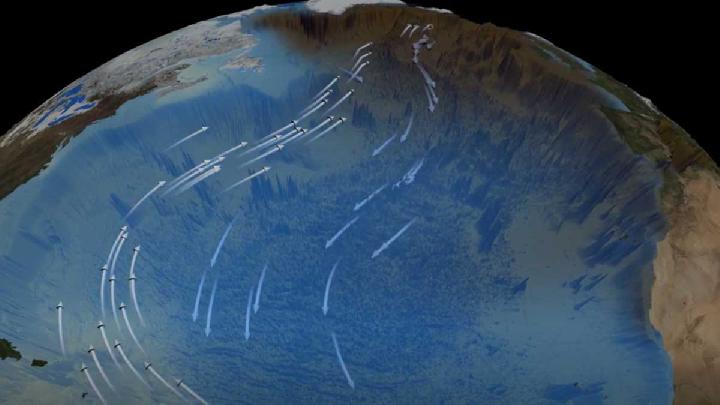
Illustration of earth. cdn.jwplayer.com
TEMPO.CO, Jakarta - Scientists have warned that climate change is now slowing Earth’s rotation at a rate unlike anything seen in the past 3.6 million years, as melting polar ice redistributes massive amounts of water across the planet.BBC Science Focus revealed that researchers from the University of Vienna and ETH Zurich found that Earth’s days are gradually becoming longer because melting glaciers and ice sheets are shifting mass away from the poles toward the equator.The phenomenon slightly slows the planet’s spin, similar to how a figure skater slows down by extending their arms while rotating. Although the effect is measured in fractions of milliseconds, scientists said the forces involved are enormous.According to the study, the current rate of climate-driven day lengthening has reached around 1.33 milliseconds per century, making it unprecedented in modern geological history.Researchers explained that Earth’s rotation has never been completely stable. The length of a day naturally changes over time due to factors such as the Moon’s gravitational pull, processes deep inside Earth, and atmospheric changes.However, scientists now believe climate change has become powerful enough to rival — and eventually surpass — those natural influences.To reconstruct Earth’s rotational history over millions of years, the researchers studied fossilized remains of microscopic marine organisms known as benthic foraminifera. The chemical composition preserved in their shells records ancient sea-level changes, allowing scientists to estimate how Earth’s spin shifted over geological time.The team also used a specially developed machine learning system to analyze data dating back to the Late Pliocene period around 3.6 million years ago.According to NDTV, the researchers found only one comparable period roughly two million years ago, when fragile ice sheets and a natural increase in atmospheric carbon dioxide triggered large-scale polar melting.Professor Benedikt Soja of ETH Zurich, one of the study’s co-authors, said the scale of the ongoing mass redistribution is difficult to comprehend.“Such a shift in the length of day requires a staggering redistribution of mass: on the order of 1,000 gigatonnes moving from the poles to the oceans,” Soja said.He compared the amount of melting ice to a solid cube placed over New York City that would rise about 10 kilometers high, taller than Mount Everest.Lead researcher Mostafa Kiani Shahvandi from the University of Vienna said the change in Earth’s rotational energy is comparable to the energy released by a magnitude 9.0 earthquake, though not in terms of destructive impact.The scientists warned that under a high-emissions future with continued dependence on fossil fuels, climate change could become the dominant force affecting Earth’s day length by the end of this century, even exceeding the long-term influence of the Moon.Beyond its scientific significance, researchers said the slowing rotation could also have practical implications.As reported by BBC Science Focus, even millisecond-level changes can affect ultra-precise timing systems used in GPS navigation, satellite operations, and spacecraft navigation.Researchers also stressed that the slowing rotation reflects much broader environmental changes caused by climate change, including rising sea levels and increasingly extreme weather patterns.“The most important takeaway is that human influence on the Earth system has become so profound that we are now changing the very way our Earth spins,” Soja said.The research team is now examining other human-driven changes that may also affect Earth’s rotation, including groundwater depletion and disruptions to the global water cycle.Read: Asteroid 2026 JH2: No Need to Worry About It Hitting EarthClick here to get the latest news updates from Tempo on Google News