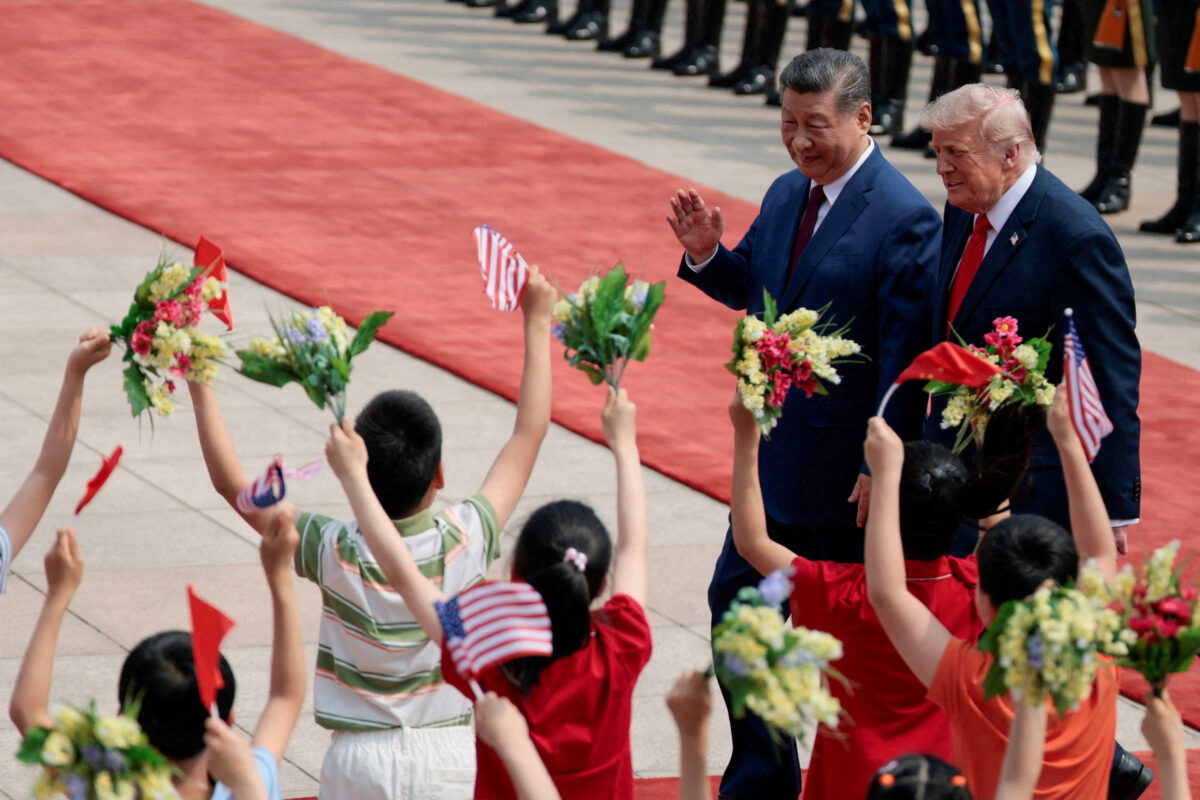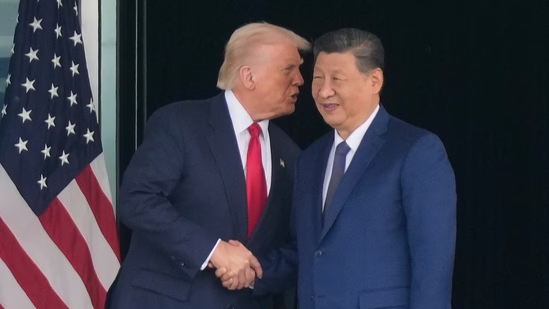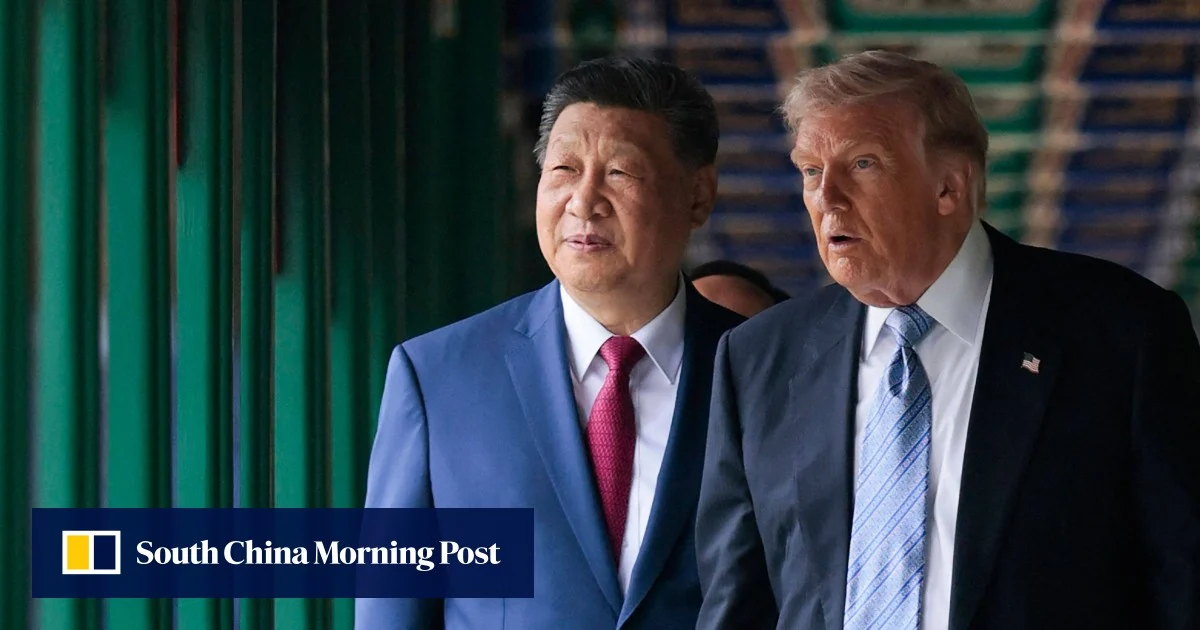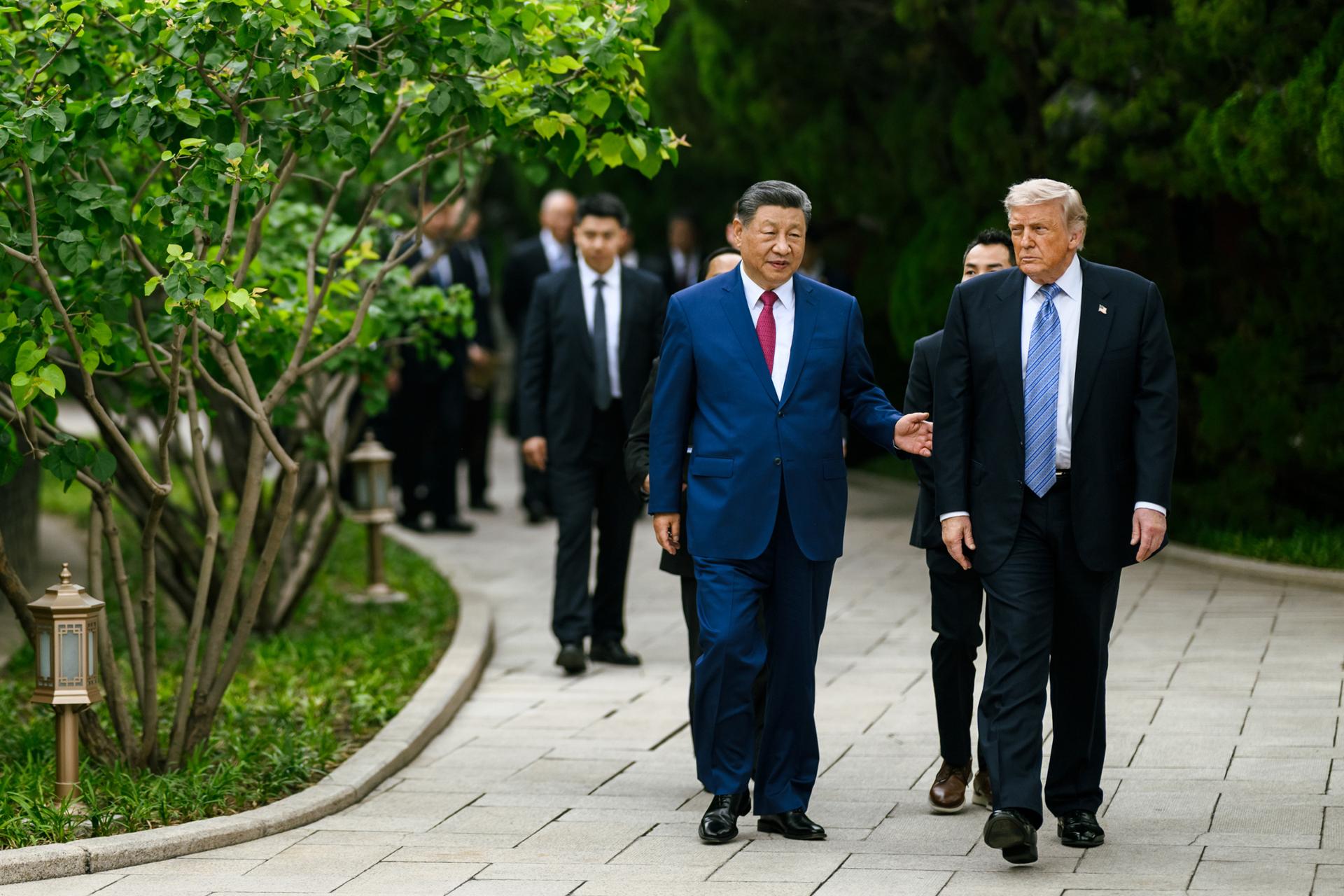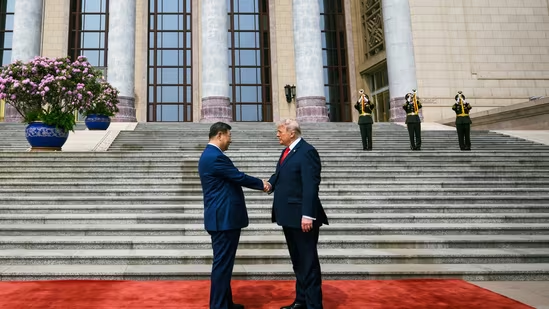
The tensions in the US-China relationship have been less an eventual direct war; they are more about a sustained competition to test hegemonic reach, strategic resilience and comparative national strengths. Trump’s visit to Beijing in May 2026 was highly anticipated to bring a thaw in their conflict on multiple fronts. The ongoing conflict is neither a stable balance nor an uncontrolled slip into war. Instead, it serves as a structured process of economic insulation, domestic legitimacy and trade reorganisation. It falls vaguely between “managed” and “unmanaged” conflict.US President Donald Trump being welcomed by Chinese President Xi Jinping, at Great Hall of the People, in Beijing on Thursday. (@WhiteHouse)Their contention is managed through the establishment of joint mechanisms, such as the Board of Trade, which is not designed to resolve the core structural rivalry. On the contrary, it is an institution that seeks to isolate the high-end technology dispute from the broader business relationship. The Board of Trade isolates non-sensitive sectors to manage highly protected trade. For instance, China’s commitment to buy $17 billion annually in US agricultural goods—major import items include soybean, corn and pork—represents about 55% of all US agricultural goods. Likewise, the $24 billion deal to purchase 200 US-made Boeing commercial aircraft seeks to sustain more than 120,000 American aerospace jobs without threatening critical supply chains.This contention is further evident when differentiating between low-tech insulation and high-tech containment policies. The May summit barely discussed the critical dimensions of US-China technology competition. For instance, it ignored chip export controls and the stalemate over Nvidia H200 sales, which are blocked for Chinese purchase despite US licensing clearances. This was despite the presence of representatives from Nvidia, Tesla and SpaceX, Apple, and Cisco. Since 2022, the US has imposed strict export controls on high-end chips to choke China’s AI development. It is matched by China’s $47.5 billion (344 billion RMB) under Big Fund Phase III launched in 2024 to achieve domestic semiconductor self-sufficiency.Moreover, the two sides’ bilateral engagement is to maintain a shared economic interest in preserving a predictable environment for global trade, which suffered a blow. The managed relocation of assembly chains to middle-power nodes (e.g., Vietnam and Mexico) allows multinational capital and State-backed firms to continue exploiting lower-wage manufacturing pools while avoiding the direct impact of high-end technology restrictions. The China Plus One strategy of multinational manufacturing could not really decouple China and the US in global trade. For instance, the bilateral trade deficit for the US against China fell from $382 billion in 2022 to $202 billion in 2025 (Statista), the deficit with Vietnam rose by 54% (from $116 billion to $178 billion), and the deficit with Mexico rose by 58% (from $125 billion to $197 billion). The US is still trading with China through third countries via indirect supply chains and investment. An NBER study argues that China is circumventing US restrictions through FDI and production facilities in Vietnam and Mexico.This confrontation is also about performative rivalry in terms of ritualised summitry and domestic legitimacy. The high-level summits in 2017 and 2026 function as social and political performances aimed at navigating domestic audiences rather than a transformation of international trade. Both leaders have to present themselves as unyielding toward the other to gain domestic credibility. They cannot appear to make unilateral concessions without a show of resistance for fear of backlash from domestic factions, military elites, or electoral bases. Thus, each side demonstrates strength by crafting a narrative of victory for its respective home audience while keeping the underlying economic machinery running.During Trump’s State Visit Plus in 2017, Beijing hosted the President in the imperial backdrop of the Forbidden City for a private dinner for a foreign leader for the first time since 1949 to project civilisational parity. On the contrary, the confrontation between US security officials and Chinese officers over the US nuclear football at the Great Hall of the People served as a performative counter-signal to the US domestic audience. It demonstrated that the US delegation would not submit to Chinese physical or symbolic control.In 2021, a diplomatic incident occurred during the Anchorage event in Alaska, when both delegations engaged in a highly publicised exchange in front of the press. Chinese Communist Party foreign affairs chief Yang Jiechi declared that the US did not speak to China “from a position of strength”. It was immediately popularised on Chinese social media and cemented a domestic image of China standing equal to the West. Nonetheless, numerous negotiations on global financial issues proceeded.During the recent meeting in Beijing, President Xi issued a stern warning that foreign interference in Taiwan would lead to direct clashes and even conflicts. President Trump publicly referred to arms sales as a negotiating chip in future to get deals done with China. He also stated that Taipei was pressured to relocate its semiconductor fabs to the US. These high-volume and adversarial exchanges satisfied nationalistic military bases in Beijing and protectionist constituencies in the US. Nonetheless, both sides signed off on the Board of Trade charter to advance agricultural and aviation trade.The US administration is more concerned about ceding to China, which may be reflected immediately in electoral terms. Likewise, the Chinese leadership also cannot be perceived as weak in failing to project symbolic defiance.The temporary calm between the two, achieved through negotiations and boards, does not necessarily lead to permanent peace. However, it is a strategic pause allowing the two world’s biggest economies to restructure their domestic bases for a longer-term confrontation. First, the current thaw is a window to restore critical manufacturing, secure alternative supply chains, and build up industrial-defence capacities. The non-sensitive areas of trade act as a safe zone for both, establishing the broader stability needed to fund massive domestic capital reallocations without triggering immediate domestic crises. Second, since both states are vying for dominance over the future value chains of the global economy, the competition remains zero-sum despite Xi’s call for “win-win” cooperation. (The views expressed are personal)This article is authored by Mehdi Hussain, former research associate, Indian Council of World Affairs, New Delhi.
US-China meet: Strategic pause or lasting peace?
This article is authored by Mehdi Hussain, former research associate, Indian Council of World Affairs, New Delhi.
1,004 words~5 min read