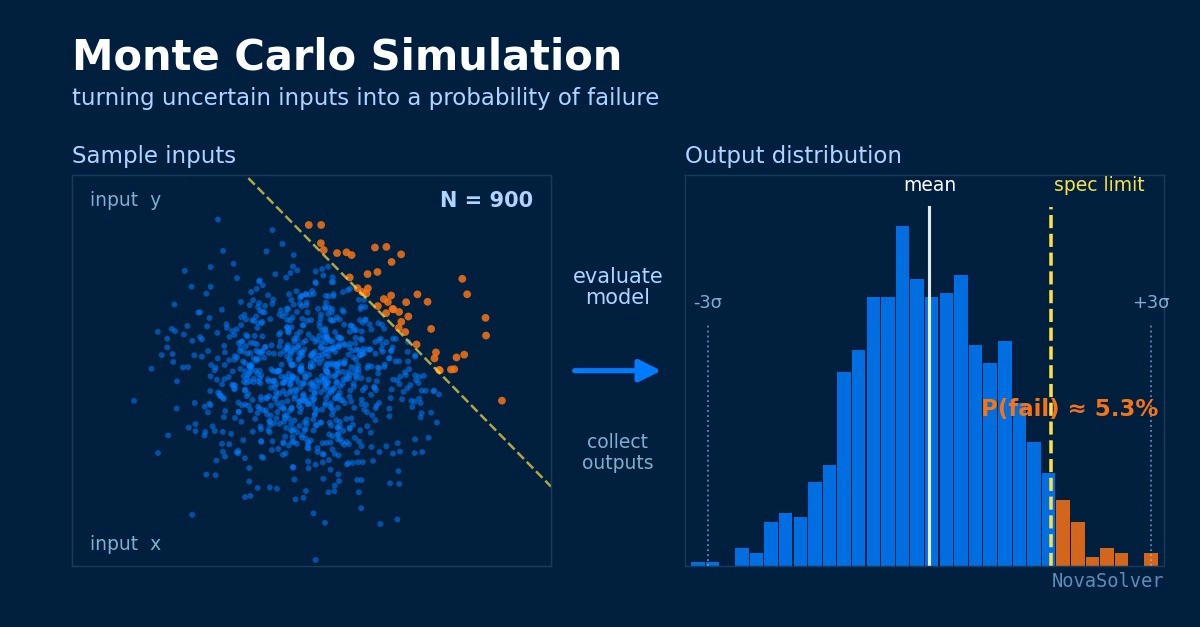
Most engineering formulas assume the inputs are known exactly. Reality is not so tidy. A machined dimension is a nominal value plus a distribution. A material property is a mean with scatter. A load is a best estimate with a range. When several of those uncertain inputs feed into one output, the question stops being "what is the answer" and becomes "what is the spread of answers, and how often does it cross a limit." Monte Carlo simulation is the most general tool for answering that question.
This article explains the method as a practical recipe, works a tolerance stack-up example, and is honest about what controls the accuracy.
Why this calculation matters
Two classic methods exist for propagating uncertainty. Worst-case analysis adds up every tolerance at its extreme — it is safe but absurdly pessimistic, because all parts being at their worst limit at once is vanishingly unlikely. Linearized error propagation is fast but breaks down when the model is nonlinear or the inputs are not small.
Monte Carlo sidesteps both problems. It makes no assumption that the model is linear or the distributions are well-behaved. You simply sample the inputs from their real distributions, run the model, and collect the outputs. With enough samples you get the full output distribution: its mean, its spread, and — crucially — the probability of exceeding any limit you care about. That last number is what reliability and quality work actually needs.