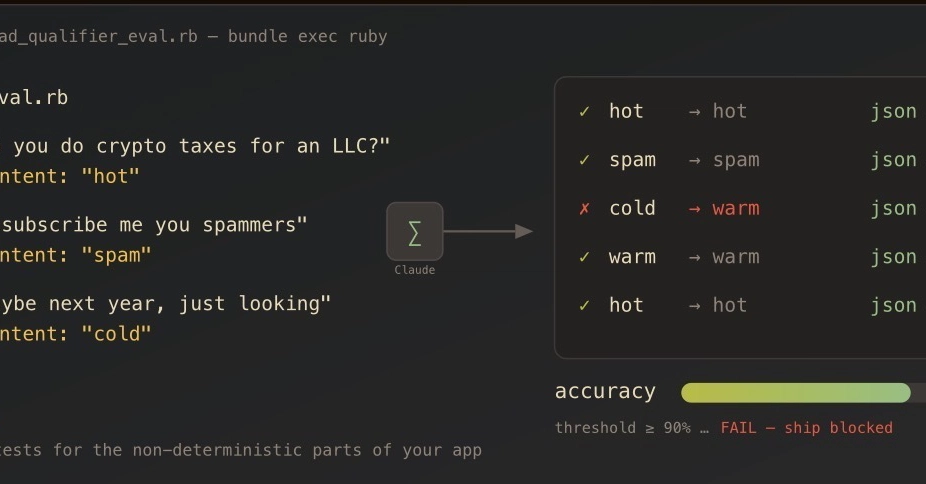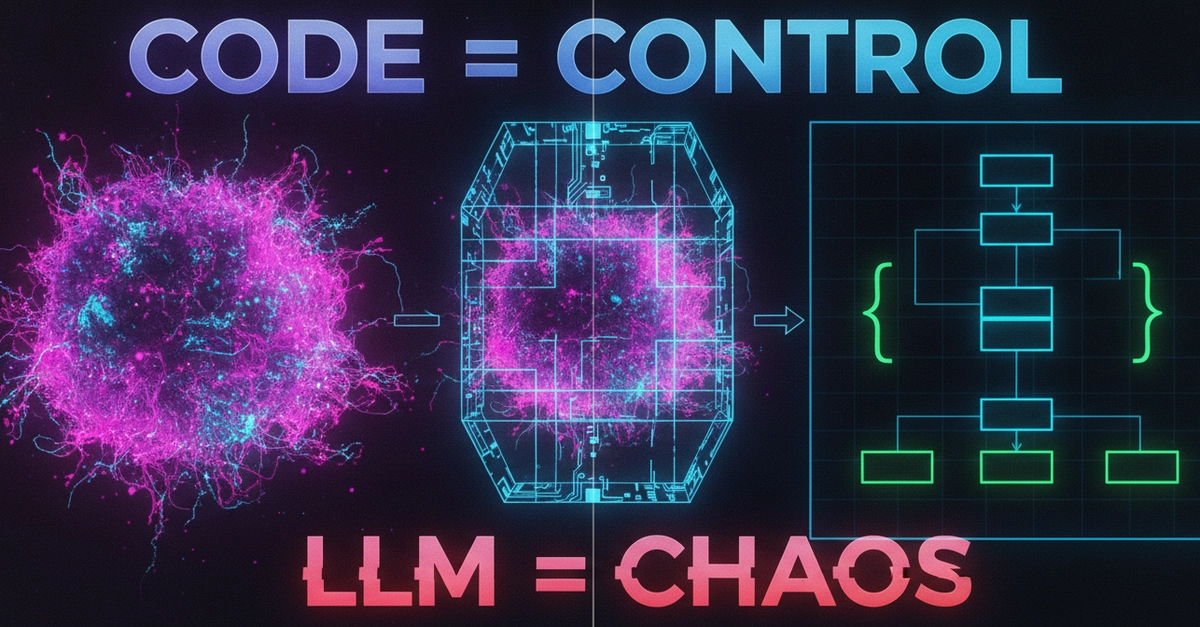
In the world of software engineering, we are witnessing a fundamental collision of two opposing paradigms. Classical programming is deterministic: based on Alan Turing’s theoretical model and the Von Neumann architecture, it operates on the principle that the same initial state plus the same program always equals the same final state. Conversely, Large Language Models (LLMs) are stochastic: they generate outputs by sampling from probability distributions, meaning the same input can—and often does—produce a different output every time.
The challenge for modern architects is not to eliminate this unpredictability, but to engineer around it. By using deterministic code as a "skeleton" or "container," we can bound the probabilistic intelligence of an LLM into a reliable, production-ready system.
1. The Core Tension: Determinism vs. Stochasticity
To build robust AI systems, we must first understand why these two worlds sit at odds:
The Deterministic Gold Standard: Classical computation relies on pure functions—operations with no side effects that always return the same value for the same inputs. We reinforce this with static type systems (like Rust or TypeScript) that provide compile-time guarantees of correctness.