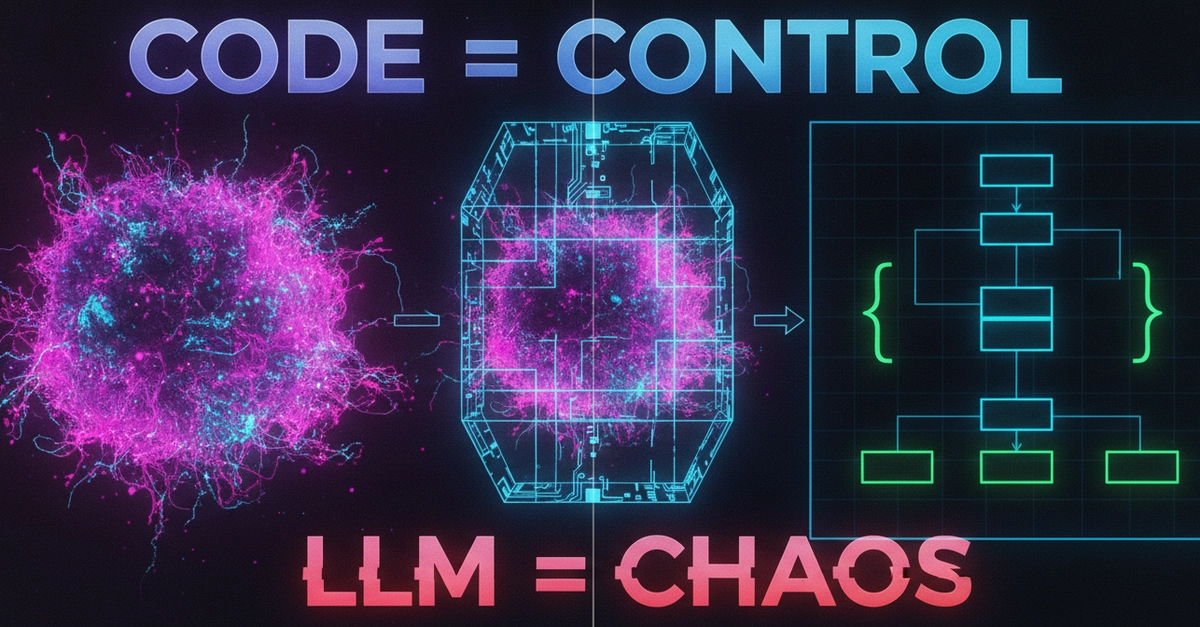
Anna Meadows, CTO of CodeROI. Building deterministic infrastructure for regulated software workflows. US patent holder.gettyThe most overconfident sentence in technology right now is some variant of "AI will handle that." It gets said in board meetings, in product reviews and in pitches to companies whose actual work involves decisions that have to be defended later. The sentence is usually wrong, and it's wrong in a specific way. The people saying it are conflating two problems. One is whether AI can produce a plausible answer. The other is whether the system around the AI can produce a defensible record of how that answer was reached.In high-stakes workflows, the second problem is the one that matters, and it's the one most generative systems are structurally bad at solving.Why High-Stakes Workflows Need DefensibilityA workflow is high-stakes when its output has to survive contact with a skeptical reader later. The skeptical reader could be an auditor, a regulator, a litigator, a board, an acquirer doing diligence or a customer disputing a charge. The defining feature is that nobody deciding in the moment knows when or how it will be reviewed, only that it will be. A few of these workflows include financial reporting, clinical decisions, insurance underwriting, legal work product, payroll and tax and most things involving regulated communications. The list grows every year as more decisions get pulled into compliance regimes that didn't exist a decade ago.In each of these domains, the system is judged on two axes. The quality of the answer is one. The reproducibility of how it was produced is the other. Most discussion of AI in business focuses entirely on the first axis. The second is where the actual production work lives.Generative systems have a structural problem on the second axis. A large language model (LLM) produces an output that's a function of its weights, its prompt, its context window and a probabilistic sampling step. Re-run the same prompt, though, and you may get a different answer. Change a sentence and you may get a substantially different answer. Update the model and last week's answer is no longer reproducible. None of this matters for casual use. All of it matters when a regulator asks how you arrived at a number, or when opposing counsel asks why the same query gave two different recommendations on two different days.Deterministic systems don't have this problem. Given the same inputs, they produce the same outputs every time. The transformation from input to output is inspectable, testable and reproducible. Whether the system is a SQL query, a rules engine or carefully constrained code, the property that makes it useful for high-stakes work is that you can answer "How did this number get here" with a finite, complete answer. The answer might be long. It might involve a hundred steps. But it terminates, and every step is visible.Generative AI's Role In High-Stakes WorkflowsThe pattern I expect to win in high-stakes domains is not generative replacing deterministic. It's deterministic systems with generative components used in narrowly scoped ways. Use generative AI to draft a summary. Use a deterministic pipeline to assemble the underlying evidence that the summary references. Use generative AI to suggest a categorization. Use a deterministic rules engine to apply it once a human has reviewed it. The generative layer is fast and approximate. The deterministic layer is slow and exact. The product is the combination, and the combination only works if you're clear about which job each part is doing.This is not the dominant framing right now. The dominant framing is "agentic AI replaces the workflow." That framing will age badly in any domain where the workflow needs to defend itself. Not because the AI isn't capable. It's getting more capable every month. The issue is that capability without traceability isn't useful to the customer. A regulator asking how you reached a conclusion will not be satisfied by an answer that begins "the model decided." A judge will be less satisfied. An auditor will issue a finding and move on. The pressure to produce explainable answers will outpace the pressure to produce smarter answers in every domain where the answer has consequences.There's a second-order effect worth flagging: As more workflows get AI components, the value of being the system of record for the deterministic part goes up, not down. If you're the system that holds the underlying data, the audit trail or the immutable history of what happened and when, you become the source of truth every AI layer has to reconcile to. The AI tools come and go. The system of record stays. The most valuable category of software in regulated domains over the next decade will be the boring infrastructure that captures, stores and exposes evidence with full lineage. The AI tools on top will be commoditized faster than people expect. The infrastructure underneath will compound.ConclusionFor engineering leaders making architectural decisions right now, the practical implication is this: Be careful about which parts of your system you let become non-deterministic. It's easy to add generative components and hard to remove them once downstream consumers depend on the outputs. Treat the generative layer as a UI on top of a deterministic core, not as a replacement for the core. Keep your data lineage clean. Keep your audit trails intact. Resist the temptation to let an LLM rewrite a record when an exact reference will do.None of this is an argument against using AI. It's an argument for understanding which property of AI you're paying for. If you're paying for plausibility, generative AI is fine. If you're paying for defensibility, you need something else underneath. The value of deterministic systems and their outputs will only scale as AI improves, because AI is designed for creativity, not consistency. Where you need consistency and traceability, those properties will be the most valuable part of your stack.Build for the question you'll be asked later, not the one you're asked now. That's the whole point.Forbes Technology Council is an invitation-only community for world-class CIOs, CTOs and technology executives. Do I qualify?
Your Best AI Architecture Decision Might Be Where Not To Use AI
Be careful about which parts of your system you let become non-deterministic.
1,004 words~5 min read