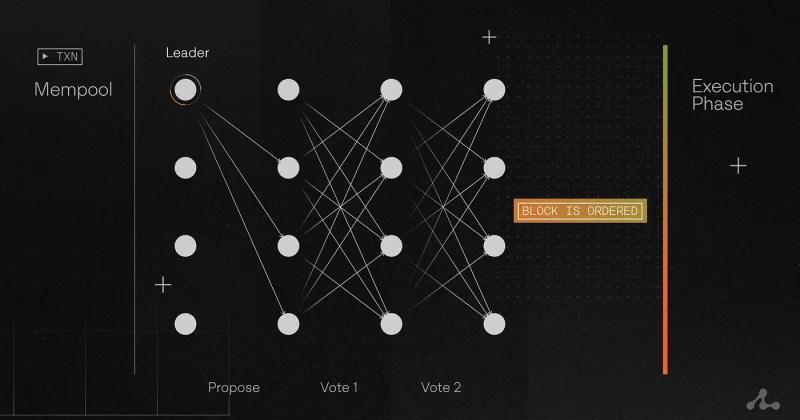
Aptos just introduced what might be the most consequential anti-front-running mechanism any Layer 1 blockchain has shipped to date. The network’s new Encrypted Mempool lets users submit transactions as encrypted payloads, meaning no one, not even validators, can see what a transaction is trying to do until after block ordering is complete and the block is confirmed.
In English: imagine placing a sealed bid at an auction where the auctioneer can’t peek inside your envelope before deciding the order of bids. That’s essentially what Aptos is doing for on-chain transactions.
How the encrypted mempool works
The feature relies on a batched threshold encryption scheme that integrates directly into Aptos’ existing consensus mechanism. Transactions enter the mempool encrypted. Validators order them without knowledge of their contents. Only after the block order is finalized do the encrypted payloads get decrypted and executed.
The technical elegance here matters. Batched threshold decryption reduces computational overhead to O(n), which means the cost scales linearly rather than exponentially as more transactions pile in. For a network processing high volumes of DeFi activity, that’s the difference between a practical feature and a theoretical one.