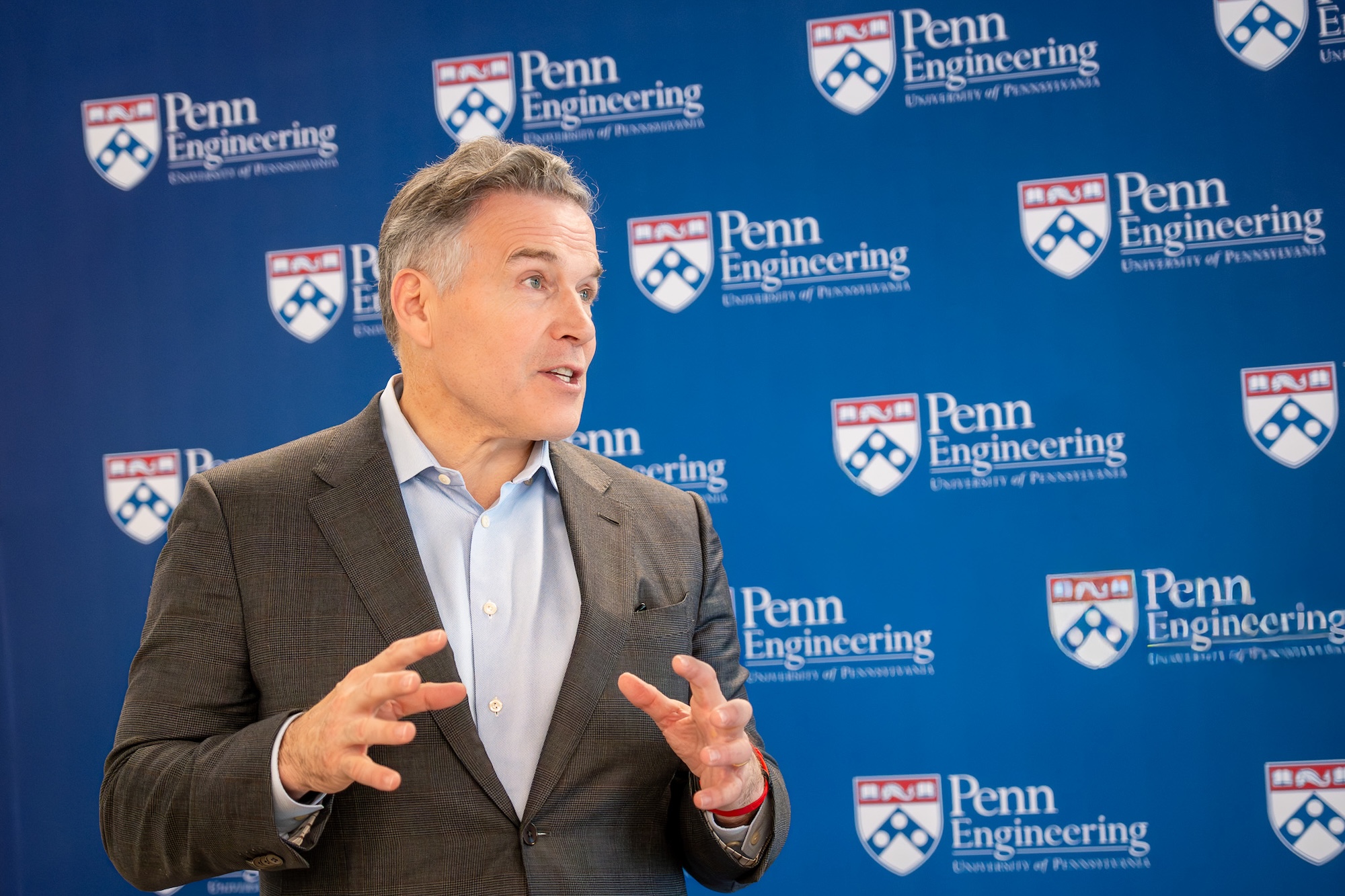
Standing inside the National Science Foundation (NSF) Artificial Intelligence-driven RNA BioFoundry (AIRFoundry) at One uCity Square, U.S. Senator Dave McCormick watched as Andrew Hanna, a graduate student in Bioengineering (BE), demonstrated one way Penn Engineering is accelerating RNA research.
“Each droplet is a different candidate for drug delivery,” said Hanna, pointing to a rectangular plastic plate dotted with tiny wells. “Conventionally, creating a single one of these would take a scientist 20 to 30 minutes.”
A robot that Hanna developed whirred, carrying the plate back and forth as it collected formulations mixed by tubes pushing fluid through a tiny chip, at speeds an order of magnitude faster than researchers could achieve by hand.
“So you’re creating a huge data set,” said McCormick. “Where does the data go next?”
Senator McCormick, second from left, asks Andrew Hanna, at left, a question about the latter’s new robotic system for rapidly formulating large numbers of lipid nanoparticles, at right. (Credit: Sylvia Zhang)