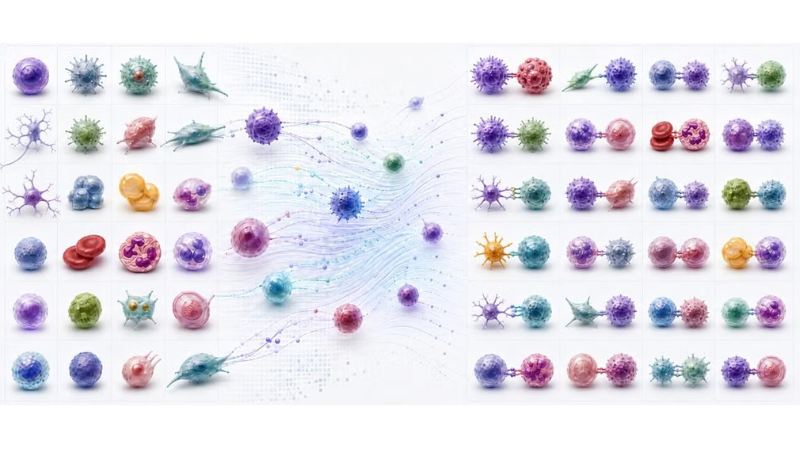
Just as the human body relies on organs such as the heart or liver for essential functions, cells depend on their own tiny organs, or organelles, to carry out vital tasks, including transporting nutrients, removing waste and regulating genetic activity.
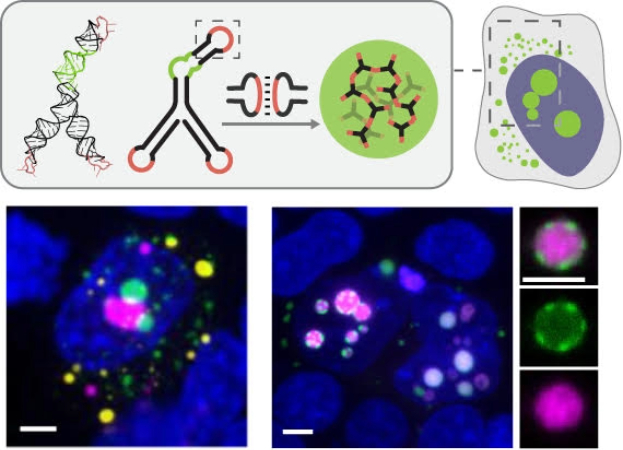
Now, a team of UCLA researchers has developed a new method to build programmable artificial organelles inside living cells using RNA as both the material and the blueprint. The approach enables researchers to design droplet-like cellular compartments that assemble in predictable ways and can be controlled in how and where they form, as well as what molecules they recruit. A study describing the new approach was published today in Nature Nanotechnology.
Some organelles are enclosed by membranes, but others are membrane-less, droplet-like clusters of proteins and RNA known as biomolecular condensates. These structures form as needed and act as temporary workspaces where molecules gather to perform specific functions more efficiently. Artificial condensates have emerged as a promising tool in synthetic biology, offering a way to reorganize the cell’s internal environment and direct chemical reactions and gene activity.
Unlike previous approaches that rely on naturally aggregating proteins, this method encodes assembly instructions directly into the RNA sequence and structure, enabling condensates to be designed with precise interaction rules and tunable properties.