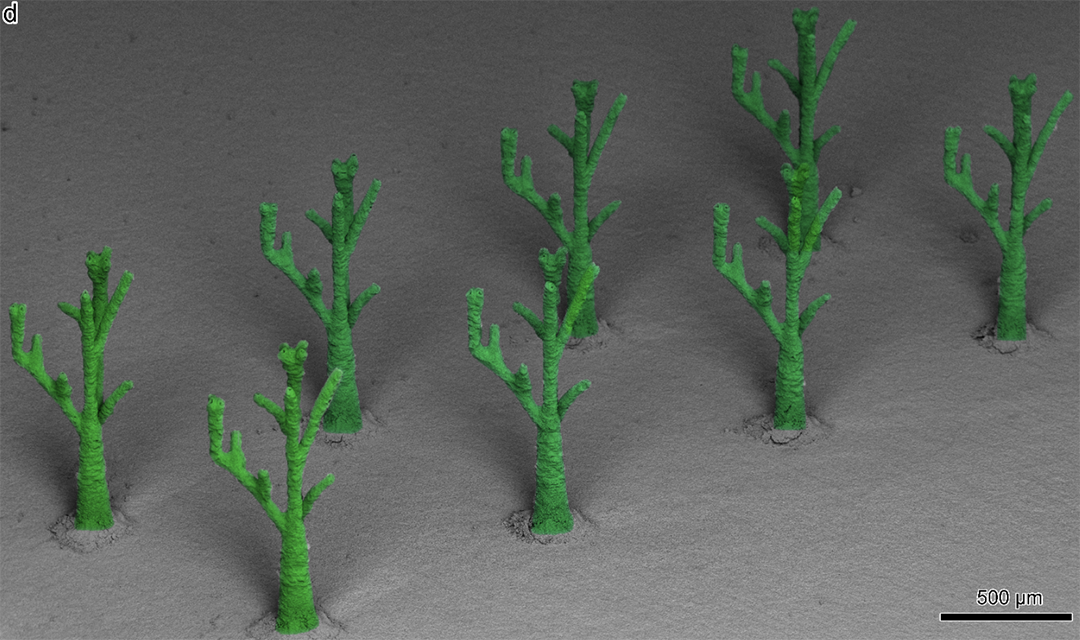
In a breakthrough that could power next-generation electronics, sensors, and energy storage devices, CMU engineers have developed a fabrication technique that arranges MXene nanosheets, each a million times thinner than a sheet of paper, into complex 3D structures in just a single printing step.
“A 3D arrangement of this 2D nanomaterial can help us reach the performance requirements for miniaturized electronic devices like microsupercapacitors and batteries.” said Rahul Panat, lead author of the research published in Small.
MXenes’ outstanding mechanical strength and superior electrochemical stability have captivated researchers for more than a decade. However, their impressive properties alone are not enough to create high-performance devices. The material’s architecture plays a crucial role by governing how efficiently ions and electrons move through an electrode. Without a carefully designed structure, even the most advanced MXenes can run into bottlenecks and barriers.
In previous work, Panat, a professor of mechanical engineering, demonstrated the ability to arrange 2D MXene into 3D structures with the support of a ceramic backbone. Now, Panat’s group has advanced the technique by creating freestanding 3D structures.