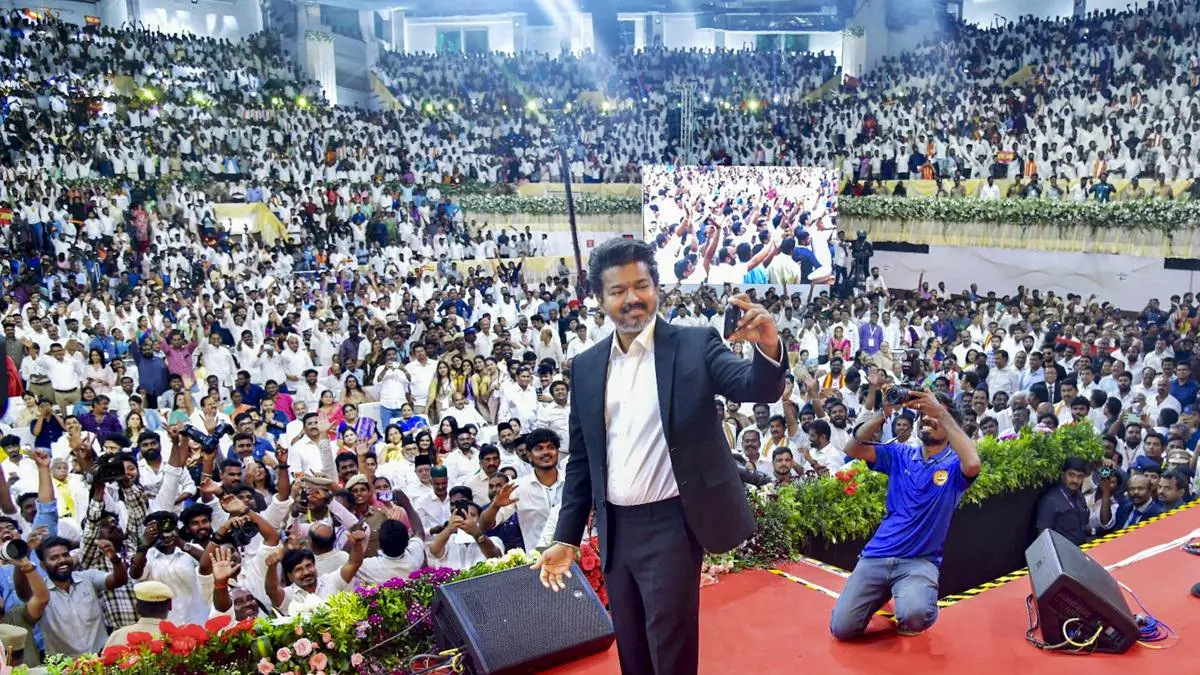
VIRAL VICTOR. Newly anointed Tamil Nadu Chief Minister Joseph Vijay
| Photo Credit:
Picture this. It’s the 2034 general elections. Constituency 247, somewhere in coastal Andhra Pradesh. On the ballot: A name, a symbol and a QR code. The candidate does not exist. Not in any meaningful sense. There is no body, no biography, no childhood in a modest home that the speechwriter romanticises.It is entirely virtual — a large language model dressed in electoral clothing, with a face generated by a diffusion model, a voice cloned from a composite of beloved regional actors, and a policy position recalibrated to the microsecond by sentiment analysis of 340 million social media posts.It feels nothing — not ambition, not empathy, not the particular anxiety of counting day. What it does, with unnerving precision, is know.It knows what the voter in Ward 12 is angry about before she has fully articulated it to herself. Its manifesto rewrites itself nightly based on trending grievances and aspirations.On counting day, it wins by 40,000 votes.The distance between the fiction above and what just happened in Tamil Nadu is shorter than anyone in the political establishment is comfortable admitting.The human algorithmIn less than two years after launching TVK, Joseph Vijay emerged victorious through a campaign that depended heavily on digital circulation rather than constant roadshows, marathon speeches or primetime television visibility.And the manner in which he got there should make every traditional political strategist quietly rethink their career. TVK’s campaign moved the way internet culture does: Through repetition, virality, remixing and constant social circulation — reels, fan edits, whistle-themed memes and teaser-style videos travelling rapidly across Instagram, WhatsApp, YouTube Shorts and X.This wasn’t a political campaign. It was a content operation with electoral intent.The masterstroke was scarcity. Vijay rarely engaged in constant media interactions or daily television appearances. Even short speech fragments gained traction once clipped and redistributed. In an attention economy flooded with noise, infrequent visibility itself became part of the communication strategy.What the breathless “celebrity politician wins!” narrative misses is the infrastructure beneath the aura. The foundation went back to 2009, when Vijay organised his fan clubs — reportedly numbering around 85,000 across Tamil Nadu — under the umbrella of Vijay Makkal Iyakkam.By 2026, those fan clubs had evolved into a digitally disciplined political mobilisation network, with tens of thousands of WhatsApp groups coordinating messaging, trends, hashtags and emotional narratives — decentralised cells capable of extraordinary reach.AI-generated visuals and hologram projections extended Vijay’s virtual presence without depending entirely on physical rallies.The man was everywhere without being anywhere.A global playbookTamil Nadu didn’t write this playbook alone. In Nepal, rapper-turned-politician Balen Shah defeated KP Oli, who had won the same constituency six consecutive times since 1991, by almost 50,000 votes, riding a Gen-Z revolution fuelled by the #nepobabies trend, which migrated from Indonesia to Nepal via TikTok and Instagram reels.Discord, a platform built for gamers, became a hub for political decision-making amid the power vacuum. Nepal’s Gen-Z negotiated government formation via group chat.In Hungary, Peter Magyar’s initial popularity was linked to a YouTube interview in February 2024 that gained over a million views.Blocked from State television, Magyar streamed his speeches on social media, responding within hours to government developments and incorporating them into his campaign.Politico attributed his eventual landslide victory partly to his successful use of social media and the large youth turnout it generated — toppling Viktor Orbán’s 16-year grip on power.The throughline from Chennai to Kathmandu to Budapest is identical: Platform fluency, outsider credibility and a generation that trusts influencers more than institutions.Back to 2034Which returns us to that virtual candidate in constituency 247. It has no ideology — only a perpetually optimised approximation of one. It does not believe in anything. It believes in everything you believe in, reflected back at you with supernatural accuracy.This is the logical terminus of a journey Vijay’s campaign accelerated: The understanding that modern elections are won not in town squares but in feeds, not through conviction but resonance, not by being real but by being ‘felt’.Political visibility is now built more through online momentum, recall value and “vibe marketing”.The only thing separating Thalapathy from the machine is that he actually exists.(Shubho Sengupta is a digital marketer with an analogue past)Published on May 18, 2026