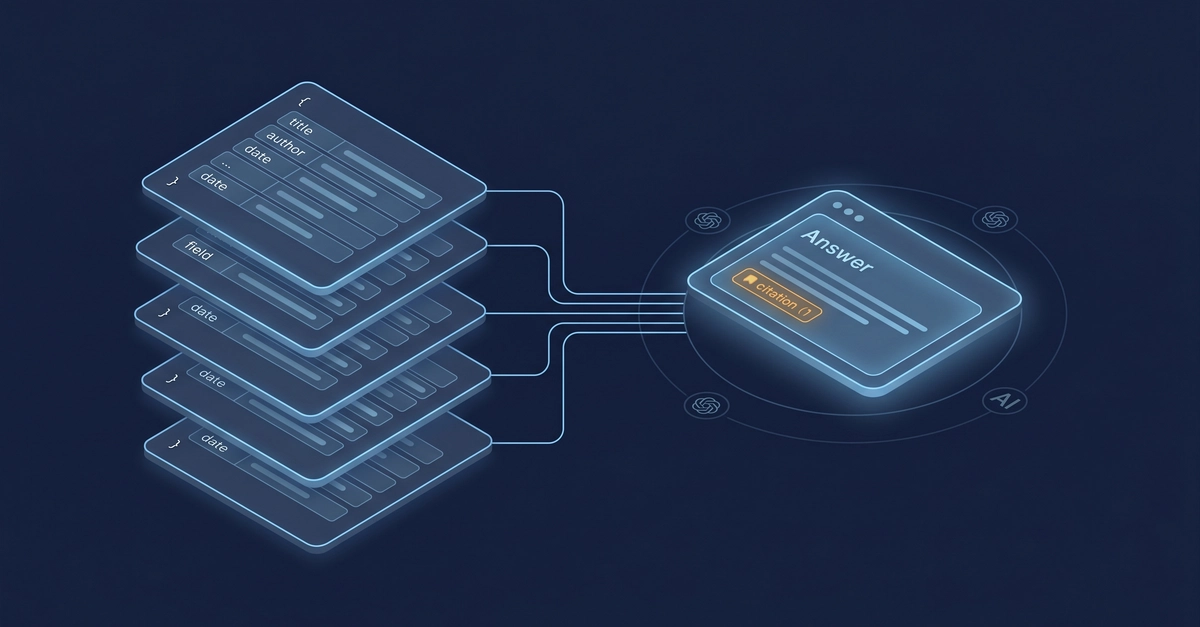
How a knowledge engine works in three sentences.A knowledge engine reads your sources once and compiles them into purpose-built artifacts shaped for each agent's task. Agents query those artifacts through a single declarative interface and get structured answers back. The reasoning that used to happen every retrieval, burning tokens and producing ambiguous results, now happens once at compile time, and gets better with every iteration.Anyone shipping agents in production today has hit the same wall. The model isn't usually the problem. Frontier models reason just fine. What breaks is everything before the reasoning step: the agent gets a task, decides it needs information, searches, retrieves, evaluates, decides it needs more, searches again, fragments the picture together, loops. By the time the model is ready to answer, most of the token and latency budget is already gone.Most of an agent's effort goes to orientation, not reasoning. The discipline that has emerged around closing this gap has a name now: context engineering. Shape data into knowledge the model can use, instead of asking the agent to reassemble it from raw data on every query.The hard part isn't the concept. It's operationalizing context engineering across the dozens of domains a real company runs on. This article walks through what a knowledge engine is, the infrastructure category that makes context engineering work at scale: how one is built, how agents query it, and what changes when you stop bolting agents onto brute-force retrieval and start running them on infrastructure designed for the workload.Walk into almost any SaaS company that's trying to put agents into production today, and the picture looks roughly the same. The data lives in a data warehouse, and also in Salesforce, Slack, Gong, Gmail, Jira, and Google Drive. Engineers know which fields matter and which are noise, which dashboards are trustworthy and which are abandoned, that the renewal team uses one definition of "active customer" and that product uses another. None of this is written down.When the same company tries to give an agent access to that knowledge, the cracks show up fast. We'll use a hypothetical mid-market SaaS company called Riverbend as a recurring example. Riverbend is composite, not a real company, but if you've shipped agents anywhere in the last two years, you'll recognize it.Riverbend's data falls into four rough categories. The structured stuff sits in Snowflake, DataBricks, Redshift, and BigQuery: hundreds of tables, weekly schema changes, hourly transformation jobs, tribal knowledge about what means what. The documents sit in Notion, wikis, and shared drives: sprawling, inconsistent, and often duplicated. Specs, runbooks, and policies that nobody is sure are still current. The operational systems are Zendesk, Jira, Salesforce, and HubSpot, holding customer history, account state, and open issues. And the conversations, where intent actually lives, are in Slack, Gong, and email. That's where decisions get made and commitments live. The data is all there. It just isn't in a form an agent can use.The standard playbook for getting agents this knowledge looks clever in principle but is painful in practice: bolt on an MCP server, hand the agent CLIs and APIs to call, and let it loop. The agent retrieves, reads, realizes something's missing, retrieves more, synthesizes, hits a conflict, retrieves again. Repeat. This is brute force, and it's the default because it's the only thing most teams can ship without significant time from their AI, data, or software engineering teams.The Cost of Brute ForceThe brute-force pattern produces a recognizable failure profile. Retrieval can eat 80% or more of an agent's token budget. Task completion rates often sit in the 50 to 60% range. Completion times are unpredictable. Token costs run away.Mapped to Riverbend, the four failure modes look like this:Failure modeWhat it looks like at RiverbendSlow responsesA "what's going on with Acme?" query takes minutes of tool calls before the agent has enough context to attempt an answer.Token burnRaw Salesforce records and Gong transcripts dumped into the context window. Cost scales with confusion, not with task.Incomplete and unreliableThe same question asked twice produces different answers. Cross-document synthesis fails silently.No governancePermissions aren't respected at retrieval time. There's no audit trail back to source. Compliance has nothing to inspect.Each failure has a business consequence. Runaway tokens are cost. Failed tasks are risk. Slow loops are velocity. Lack of governance is risk and compliance exposure.Web search already made the transition from a ranked list of links to direct answers. Knowledge infrastructure needs the same leap.How to Tell If Your Agent Has a Knowledge ProblemEngineers shipping agents tend to start by blaming the model. That's almost never where the problem actually lives. Five failure patterns show up over and over in production. Each one has a different root cause and a different fix. If you can name the pattern you're seeing, you can match it to the right approach instead of cycling through model upgrades that don't help.1. Slow. First responses take minutes instead of seconds. The trace shows long stretches between tool calls, not actual model thinking time.Root cause: too many retrieval round trips at runtime. Each tool call is a network hop and a re-parse cycle. The agent burns the latency budget assembling context before it can attempt an answer.What addresses it: pre-compiling the structure agents need so the answer comes back in one or two calls instead of ten.2. Expensive. Token bills compound fast. The agent pulls back chunks, stuffs them in the context window, decides it needs more, pulls more, stuffs again. Cost scales with confusion.Root cause: unbounded retrieval depth combined with chunked context that doesn't carry the relations the agent needs.What addresses it: structured artifacts shaped for the task, plus a query interface that lets the agent declare a budget instead of running until it gives up.3. Unreliable. Same question, different answer across runs. Cross-document synthesis fails silently. The agent says "no information found" when the information is there, just not co-located in any single chunk.Root cause: stochastic retrieval over fragmented data. The agent stitches a different subset together each time, which means each run is effectively a different prompt to the model.What addresses it: deterministic, pre-built artifacts that consolidate cross-document facts at construction time. Same query, same artifact, same answer.4. Multi-document reasoning fails. Single-document lookups work fine. As soon as the question requires combining facts from multiple sources, the agent loses the thread.Root cause: chunks don't carry relations. The agent has the pieces but no connective tissue to join them.What addresses it: artifacts that pre-compile cross-document relationships at build time. The agent receives a coherent object instead of a pile of fragments.5. Ungoverned. Permissions aren't enforced at retrieval time. There's no audit trail back to source. Compliance has nothing to inspect, security teams can't sign off, and regulated workloads stay blocked from production.Root cause: governance was bolted onto a retrieval system designed for a different consumer (humans clicking through results), not designed in for agents declaring queries programmatically.What addresses it: a query interface that enforces permissions at the surface and returns provenance with every field, not as a separate audit pass.A short self-test:Are you seeing more than one of these five patterns in production?Has fixing the model (better embeddings, larger context window, switching to a smarter LLM) made the problem better, or just more expensive?Would your agent still work if it had to answer five times the queries it answers today?Could a compliance auditor trace any answer the agent has produced back to its source data?If you're seeing more than one pattern, model upgrades haven't stuck, scale is on the horizon, or governance is a sign-off blocker, you have a knowledge problem. The next instinct is usually to upgrade retrieval, which is the wrong fix.Why This Is a Knowledge Problem, Not a Retrieval ProblemIt's tempting to read the failure modes above and conclude that the team needs better retrieval. A vector database, better embedding model, better re-ranking, better chunking. That's not the diagnosis.Agents aren't failing because retrieval is slightly off. They're failing because they can't express what they need, and the systems they're querying can't serve typed structured requests anyway.Consider the three things an agent should be able to say but can't:Return the answer, not twenty chunks: the agent doesn't want a ranked list of passages it then has to re-parse. It wants a typed answer with the fields the calling code already expects. Without that contract, the agent burns tokens re-parsing every call.Cite which source, with confidence: the agent needs to know which fields came from a contract, which came from a Slack message, and how confident the system is in each. Without field-level grounding, the agent can't separate facts from guesses, and the answer can't be governed.Standard depth, under 500 milliseconds: the agent needs a budget envelope for cost and latency. Without one, every call runs however deep, however long, and however expensive.These are language problems. The agent is missing the vocabulary. But even if the vocabulary existed, today's retrieval systems can't serve those requests. They're built to return passages, not typed answers with provenance and budget contracts. That's an engine problem.A language alone is an aspirational spec. An engine alone is just another retrieval API. You need both.The architecture is layered. Data sources at the bottom, a database that runs vectors, full-text, and metadata under one consistency model, the knowledge engine itself with two components inside (a context compiler and a composable retriever), a declarative query language above that, and the agents on top. The diagram below shows Pinecone Nexus, the example we'll use for the rest of the article.Knowledge Engine architecture: agentic build loop (coding plus evaluation against evals) produces curated knowledge artifacts and a Pinecone-backed query surface.The rest of this article unpacks that summary, layer by layer.The Four-Layer HierarchyA knowledge engine sits at the top of a four-layer composition. Each layer is built from the layer below, and each has its own active verb. Construction happens at the artifact level, where artifacts are built from raw data. Design happens at the context level, where contexts are curated from artifacts. Knowledge emerges from the collective body of contexts. And the engine ties it all together with an agent at its core, building and tuning contexts from the same underlying data.The definitions:Artifact. The concrete form of information an AI agent can act on, constructed for a specific task or outcome. Two agents working over the same data require different artifacts to be successful.At Riverbend: the customer-support bot's BigQuery query guide and the Sales agent's deal-stage map look nothing alike, because each is shaped for one job.Context. A curated set of related artifacts, designed to serve a specific domain or agent use case (typically a team, role, or workflow).At Riverbend: Sales has its context, built from deal artifacts, CRM artifacts, and Gong-derived competitive mentions. Customer Success has its own context, built from account health artifacts, ticket history, and product usage signals. RevOps has its own. Each is a deliberate grouping for the agents that team builds and runs.Knowledge. The collective body of all an organization's contexts, representing the meaning, relationships, and operating logic that emerge across every team, role, and agent.At Riverbend: knowledge is everything the four agent-teams (Sales, Finance, Marketing, CEO-staff) have curated, taken together. It's the picture of how Riverbend operates, made usable by every agent it deploys.Knowledge Engine. A new category of data infrastructure purpose-built for the agentic era. It builds any number of contexts from the same underlying data through an agent that constructs and tunes each one to fit how a team actually works.At Riverbend: one engine, one set of source connections, four contexts, four sets of artifacts compiled from the same underlying data.What the Artifacts Actually Look LikeTake a single source, like a sales call recording. For a Sales agent, that recording becomes deal context: who pushed back on what, who's the champion, what the timeline looks like. For a Finance agent, the same recording becomes an expansion-signal indicator: hints about budget cycles, contract structure preferences, when to expect renewal motion. For a Marketing agent, it's a competitive-mention extraction. For a CEO-staff agent, it's one signal in a cross-functional roll-up of how the business is moving.Same source. Different artifacts. Each shaped for the agent's task, not generic retrieval over the recording.Other shapes show up in real deployments. Entity profiles compiled across hundreds of documents, where Acme Corp shows up as one coherent object instead of 40 scattered mentions. Dependency graphs that capture how modules depend on each other rather than a raw import list. Semantic layers for analytics that hold tables, columns, relationships, anti-patterns, and worked examples instead of dumping a dbt schema. Decision frameworks distilled from policy documents: the rules, not the PDF.The hierarchy lands an old distinction in a new place. A system of record stores what happened to your data. A knowledge engine compiles that data into something each agent can act on directly, with the artifact shape varying by what each agent is trying to do.How Knowledge Engines Compile ThemselvesThere's a structural distinction underneath everything in this article that's worth naming directly.Reasoning at retrieval (today's pattern).A retrieval system finds documents and hands them to a frontier model at inference time. The model burns tokens sifting through raw content, introduces latency, and risks hallucination. This happens on every query.Reasoning at compilation (the knowledge-engine pattern).A context compiler structures, contextualizes, and composes specialized contexts before the agent needs them. The work happens once at compilation time and gets better with every iteration. The agent receives trusted knowledge, not raw documents.That shift is what unlocks the rest. Frontier models are freed to do what they were designed for: intelligent reasoning, not managing knowledge.Compiled-artifact retrieval is not new in concept. The problem has always been labor. Every pipeline is artisanal. Domain schema, chunking, retrieval tuning, eval-driven iteration, ongoing maintenance. Well-funded AI-native teams can afford it. Most teams cannot, so they fall back to naive RAG because it's the only thing they can ship.Riverbend has eight engineers and shipping deadlines. They can't live the artisanal-retrieval-pipeline lifestyle. They need the engine to do the work an artisan would otherwise do.The build loop is what that automation looks like in practice. Given source data, a task spec, and an eval set, the loop composes ingestion and retrieval code from a vetted skill library that includes entity extraction, dimensional modeling, symbol-tree generation, and cross-document linking. It scores candidate strategies against a multi-objective function (accuracy, tokens, and latency, jointly), so that no single objective dominates. It diagnoses failures and iterates against the evals until the quality threshold is met. And it commits the winning code as a versioned, inspectable, forkable strategy: code the team can read, modify, and override.Iterative compilation loop for the context compiler: ingest and parse sources against a task spec, represent and derive artifacts, evaluate until convergence, then emit curated knowledge artifacts to the composable retriever. Callouts contrast compile-once retrieval with per-query inference and summarize claimed impact (token savings, completion rate, single compile).What's not obvious is why this works without compromising on any single objective. The trick is the joint scoring. Artifact shapes that raise accuracy also reduce the re-orientation an agent has to do at query time. Tighter token budgets force sharper representations, and sharper representations tend to be more accurate. Accuracy and efficiency pull in the same direction once the loop is set up correctly.This is what "compile once, read many" means. The reasoning the model would have spent re-orienting at runtime is reasoning the engine spent once at compile time and serves cheaply thereafter.Pinecone Nexus doesn't ship a retrieval strategy. It ships a coding agent that writes the retrieval strategy for your task, on your data, against your evals, and rewrites it when either changes.The practical implication: a team like Riverbend doesn't have to staff a retrieval pipeline. They point the engine at their sources, declare a task spec for each agent, and let the loop produce the artifacts.How Agents Query: KnowQLThe interface between agents and a knowledge engine is what determines whether the engine pays off in production. If the agent has to issue a paragraph-level natural-language query and parse a blob of text back, the failure modes from earlier all come back. The agent burns time and tokens re-orienting on every call.What agents need is an interface where they declare what they want and get a precise, typed, cited response back. That's KnowQL: a typed declarative query language for agentic knowledge retrieval. It composes four categories into a single declarative call:Intent: what the agent is asking, what shape it expects the answer in, and which contexts to search across.Filter: deterministic predicates and access-control policies enforced at the surface. The agent only sees what its caller is permitted to see.Provenance: field-level citations returned by construction, not reconstructed afterward. Every value carries its source.Control: a budget envelope. Cost declared in outcomes (depth, latency), not raw tokens.The structural parallel is SQL and GraphQL. SQL gave relational data a universal interface, and an ecosystem of applications grew on top. GraphQL did the same structural job for connected APIs. KnowQL plays the same role for agentic AI knowledge.KnowQL query lifecycle: declarative parameters drive Nexus retrieval and yield typed, cited, confidence-aware responses. Side panels contrast today’s agent constraints with KnowQL’s positioning and ecosystem upside (standard interface, composability, framework neutrality).Before and After: A Renewal QuestionRiverbend's Sales agent needs to answer a renewal question: does Acme, one of Riverbend's customers, qualify for a renewal discount?Before, the question goes to a brute-force agent as a natural-language prompt: "Does Acme qualify for a renewal discount based on their contracts, usage, and our pricing policy?" The agent gets ranked chunks back. It parses, synthesizes, re-retrieves what's missing, parses again. Multi-turn loop. Tokens scale with confusion.After, the same question is a single KnowQL query:{
How Knowledge Engines Work: From Artifacts to Agent-Ready Answers | Pinecone
How knowledge engines compile organizational data into agent-ready artifacts. The architecture, KnowQL, and why this changes the economics of agentic AI.
4,037 words~18 min read
 aws.amazon.com