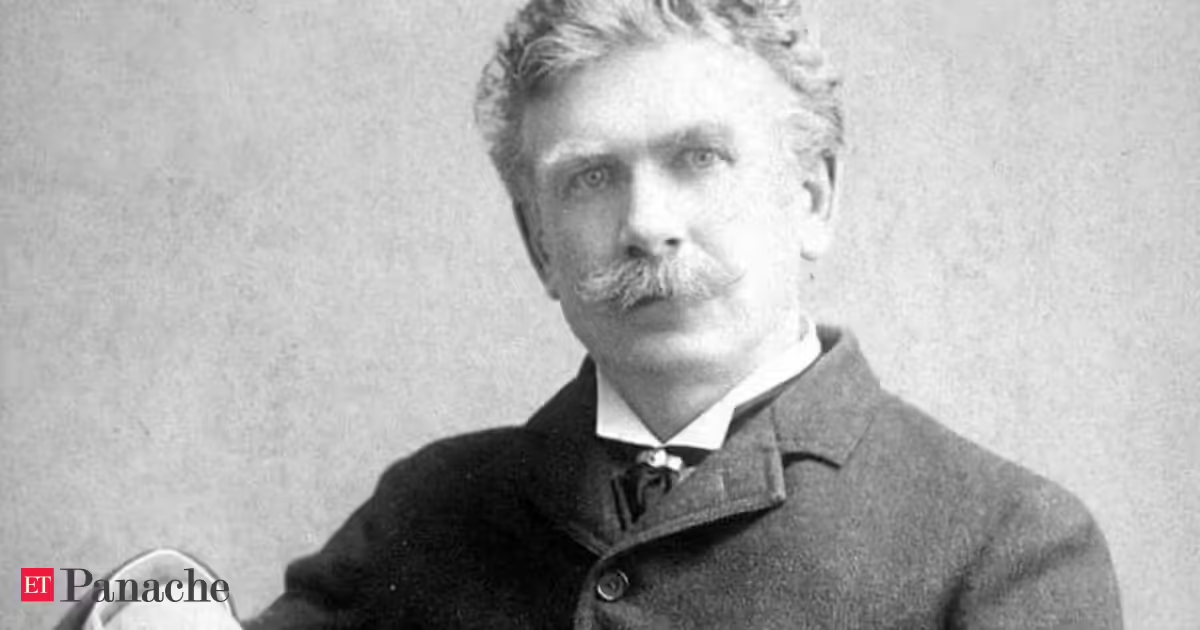
In a time when people constantly debate what is real, what is truth and how much human thinking is shaped by emotion, old philosophical quotes often find fresh relevance again. Many readers return to classic writers not just for motivation, but because some observations about society and human behaviour still feel surprisingly accurate even after decades. One such quote that continues to spark discussion came from American writer and satirist Ambrose Bierce, a man known for his sharp criticism of society, politics and human nature.The quote of the day by Ambrose Bierce: “All are lunatics, but he who can analyze his delusion is called a philosopher.”The quote is short, but it carries several layers of meaning. Bierce, who was known for his dark humour and cynical writing style, appears to question the idea of absolute sanity itself. According to the line, every person lives with some kind of illusion, bias or distorted understanding of reality. What makes someone appear wise, he suggests, is not freedom from delusion but the ability to study and explain it. That observation is part satire and part philosophy, which is why the quote continues to resonate with readers even today.The statement also reflects how society often labels people differently based on presentation and intellect. Someone speaking unusual ideas without structure may be dismissed, while another person expressing similar thoughts through analysis and reasoning may be celebrated as a thinker. Bierce’s line quietly points at that contradiction. It suggests that humans may not be as rational as they believe themselves to be.A quote rooted in Ambrose Bierce’s worldviewMuch of Bierce’s writing carried this same tone. He spent years exposing hypocrisy, corruption and pretension through newspaper columns, essays and fiction. His experiences during the American Civil War deeply shaped his understanding of life and death, and many critics believe that harsh reality influenced his pessimistic view of humanity.Born on June 24, 1842, in Meigs County, Ohio, Bierce grew up in a poor farming family and was the tenth of thirteen children. Despite limited formal education during childhood, he developed a strong interest in literature early in life. He later worked as a printer’s apprentice before joining the Union Army during the Civil War in 1861.Bierce fought in several major battles, including Shiloh and Chickamauga. He was seriously wounded during the Battle of Kennesaw Mountain in 1864. Many biographers and literary historians have pointed out that the brutality of war stayed with him long after the conflict ended. His later stories often dealt with violence, fear, death and psychological breakdown.After the war, Bierce eventually settled in San Francisco, where he began building his reputation as a journalist and literary critic. He wrote for several publications and became famous for his sharp commentary. Over time, he earned nicknames such as “Bitter Bierce” and “the wickedest man in San Francisco” because of his ruthless wit and biting satire.Writing mixed horror, war and psychological tensionAlthough Bierce worked as a journalist for decades, modern readers mostly remember him for his short stories and satirical works. His fiction often explored the darker side of the human mind. Critics frequently compared his work to that of Edgar Allan Poe because both writers dealt with horror, psychological tension and strange realities.Among his best-known stories are An Occurrence at Owl Creek Bridge, Chickamauga, The Damned Thing and The Boarded Window. Many of these stories blended war experiences with surreal or supernatural elements. Rather than writing straightforward realism, Bierce often manipulated perspective and perception, making readers question what was real and what existed only in the mind.His style was usually direct and economical. Unlike some writers of his era who preferred long descriptions and dramatic prose, Bierce often kept his language sharp and controlled. That approach made the emotional shock in his stories feel even stronger.The Devil’s Dictionary became one of his defining worksAnother major contribution from Bierce was The Devil’s Dictionary, first published in 1906 under the earlier title The Cynic’s Word Book. The collection offered sarcastic and ironic definitions of everyday words, institutions and ideas. Through humour, Bierce criticized politics, religion, greed and social behaviour.The book helped strengthen his public image as a fearless satirist who refused to flatter authority or popular opinion. Even today, many readers continue to share lines from The Devil’s Dictionary because of how modern some of its observations still sound.Bierce’s quote about philosophers and delusions fits naturally within that larger body of work. He often challenged accepted truths and questioned whether people genuinely understood themselves.Why the quote still connects with readersPart of the reason the quote remains popular is because it touches on self-awareness. Modern discussions around psychology, identity and mental health have made people more interested in understanding their own thinking patterns. Bierce’s line indirectly asks readers whether human beings are truly rational or simply skilled at justifying their beliefs.The quote also speaks to intellectual culture. Philosophers, writers and thinkers throughout history have spent years trying to understand fear, meaning, morality and existence. Bierce’s statement humorously suggests that philosophy itself may simply be a more organized attempt to study human confusion.At the same time, readers often interpret the line differently depending on their own experiences. Some see it as dark humour. Others view it as criticism of society’s double standards. Some even read it as a reminder that self-examination matters more than pretending to be certain about everything.A mysterious ending added to his legacyThe final chapter of Bierce’s life became almost as famous as his writing. In 1913, he travelled to Mexico during the Mexican Revolution and reportedly joined the forces of revolutionary leader Pancho Villa as an observer. After that journey, he disappeared completely.Historians generally believe Bierce may have died during the siege of Ojinaga in early 1914, but no confirmed account of his death was ever established. That unresolved disappearance added another layer of mystery to an already unusual literary figure.
Quote of the day by Ambrose Bierce: 'All are lunatics, but he who can analyze his delusion is called a philosopher...' - The dark truth about madness and philosophy explained by the American author-poet
Ambrose Bierces quote of the day reflects his deeply cynical view of human nature, suggesting that everyone lives with some form of illusion and what separates a philosopher is not the absence of bias but the awareness and analysis of it. The idea continues to resonate today because it challenges assumptions about rationality, truth, and how society labels people as sane or intelligent. Rooted in Bierces own experiences as a Civil War soldier and later a sharp satirist, the quote mirrors the themes of his broader work.
974 words~4 min read