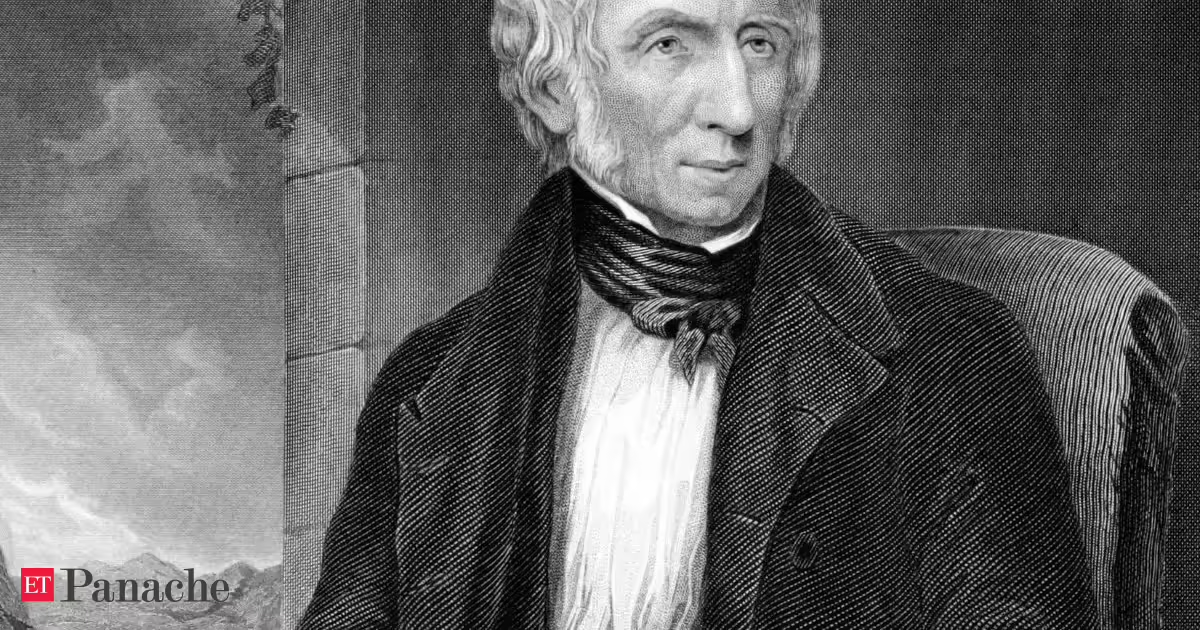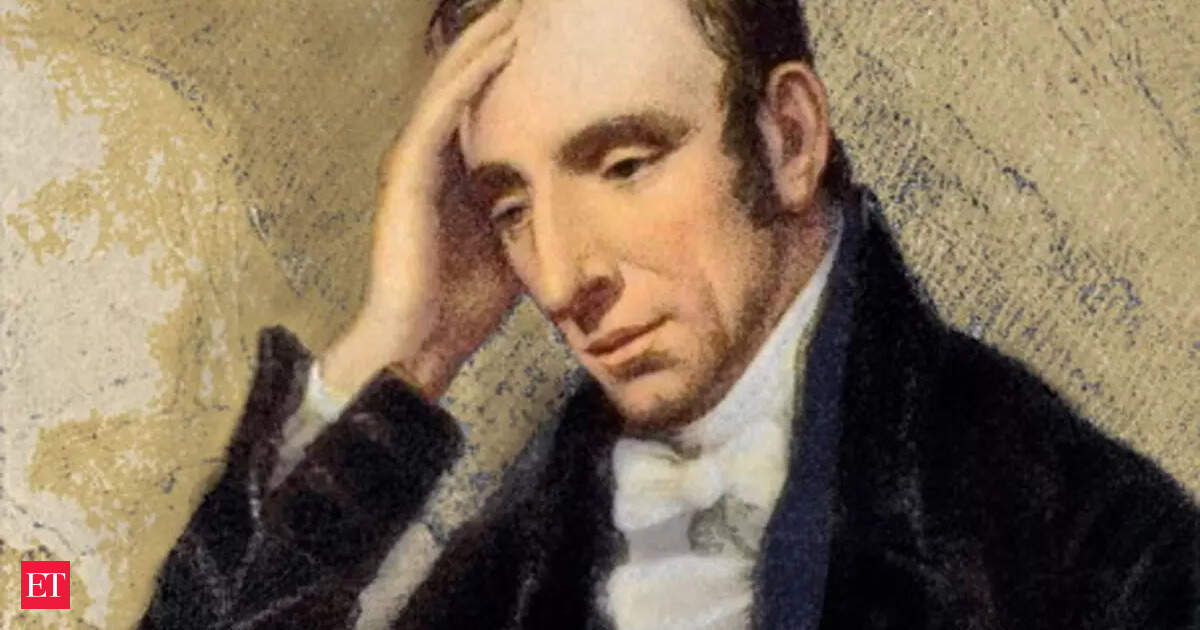
Quote of the Day: A memorable Quote of the Day often survives generations because it speaks not only to the time in which it was written, but also to the emotional and intellectual struggles of people centuries later. Few writers understood the connection between the inner world of human thought and the outer world of nature as deeply as William Wordsworth. His poetry transformed ordinary experiences into profound reflections on memory, imagination, emotion, and the spiritual power of nature.Wordsworth lived during a period of immense political and social change, yet his writings consistently returned to one central belief: the human mind possesses extraordinary beauty and depth. That idea is captured perfectly in today’s Quote of the Day. In an age increasingly distracted by material ambition and external appearances, Wordsworth’s words remain strikingly relevant because they remind readers that the true richness of life lies not merely in landscapes, possessions, or achievements, but in the imagination and emotional capacity of the human spirit itself.Quote of the Day Today May 14The Quote of the Day today by William Wordsworth is:“The mind of man is a thousand times more beautiful than the earth on which he dwells.”You Might Also Like:The line reflects Wordsworth’s lifelong fascination with human consciousness, imagination, and emotional perception. While he is widely celebrated as one of history’s greatest nature poets, Wordsworth believed that nature alone was not the ultimate source of beauty. Instead, it was the human mind, with its ability to feel wonder, compassion, memory, sorrow, and joy, that gave meaning to the natural world.Born on April 7, 1770, in Cockermouth, Cumberland, England, Wordsworth became one of the defining voices of the English Romantic movement. His collaboration with Samuel Taylor Coleridge on Lyrical Ballads in 1798 changed the direction of English literature forever. Through that revolutionary work, Wordsworth rejected the rigid and artificial style of earlier poetry and instead embraced ordinary language, common life, and deeply personal emotion.He believed poetry should emerge from authentic feeling rather than elaborate ornamentation. In the preface to the second edition of Lyrical Ballads, Wordsworth argued that poetry should reflect “incidents and situations from common life” using language genuinely spoken by ordinary people. That philosophy reshaped English poetry and established him as one of literature’s most influential innovators, as per information taken from Britannica.You Might Also Like:A Childhood Shaped by Nature and LossWordsworth’s early life was marked by both emotional hardship and deep connection with the natural world. He was born in the Lake District of northern England, an environment whose rivers, hills, valleys, and lakes would later dominate his poetry. His father, John Wordsworth, worked as an estate manager and lawyer, while his mother, Ann Cookson Wordsworth, came from a respected family connected to local trade and landholding traditions.Tragedy entered Wordsworth’s life early. He lost his mother at the age of seven and his father when he was only thirteen. Afterward, he and his brothers were sent to Hawkshead Grammar School in the heart of the Lake District, while his sister Dorothy lived separately with relatives. Those years of separation and emotional uncertainty profoundly shaped him.Yet the landscapes surrounding him also nurtured his imagination. The natural beauty of the Lake District became both refuge and inspiration. Wordsworth later wrote about how nature could inspire awe, comfort, fear, and spiritual reflection all at once. His poetry repeatedly returned to the idea that human beings are emotionally and morally shaped by their relationship with the natural environment.You Might Also Like:At Hawkshead, he developed a love for literature, classics, and mathematics, but perhaps more importantly, he developed the habit of observing ordinary life with unusual emotional intensity. The experiences of wandering through woods, climbing hills, and watching rivers and storms would later become central elements in his greatest poems, as per information taken from Britannica.Cambridge, Revolution, and Emotional TurmoilIn 1787 Wordsworth entered St. John’s College, Cambridge. Unlike many ambitious students around him, he felt disconnected from the competitive academic environment. Though he completed his studies, university life failed to inspire him deeply.A more important turning point came during his travels through revolutionary France in 1790. The excitement surrounding the French Revolution captured his imagination, and he became strongly sympathetic to republican ideals. He believed the revolution represented hope, equality, and social renewal.During a later visit to France, Wordsworth formed a relationship with a Frenchwoman named Annette Vallon, and the couple had a daughter, Caroline. However, political conflict between England and France forced Wordsworth to return home before his child was born. The separation caused him years of emotional pain and instability.The years following his return to England were among the darkest of his life. He struggled financially, felt politically disillusioned, and lived in uncertainty. Yet those difficult experiences also deepened his sympathy for ordinary people suffering from poverty, war, and social neglect. Many of the poems he wrote during this period reflected compassion for society’s forgotten individuals.The Bond That Changed His PoetryOne of the most important influences on Wordsworth’s life and work was his sister, Dorothy Wordsworth. The siblings reunited in 1795 and remained extraordinarily close for the rest of their lives.Dorothy possessed remarkable powers of observation and kept detailed journals describing landscapes, flowers, weather, and everyday experiences. Her descriptions often inspired William’s poetry. In many ways, their relationship became a creative partnership rooted in shared emotional sensitivity and love of nature.Wordsworth’s famous poem “I Wandered Lonely as a Cloud,” inspired by a field of daffodils, drew heavily from Dorothy’s journal observations. Her influence helped sharpen his ability to transform simple natural scenes into emotionally powerful reflections about memory and imagination, as per information taken from Britannica.This period also marked the beginning of Wordsworth’s friendship with Samuel Taylor Coleridge. Together, the two poets launched the Romantic movement in English literature. Their collaboration encouraged Wordsworth to move away from long philosophical works and toward the lyrical, emotionally direct poetry that would make him famous.The Revolutionary Power of Lyrical BalladsPublished in 1798, Lyrical Ballads became one of the most influential books in English literary history. The collection challenged the formal style and elevated subjects favored by earlier poets. Instead, Wordsworth focused on ordinary people, rural life, emotion, childhood, memory, and the healing power of nature.His poetry suggested that profound truths could be discovered in everyday experiences. A solitary wanderer, a rural worker, a child, or a field of flowers could all become subjects worthy of serious poetry.Wordsworth’s revolutionary ideas extended beyond subject matter. He believed poetry should capture authentic human feeling. Rather than writing for aristocratic audiences using artificial language, he sought emotional honesty and simplicity.Many of his greatest poems emerged during this extraordinarily productive period, including “Tintern Abbey,” “The Solitary Reaper,” “Michael,” and the immortal “Ode: Intimations of Immortality.”William Wordsworth’s Timeless Reflection on the Beauty of the Human MindThe meaning behind Wordsworth’s Quote of the Day reaches far beyond a simple comparison between the mind and the earth. At its heart, the quote expresses his belief that the human imagination transforms reality into something spiritually meaningful.Nature, in Wordsworth’s view, possesses immense beauty. Mountains, rivers, forests, and skies inspire wonder and reflection. But the human mind has an even greater power: it can interpret, remember, imagine, create, and emotionally respond to those experiences.When Wordsworth says the human mind is “a thousand times more beautiful,” he is celebrating humanity’s inner emotional and intellectual life. The imagination allows people to turn ordinary moments into art, memory into meaning, and suffering into wisdom.The quote also reflects Romanticism’s broader emphasis on emotion, intuition, and creativity over rigid rationalism. Wordsworth believed that imagination connected human beings not only to nature but also to something spiritual and eternal.Even today, the quote resonates because modern life often places greater value on material success and external appearances than on emotional depth, empathy, creativity, or reflection. Wordsworth reminds readers that the greatest beauty exists within human consciousness itself.A Poet of Memory, Nature, and HumanityAs Wordsworth grew older, his poetry gradually became more reflective and philosophical. Personal losses, including the death of his brother John in 1805 and the deaths of two of his children in 1812, deeply affected him. His later poetry adopted a more restrained and elegiac tone.He continued writing throughout his life, producing works such as The Excursion, sonnet sequences, and philosophical poems. In 1843 he became Britain’s Poet Laureate, succeeding Robert Southey.Wordsworth spent much of his later life at Rydal Mount in Westmorland, where he lived until his death on April 23, 1850. Although critics sometimes debated whether his later poetry matched the brilliance of his earlier work, his reputation as one of England’s greatest poets only continued to grow.Today, Wordsworth is remembered not merely as a poet of landscapes, but as a writer who transformed personal feeling into universal art. His poetry explored the relationship between nature and the human soul with emotional honesty that still speaks to readers centuries later.Other Iconic Quotes by William WordsworthBeyond today’s Quote of the Day, William Wordsworth left behind many memorable lines that continue to inspire readers around the world:“Poetry is the spontaneous overflow of powerful feelings: it takes its origin from emotion recollected in tranquility.”“Nature never did betray the heart that loved her.”“The child is father of the man.”“Fill your paper with the breathings of your heart.”"For I have learned to look on nature, not as in the hour of thoughtless youth, but hearing oftentimes the still, sad music of humanity."“Bliss it was in that dawn to be aliveBut to be young was very heaven.”“With an eye made quiet by the power of harmony, and the deep power of joy, we see into the life of things.”These quotations reveal the themes that defined Wordsworth’s life and work: emotional truth, imagination, nature, humanity, and the enduring power of memory. His poetry continues to remind readers that beauty is not confined to the physical world. It also exists within the mind’s ability to dream, reflect, and feel deeply.You Might Also Like:
Quote of the Day by William Wordsworth: 'The mind of man is a thousand times more…'-Top quotes by one of the founders of English Romanticism
William Wordsworth, a key figure of English Romanticism, believed the human mind's capacity for imagination and emotion far surpasses the beauty of the natural world. His poetry, born from ordinary experiences and a deep connection to nature, transformed reflections on memory and feeling into universal art.
1,644 words~7 min read