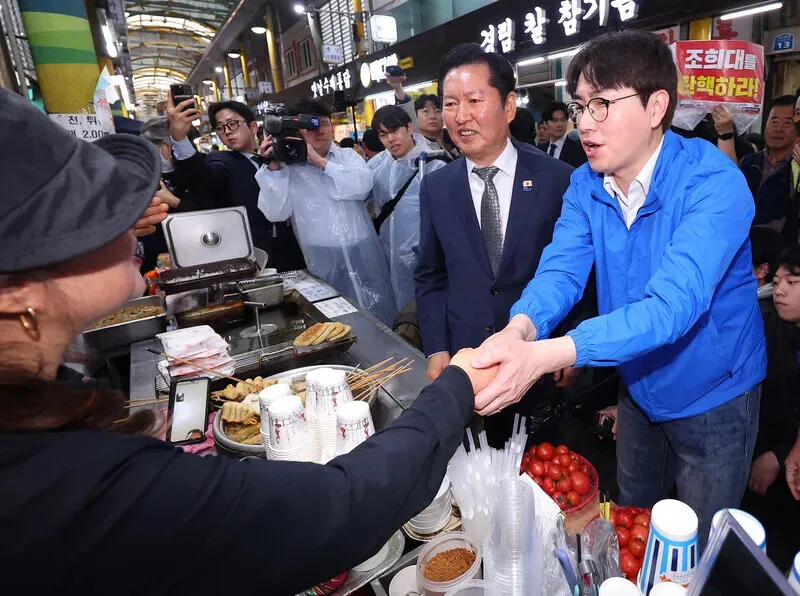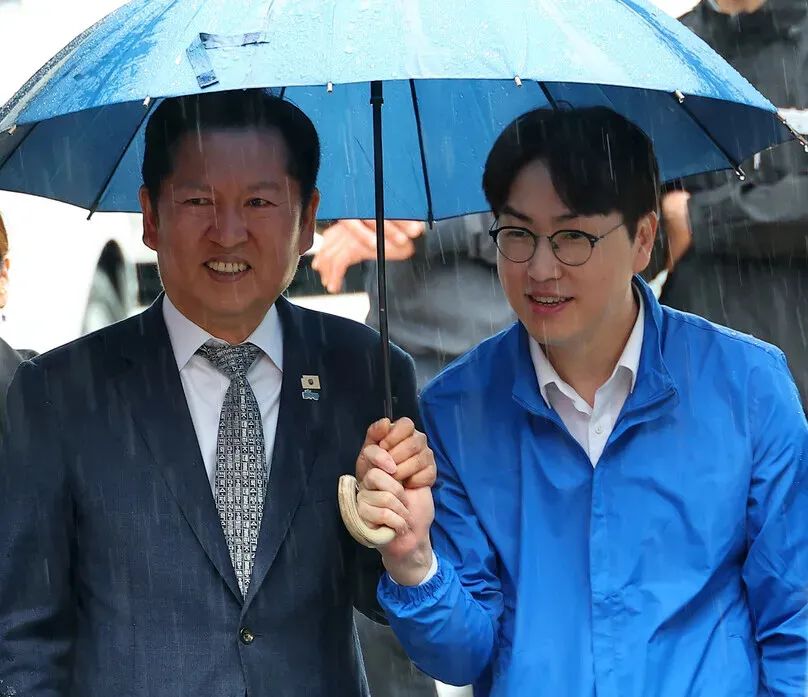
Democratic Party leader Jung Chung-rae walks through Gupo Market in Busan on May 3, 2026, with Ha Jung-woo, who is running for a National Assembly seat in one of the city’s districts. (Yonhap)
The leader of Korea’s ruling Democratic Party, Jung Chung-rae, continues to face backlash for asking a young girl at a campaign rally in Busan on Sunday to call him “oppa” (older brother). Now, a video of him during last year’s presidential race holding hands with young women and asking them to shout, “Go Chung-rae oppa!” is also circulating, further amplifying criticism that the lawmaker’s comment wasn’t a slip of the tongue but evidence of the entrenched sexist views in domestic politics.The civic group Womenlink on Thursday issued a statement in response to the recent controversy. “Rep. Jung has a history of asking women to cheer for him, asking them to call him ‘Chung-rae oppa’ at a campaign rally for the 2025 presidential election. Going further back to 2012, he protested the decision by the leadership of the then Democratic United Party for its 15% quota for female nominations, mentioning the real names of female politicians planning to run and describing their increased participation as taking away from the share of their male counterparts,” the statement read.“These scenes unconsciously and repeatedly showed the sexist perception that children and women are not considered equal political subjects,” it added.Koreans have long deemed the use of “oppa,” which is used in family relationships, as inappropriate in public or professional settings because it subordinates women to intimate private relationships. Around 2006, Na Yoon-kyeong, a professor of cultural anthropology at Yonsei University, discussed in a class the political context of the title in daily life and published the book “For a Happy Encounter Between Women and Coed Universities.”Students who pondered the use of oppa in class at the time wrote things like, “As we became oppa and dongsaeng (younger sibling), I realized that our relationship was not that of people relating to other people but one between a man and a woman,” or “The moment an upperclassman becomes an oppa, I must become a dongsaeng, and this forces me to accept a weak and submissive role.” The 2008 book “We Don’t Need Oppas” also rejected the title, blasting the patriarchy within activist groups such as those in the labor and pro-democracy movements.For that reason, comments by Kim Kwang-min, deputy director of the Institute for Democracy, defending Jung from criticism using hashtags such as #formsofaddresscensorship and #misuseoffeminism drew criticism as being even more regressive.“Recently, the persisting political climate is one in which women’s rights and gender equality agenda are not discussed for fear of ‘costing votes,’ and women’s policies are scaled back, especially within the Democratic Party,” said Kim Eun-ju, the head of the Center for Korean Women and Politics. “This atmosphere also appears to have created an environment in which the Democratic Party’s leader can more readily utter oppa, a term socially flagged as problematic,” she said. A prime example of this regression in women’s policy was also seen with President Lee Jae Myung. As the Democratic candidate who promoted gender-related policies in his 2022 presidential campaign and pledged to become a chief executive “who makes women feel safe,” he snubbed women and gender equality in his top 10 pledges during last year’s presidential election. “A politician asking voters to call him oppa in the public setting of an election campaign shows where Korean politicians stand vis-a-vis gender awareness,” said Yanglee Hyun-kyung, the co-representative of Korean Women’s Organizations United. “We must reflect on how Democrats can raise their sensitivity to gender equality in public spaces.”Kim stressed that the term oppa should stay within the bounds of the family. “Given its nature, forcing the use of a form of address normally practiced among family members in the public sphere is wrong,” she said. By Ko Na-rin, staff reporterPlease direct questions or comments to [english@hani.co.kr]