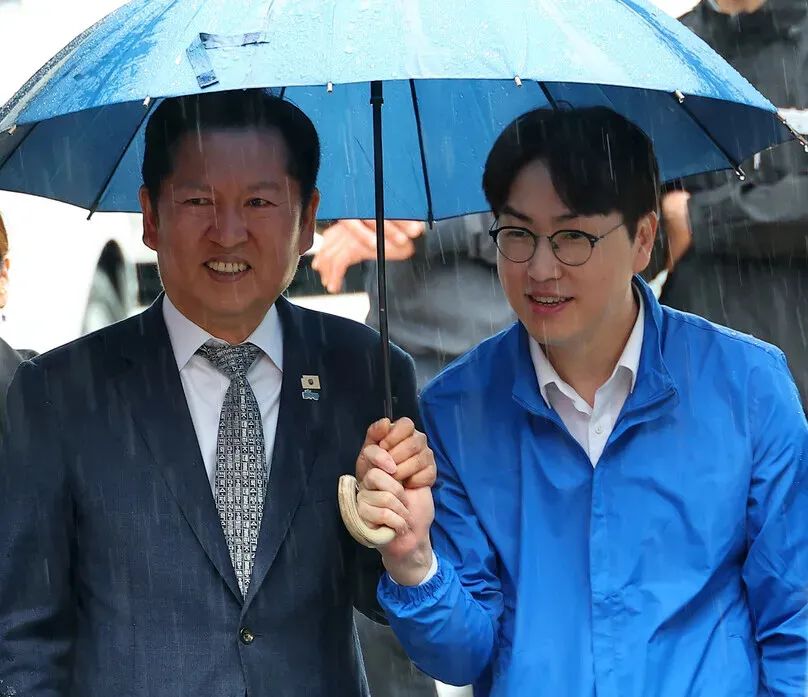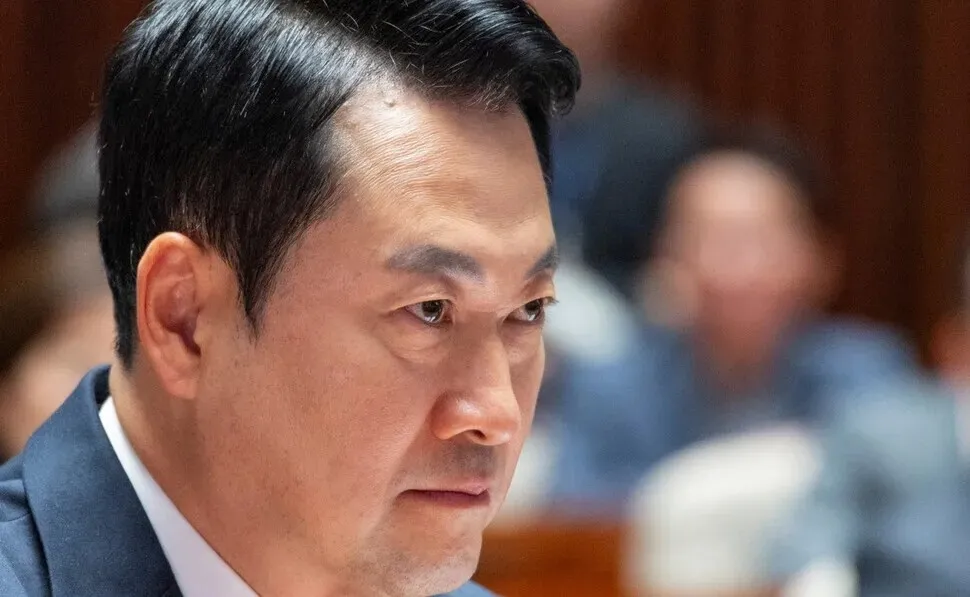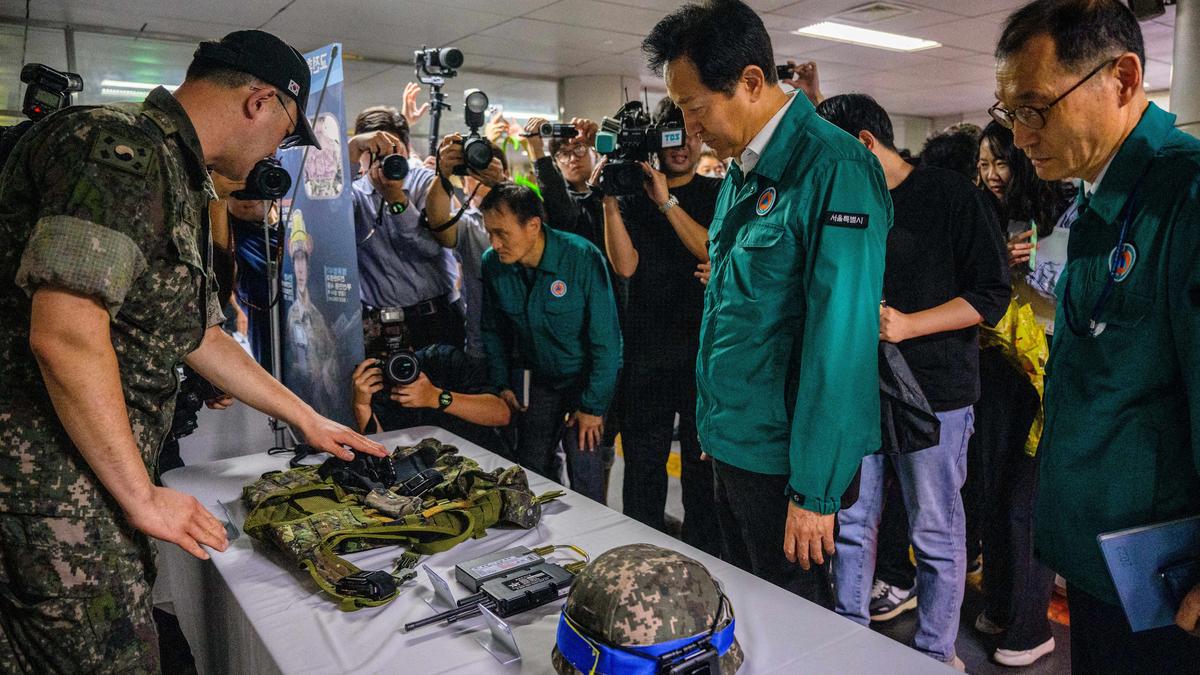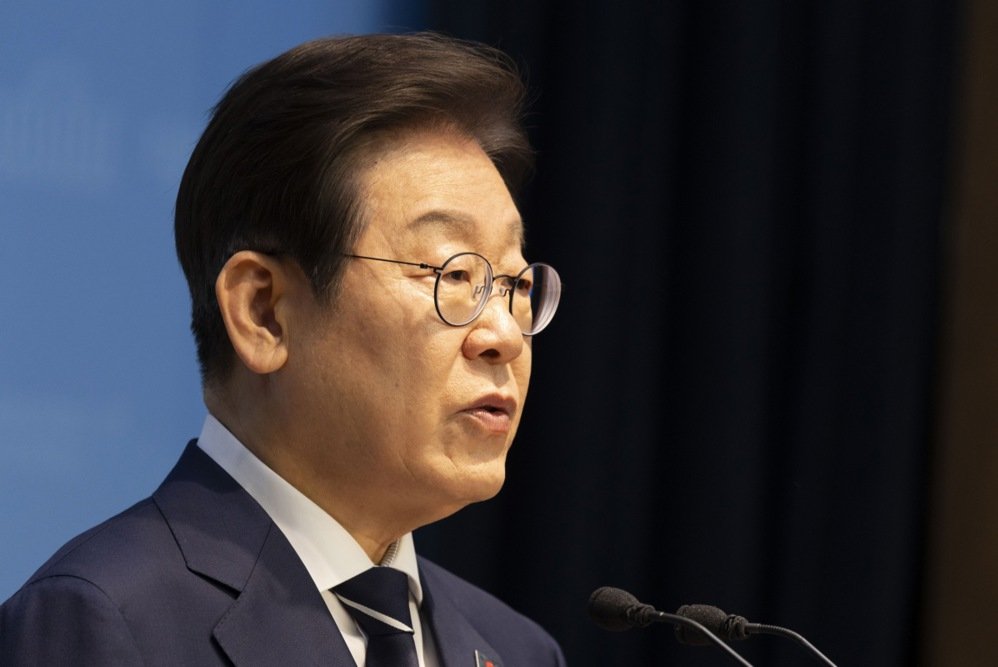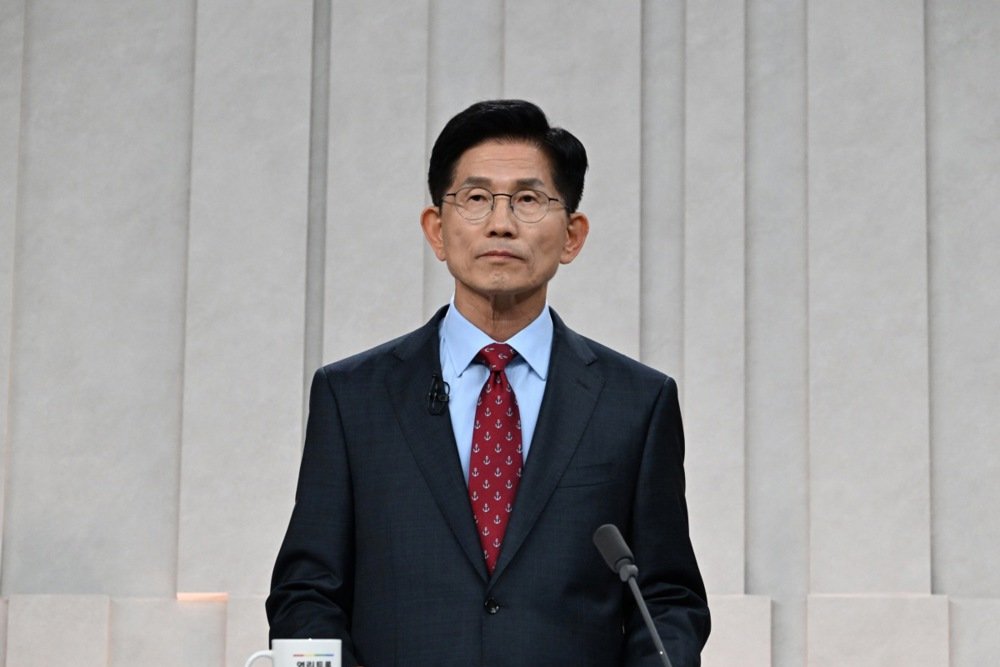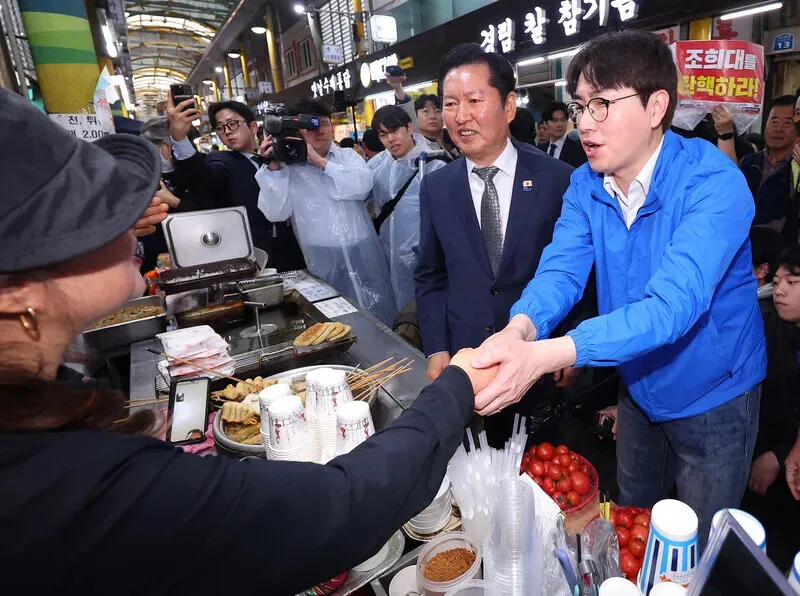
Ha Jung-woo (in blue), the Democratic candidate for a National Assembly seat in a Busan district, visits Gupo Market in the city with Democratic Party leader Jung Chung-rae on May 3, 2026. (Yonhap)
By Kim Hye-jeong, director of the Korea Sexual Violence Relief CenterWhile out shaking voters’ hands at a local market in Busan in a show of support for Ha Jung-woo’s campaign for a National Assembly seat, 61-year-old Democratic Party leader Jung Chung-rae touched off a firestorm when he approached a young girl and instructed her to call the 48-year-old Ha “oppa.” Where do you even start when the head of Korea’s ruling party is out on the campaign trail telling people to refer to middle-aged men as “oppa”?Once Jung came under fire, he released a statement apologizing that a kid ended up in the middle of all the controversy. But that little girl isn’t the controversial one here — Jung is. This latest incident is just an extension of his behavior during the last election cycle, when Jung stopped passing women and dragged them into making a video with him where he made them say, “Go Chung-rae oppa!” What’s so wrong about a man telling a woman (or girl, as it were) to call them “oppa”? I turn your attention to the following sexual harassment cases. In 2021, the deputy mayor of a district in Seoul said the following to a woman far his junior working at the district office: “Don’t I look so much younger than I am? Come on, call me oppa — even once.”When the woman said that he was closer in age to her father than an “older brother” figure, her boss called her a “killjoy.” This pattern of sexual harassment continued, combined with sexual assault. Eventually, the National Human Rights Commission of Korea recognized the deputy mayor’s actions as sexual harassment, a determination that was echoed in a 2025 Seoul High Court ruling as well. At a dinner gathering in 2017, a 50-something man working for the government tax service in the Gyeonggi region pulled aside a female employee. “Oppa” — he said, referring to himself — “will pull some strings for you come job reassignment and promotion time. I’ll make sure it’s all smooth sailing for you. You can trust your oppa.” The woman he was addressing later reported him to the police for sexual harassment. In 2019, an Incheon police lieutenant in his 50s faced disciplinary action for repeatedly badgering women in the force junior to him to call him “oppa,” and harassing them by saying, “Oppa likes you.” In 2022, the Incheon District Court ruled his actions to have constituted sexual harassment. An Army officer in 2021 faced disciplinary action for repeatedly harassing women in his unit by referring to himself as their “oppa,” and in 2023, the Seoul Administrative Court found this disciplinary action to have been justified. In short, calling yourself “oppa” to women you interact with in a professional environment or telling them to call you “oppa” constitutes sexual harassment. Let’s take a closer look at the context of these incidents and what was really going on in them. In the first incident, a high-ranking public official told a woman to call him “oppa” while remarking on his youthful looks. When you need a young woman to flatter you in terms usually reserved for intimate relationships to make you feel attractive, your subtext is sexual, your methods are coercive, and your behavior is sexist. People who act like this end up sexually harassing the women around them in the workplace who could otherwise have given them a healthy confidence boost when they needed it. That’s because sexual harassment often goes hand in hand with the abuse of disadvantage or punitive power. In the second case, the sexual harasser referred to himself as “oppa” while boasting about his sway over personnel assignments and ability to pull strings for the woman’s benefit. That goes to show that men who use that designation for themselves often either have power or like to pretend that they do. Imagine you’re the woman here; how likely are you to say no, push back, or reasonably disagree? In the third case, the man made unwanted advances toward women who worked under him, saying things like “oppa likes you.” This illustrates how a term originally meant for older brothers has come to encompass attempts to project the possibility of a romantic relationship between a man and a woman. It’s not just about seeing her as your romantic partner, but reducing her to her romantic potential for any man — be he her date, her boyfriend or her husband. In the final case, the man habitually referred to himself in the third person as women’s “oppa” in the workplace, steering conversations from normal everyday watercooler chitchat to nosy intrusions into coworkers’ private lives, lewd insults and mockery. This shows how the use of the term for oneself is often a red flag that a boundary is about to be flagrantly violated. The feminist writer and scholar Kwon Kim Hyun-young argues that a third definition of “oppa” should be added to the dictionary, beyond the standard “kinship term for a girl or woman’s older male sibling” and “term of endearment for a girl or woman to refer to a boy or man older than her.” Her proposal is as follows:“Oppa: A gender role imposed by men on women in a patriarchal society; a form of address men use to pressure women into becoming privately intimate or familiar with them.”Those who recognize the power Kim Kwon outlines in this definition of “oppa” use it to place the relationship in a gender hierarchy, to induce compliance as though it were voluntary, and to allow themselves to violate boundaries as though intimacy had erased them. For that reason, they tend to use it when offering women something (“Let oppa take care of it”) or ask women to do the dirty work for them (“What if you tried calling me oppa?”). I’m at my wits’ end writing this. What more is there to say? How many more times must this be said? Jung’s casual, habitual patriarchal language is despicable. Stop being sexist to women! Stop using young women as props in your campaigns! It’s high time something is done about sexual harassment by high-ranking politicians, both on the campaign trail and in office. I want to see real, actionable measures to prevent and discipline sexual harassment by politicians.And while I’m at it, if Korea is really so determined to become an AI powerhouse, I’m begging someone to keep chauvinistic language like “call me oppa” out of the vernacular training data. Please direct questions or comments to [english@hani.co.kr]