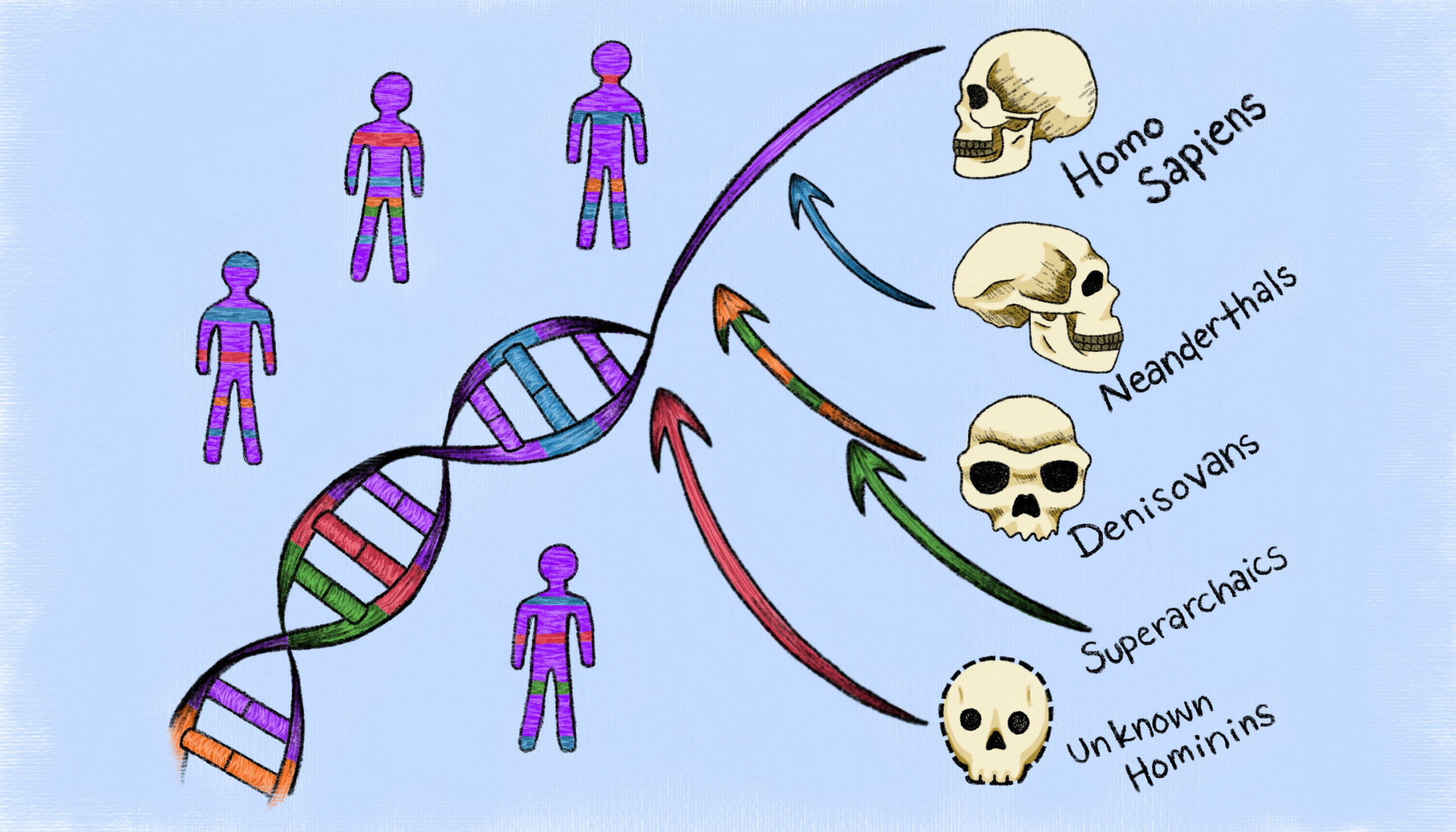
The idea that modern humans inherited DNA from Neanderthal ancestors is one of the 21st century’s most celebrated discoveries in evolution. It may not be that simple.April 14, 2026McKibillo You’ve probably heard some version of this idea before: that many of us have an “inner Neanderthal.” That is to say, around 45,000 years ago, when Homo sapiens first arrived in Europe, they met members of a cousin species—the broad-browed, heavier-set Neanderthals—and, well, one thing led to another, which is why some people now carry a small amount of Neanderthal DNA. This DNA is arguably the 21st century’s most celebrated discovery in human evolution. It has been connected to all kinds of traits and health conditions, and it helped win the Swedish geneticist Svante Pääbo a Nobel Prize. But in 2024, a pair of French population geneticists called into question the foundation of the popular and pervasive theory. Lounès Chikhi and Rémi Tournebize, then colleagues at the Université de Toulouse, proposed an alternative explanation for the very same genomic patterns. The problem, they said, was that the original evidence for the inner Neanderthal was based on a statistical assumption: that humans, Neanderthals, and their ancestors all mated randomly in huge, continent-size populations. That meant a person in South Africa was just as likely to reproduce with a person in West Africa or East Africa as with someone from their own community.
The problem with thinking you’re part Neanderthal
The idea that modern humans inherited DNA from Neanderthal ancestors is one of the 21st century’s most celebrated discoveries in evolution. It may not be that simple.
3,098 words~14 min read