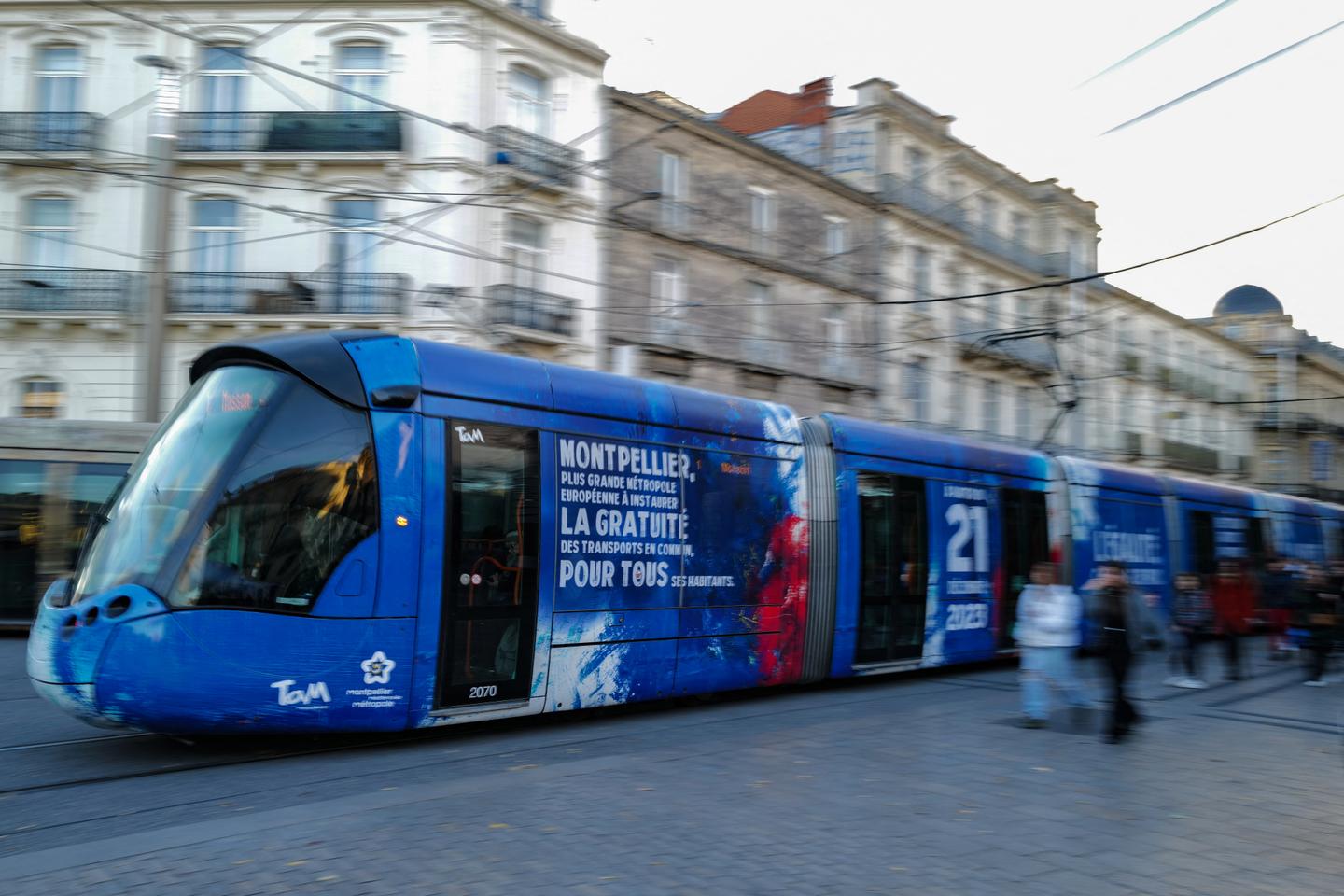
A tramway in Montpellier, December 21, 2023. SYLVAIN THOMAS/AFP
Nearly three million people in France can now use urban public transport without paying a fare. That number is likely to grow after the municipal elections on March 15 and 22, given the proliferation of proposals to make urban transport at least partially free. Some plans are meant for young people, in Aix-Marseille (Martine Vassal, right-wing independent) or Toulouse (François Briançon, Socialist); for everyone, in Brest (Cécile Beaudouin, La France Insoumise); those over 60, in Nice (Christian Estrosi, center-right Horizons); residents with incomes under €2,500, in Lyon (Jean-Michel Aulas, center-right); or on weekends, in Saint-Etienne (Régis Juanico, Socialist). And so on.
Listening to these candidates on the campaign trail, one might think that making public transport free is a revolutionary shift from one model to another, regardless of the target group. In reality, it is the result of a long process in which the share paid by urban transport users has been whittled down to a minimum. According to the Court of Auditors, which published a report on the subject in September 2025, the ratio between ticket sales revenue and operating expenses was 71% in 1977 but had fallen to just 33.1% in 2019 – excluding the Paris region, where it stands at 45.3%. "The final barrier to full fare-free transport is not very high anymore," said Arnaud Passalacqua, professor of urban planning and co-chair of the scientific committee at the Observatory of Cities with Free Public Transport.