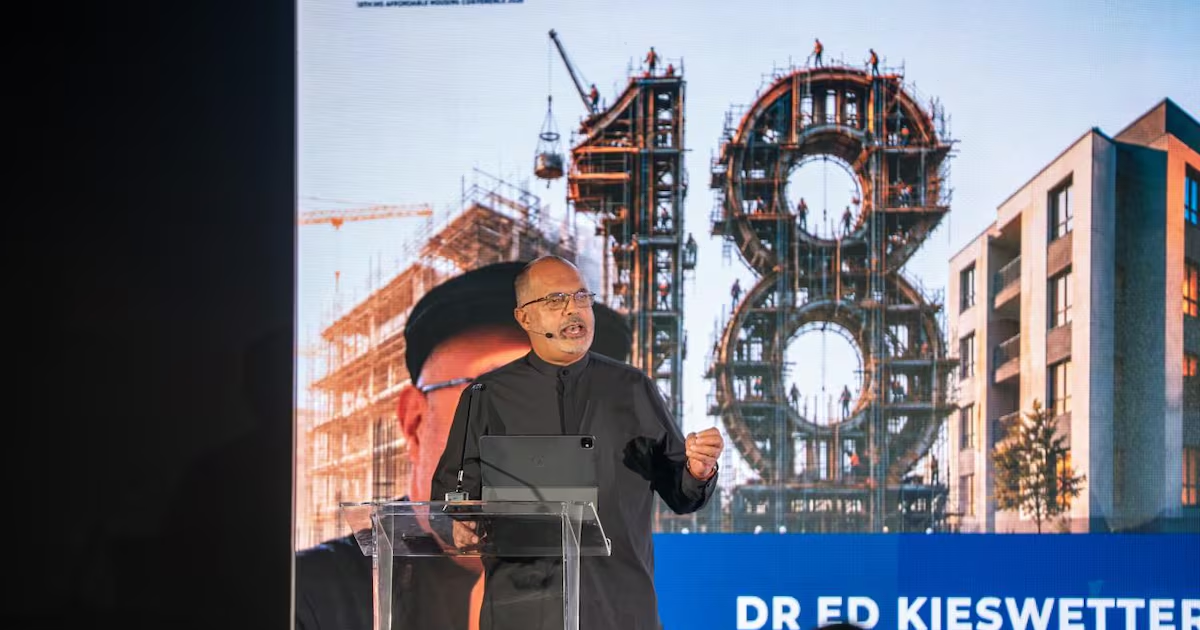
South Africa’s housing backlog is growing rather than shrinking, with population growth and urbanisation adding households faster than the country can provide them with homes, former SA Revenue Service (Sars) commissioner Edward Kieswetter says.Speaking at the 18th IHS Affordable Housing Conference 2026 at the Houghton Hotel in Johannesburg on Thursday, Kieswetter said the official figures did not capture the full scale of the crisis, with informal settlements, backyard structures and people living on the streets falling outside conventional measures of housing need.“Let me be blunt about this,” Kieswetter said.The government has 2.6-million homes, according to housing officials, while its housing needs register has more than 3.4-million households seeking assistance.“There are more than 4,000 informal settlements in our country,” he said.National household data shows that between one in eight and one in six households, depending on how informal housing is counted, live informally, Kieswetter said.“In some areas, informal settlements alone now account for roughly two-thirds of the entire urban housing backlog,” he said.But even those figures leave people out: “None of those figures even capture the people I meet for my morning walk around the seaside, and many other cities like that,” he said, referring to people living on the streets without structures that can be counted.The bigger problem, Kieswetter said, is that the backlog is being replenished faster than it can be cleared.Rapid urbanisation and population growth are compounding the pressure on the housing backlog. Close to 300,000 new residents are estimated to arrive in urban areas each year in search of housing, adding new demand faster than the state is delivering homes.SA has made significant progress since 1994, delivering close to five-million houses and housing more than 20-million people, he said.But that achievement is being undermined by the sharp slowdown in delivery. In the last financial year, just more than 23,000 fully subsidised housing units were delivered.“This is last year’s delivery rate. Not some average that we choose to use to placate ourselves,” Kieswetter said.At that rate, it would take more than a century to clear the current backlog, before accounting for the new households being added each year.“At the pace we are moving right now? Never,” he said. “Not in my lifetime, nor my son’s lifetime, nor in the lifetime of their children.”Incremental improvement is not good enoughFor Kieswetter, the maths points to a problem that cannot be solved by simply improving the existing housing system at the margins.“Incremental improvement of the current models is mathematically incapable of closing the gap,” he said. “We do not have a housing delivery problem that needs optimising at the margins. We need a paradigm that needs to be broken and reconstituted.”That rethink, he said, must also involve the private sector, including banks, asset managers, insurers and developers.Kieswetter said institutions had historically viewed the lower-income market as too risky, informal and expensive to serve using conventional products. He challenged the industry to distinguish between affordability and what it calls bankability.“Bankability, let’s be honest here, is in fact just a euphemism,” Kieswetter said. “It generally means we cannot make a profit serving this segment from the product we already have.”He pointed to Capitec as an example of an institution that questioned whether lower-income customers were inherently unbankable or whether the products being offered to them were the problem.“We need, I would argue, a Capitec moment in housing,” Kieswetter said. He stressed that this did not mean asking developers to build at a loss, banks to take reckless risks or investors to accept substandard returns.“Anyone in this room who thinks that the answer is philanthropy has underestimated the size of the problem,” he said.The central challenge, he said, is to develop a housing model capable of delivering at a scale that can finally outpace the growth in demand.“Fine-tuning our current model will be incremental and therefore unacceptable for the disruptive, discontinuous and exponential change we need,” Kieswetter said.Business Day
Disruptive ‘Capitec moment’ needed to fix housing crisis
‘We do not have a housing delivery problem that needs optimising at the margins … the paradigm needs to be broken and reconstituted,’ Edward Kieswetter says
645 words~3 min read