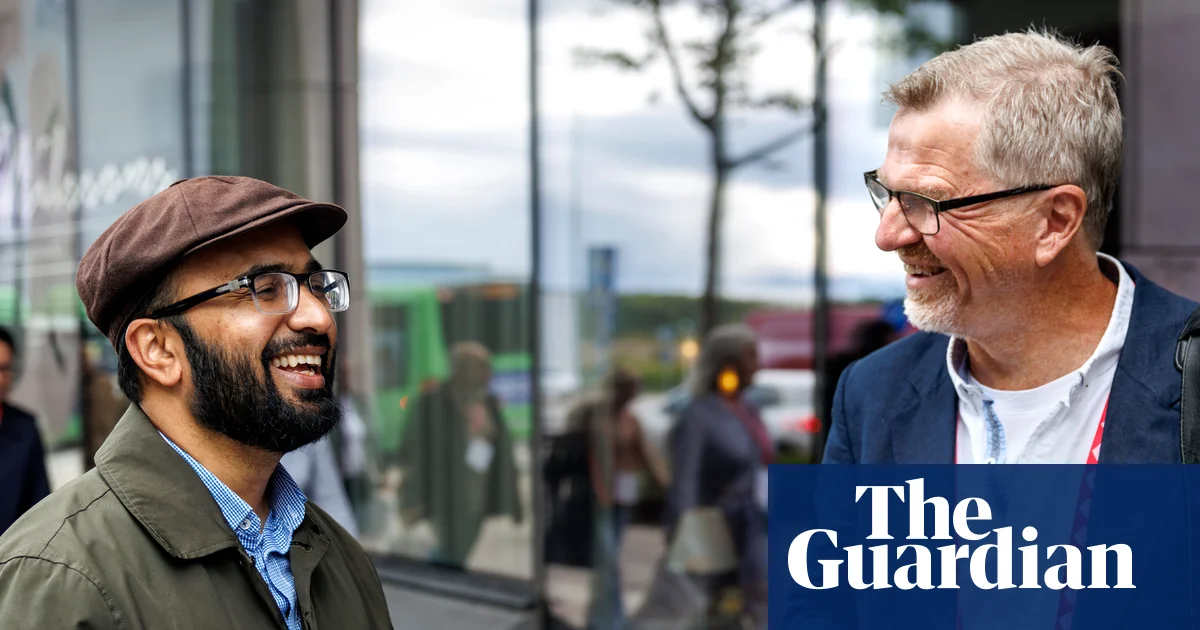
Not far from one of Scandinavia’s biggest shopping malls, Kashif Virk stood on the pavement, handing out flyers and smiling at those who passed by. On a cloudy Tuesday afternoon, the Swedish-born imam had taken to the street to invite people to ask him anything they had ever wanted to know about Islam.For years, Sweden’s far right has peddled its own, distorted view of Islam, portraying it as being at odds with Swedish values. The Ask-a-Muslim – or Fråga en Muslim – campaign, conceived by Virk in 2017, was his way of fighting back.With the help of dozens of volunteers from the Ahmadi Muslim community, the campaign had called in at more than 150 farmers markets, squares and city centres, inviting strangers to strike up a conversation in hopes of dispelling myths and shedding light on Islam.“We have some radical parties and people are genuinely afraid about Islam,” said Virk. “Sometimes people get very rude. But most people in Sweden are lovely, friendly and interested – they want to learn more.”The team at Mahmood mosque in Malmö. Photograph: Emma Larsson/The GuardianAhead of Sweden’s general election on Sunday, polls show the centre-left opposition has a narrow lead, suggesting that the rightwing minority-run coalition supported by the far-right Sweden Democrats could be ousted.Such a result would not only be significant for the Scandinavian country; it could also reassure mainstream voters across Europe that far-right forces such as the Sweden Democrats or Germany’s Alternative für Deutschland (AfD) – triumphant after its best showing in a state election last weekend – are not inevitably on the rise.But even so, the Swedish polls have narrowed slightly in recent weeks, making many nervous, particularly as the right-leaning ruling coalition has for the first time said it would offer ministerial posts to the far right if it wins. Those who have borne the brunt of the far right’s time propping up the government worry that Sweden, long held up as a leading light when it comes to equality and freedom, may have been irrevocably changed, regardless of what happens on Sunday.“It’s a kind of Pandora’s box that has been opened,” said Munir Niazi, who has long worked with Virk on the Ask-a-Muslim campaign.During the government of the centre-right prime minister Ulf Kristersson, the far-right Sweden Democrats have used their leverage to steer policies on migration and crime, seizing on the spotlight to spread rhetoric linking the two and scapegoating migrants, Muslims and other minorities for all that ails the country.Munir Niazi, who also works on the Ask-a-Muslim campaign, with Virk (right) at the mosque. Photograph: Emma Larsson/The GuardianThe result had shifted Sweden’s national conversation to the right, said Niazi. “In the past four years, the biggest opposition party, the Social Democrats, have slowly adopted and even voted with the right wing on migration, on crime. In the near future, at least, we don’t see the country going back to the policies of the 80s and 90s.”Virk nodded in agreement. “We see, unfortunately, that everybody plays the anti-Islam card when they need it.”The repercussions have been felt widely. Last year, a gunman killed 10 people in the Swedish city of Örebro, most of whom had an immigrant background. Across Sweden, mosques have regularly been vandalised and in 2023 the country grappled with a spate of protests in which copies of the Qur’an were burned or otherwise damaged.Speaking to commuters in Malmö making their way through Hyllie station, many said the politics had started to feel deeply personal, as though their existence in Sweden was a political battleground.“When the far right talk about my religion and my hijab, it feels like they’re talking about an animal,” said one nurse, 46, who asked not to be named.In 2023 the country grappled with protests where copies of the Qur’an were burned or otherwise damaged. Photograph: Jonas Gratzer/Getty ImagesOriginally from Lebanon, she had settled in Sweden in 1999. “The older people in the hospital say that myself and other immigrants have helped to build Sweden – why doesn’t the far right see this?”Sitting in a nearby park, Onyango, 42, said the atmosphere in Sweden had become “horrible” for migrants amid the far right’s steady increase in influence. “I feel like they poison the population,” he said. “They’ve created an environment where if you’re not a Swede, you are scared.”The hostile rhetoric, coupled with efforts by the government to tighten the rules around migration, had left the Kenyan national devising a backup plan despite nine years spent in the country and a good job working with supply chains. “You start thinking maybe I need to have an apartment in Kenya and set aside some money, just in case,” he said.Sitting next to him, his friend Waithira, 30, nodded in agreement. “Before you wanted to invest here, buy an apartment here, start a business. But now you start thinking twice,” she said. “We don’t know what the future holds, but it’s a bit less attractive than before.”skip past newsletter promotionafter newsletter promotionIn the southern reaches of Stockholm’s Södermalm district, Jonna Mannberg and Isaac Kuehnle-Nelson recalled how in 2015, about 1,700 people from across the country spontaneously turned up at the city’s central station, eager to welcome and help settle Syrian and Afghan asylum seekers as they arrived.In the 11 years since, the initiative, formalised into Refugees Welcome Stockholm, had unwittingly become a shorthand for the changes sweeping Sweden. “We’ve gone from being an organisation that was at the forefront of public political dialogue in Sweden to being a smaller organisation where our funding and ability to reach out have shrunk significantly,” said Kuehnle-Nelson.They had watched as policy stances once reserved for the far right became mainstream, from a slashing of refugee quotas from 5,000 to 900 people a year, to allowing residency permits to be revoked over the vaguely defined criteria of “bad behaviour”.“In 2015, people were met with open arms. We had the prime minister say: ‘My Europe doesn’t build walls,’” said Mannberg. “But the harsh reality is that we still have the same people that we were dealing with in 2015. We’re still with them in 2026 and they have not received legal status yet.”The far-right Sweden Democrats have leverage in the Swedish parliament since their support is needed by the ruling coalition. Photograph: Tom Little/ReutersThe psychological toll was laid bare during a recent programming course for young, undocumented asylum seekers. “There were days when many were unable to attend because they couldn’t get out of bed,” she said. “To have physically healthy, 20-year-old guys who have been so pushed down by life that they were unable to leave their beds, unable to see any future for themselves, that’s a really hard thing.”Among those caught up in the crackdown on asylum seekers was an undocumented 14-year-old who, despite being born in Sweden, was facing deportation to Armenia, along with his single-parent mother and his younger brother. “It’s like hell. I’ve been here my whole life,” he told the Guardian. “I feel Swedish.”His parents had come to Sweden as political asylum claimants, but their separation resulted in the claim becoming mired in bureaucracy. While there had been a visa category that might have given the family another chance of continuing the lives they had built in Sweden, it was scrapped recently by the rightwing government.Instead, the order looms over them, clouding the life of a child who had sung in a church choir and dreamed of a future as a civil engineer in Sweden. “It feels horrible,” he said, pointing out that he had never been to Armenia, did not speak the language and was terrified about the possibility of being forced to complete its mandatory military service.The changes to immigration policy, including recently introduced rules barring most asylum seekers from accessing permanent residency, were an example of how the political conversation in Sweden had been transformed by the far right’s time as power-brokers, said journalist Bilan Osman.“There’s a lot of proposals in Swedish politics today that we couldn’t even imagine 10 years ago,” she said, citing the tens of thousands of euros being offered to migrants to return home as an example. “People would have said: ‘You’re a lunatic.’ Now it’s like: ‘Let’s discuss it.’”Osman had long researched rightwing extremism, tracking the movement as they created their own media outlets capable of reaching new audiences. What emerged was a steady normalisation of their discourse, blaming migrants and minorities for Sweden’s social and economic ills, while the fallout of the country’s soaring inequality levels was largely overlooked.The resulting rhetoric had pushed some to the margins, recasting Sweden as a place where some belonged and others were made to feel as though they did not. It was a marked shift that would probably have long-lasting consequences, she said, citing Swedish Muslims, who make up an estimated 8% of the population, as an example.“I think we are at a breaking point right now in Sweden, where the main question is: ‘Is there a future for Muslims in this country?’” said Osman. “If we continue to have these kinds of discussions, I think a lot of Muslims will feel that there is not a future here. And that’s sad.”
‘They poison the population’: Swedish Muslims challenge far right ahead of election
Ask-a-Muslim campaign takes to streets as country faces prospect of extremists entering highest levels of government
1,523 words~7 min read