September 9th, 2026
Without careful study design, studies in which the use of GLP-1 receptor agonists such as semaglutide lowered calorie intake significantly via suppression of appetite might be expected to teach us little that we did not already know. Reducing calorie intake without compromising minimum necessary levels of essential nutrients slows aging and extends life, whether achieved via limiting food availability or by limiting appetite. Researchers know this, and they know a great deal about the fine details of the metabolic response to reduced nutrient availability. The effects of reduced calorie intake readily overpowers the effects of other mechanisms that may or may not be operating as a result of GLP-1 receptor agonism, particularly in short-lived species. One has to look more carefully to see any more interesting outcomes that lie outside the normal effects of calorie restriction.
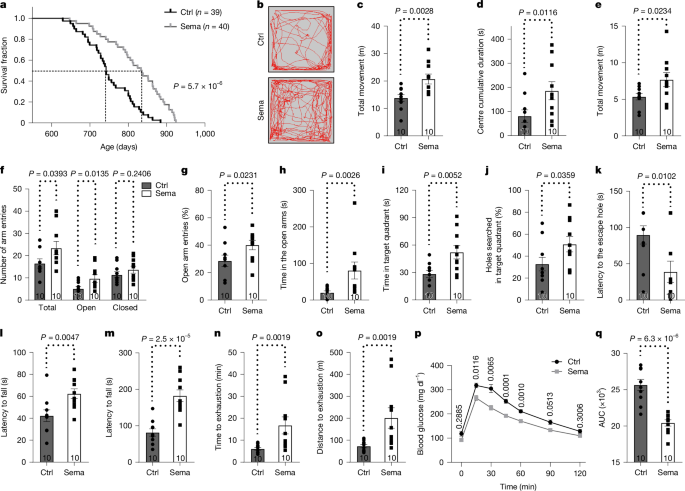
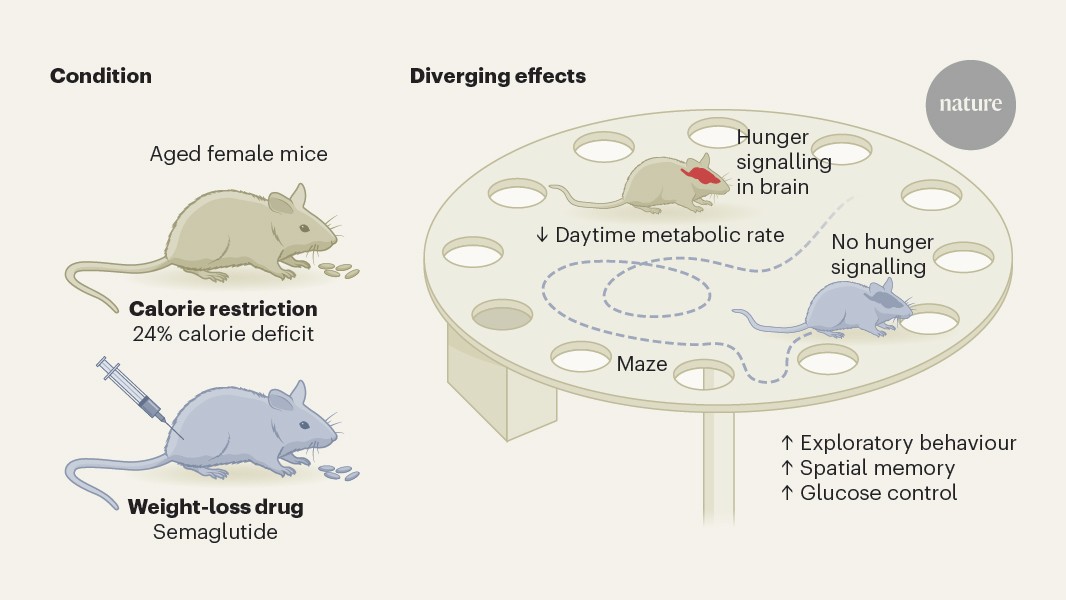
Reported in today's open access paper, researchers conducted a study in mice in which (a) GLP-1 receptor agonism reduced calorie intake by a quarter when started in late life, and (b) the mice lived ~15% longer. That falls in line with the results of many calorie restriction studies conducted in aged mice over the past twenty years. Indeed, the researchers conducted their own calorie restriction study with a reduced calorie intake matched to the results of their GLP-1 receptor agonist study, and found the outcomes in health to be very similar. There are a few differences, however. Why do those differences exist? GLP-1 receptor agonism affects some aspects of metabolism that calorie restriction does not, and vice versa. Most notably, calorie restricted mice are hungry for much of the time, while mice treated with GLP-1 receptor agonists are not. The signaling associated with the hunger response has its own effects on metabolism distinct from those resulting directly from sensing of nutrient levels in cells.