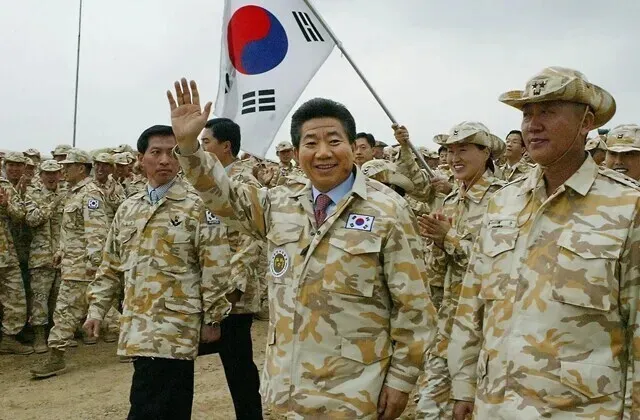
President Roh Moo-hyun pays a visit to the Zaytun Division in Iraq on Dec. 8, 2004, following a visit to France. The division was in Iraq for peace and reconstruction efforts. (pool photo)
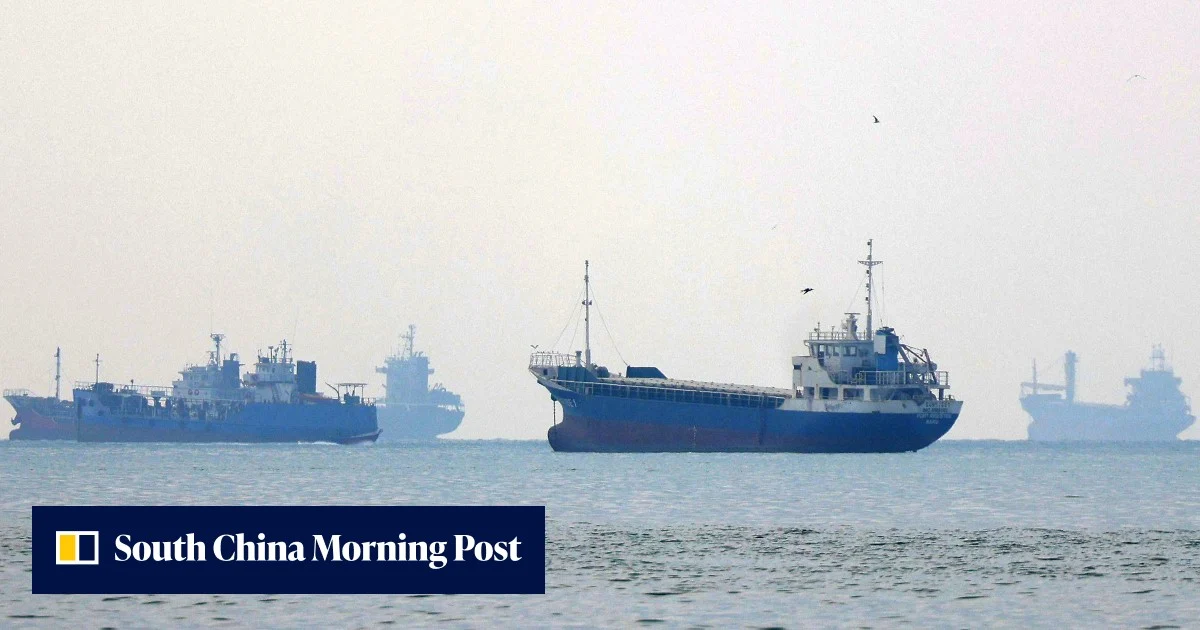
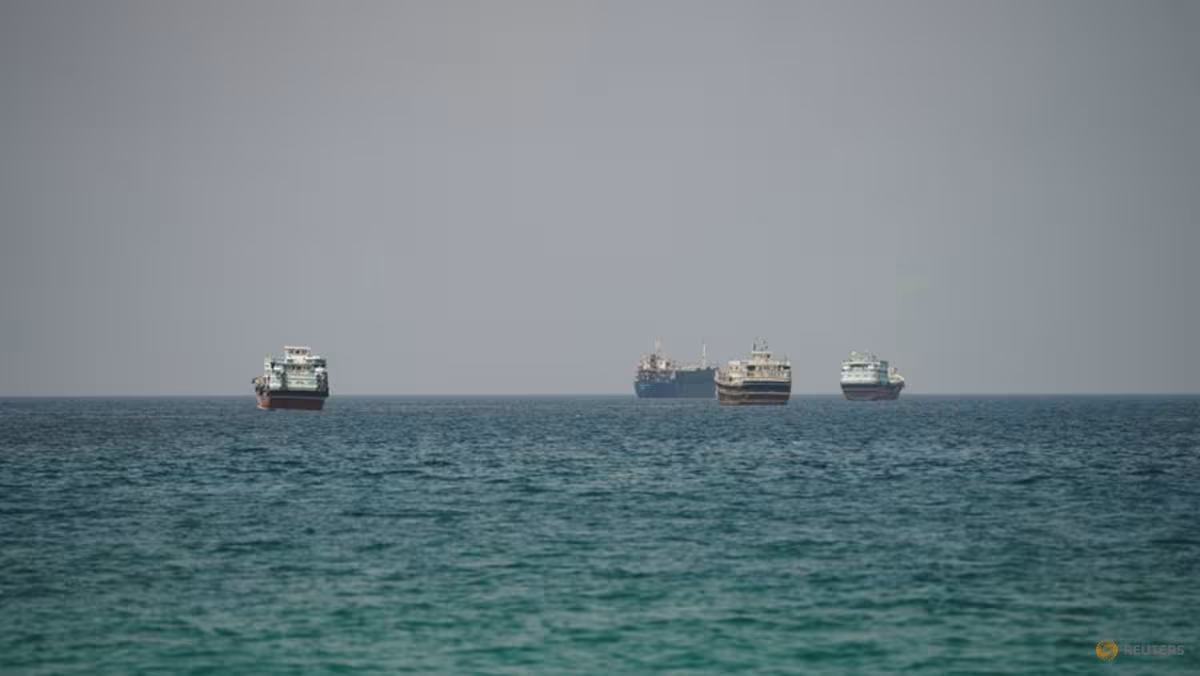
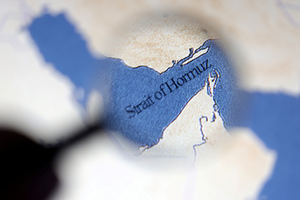
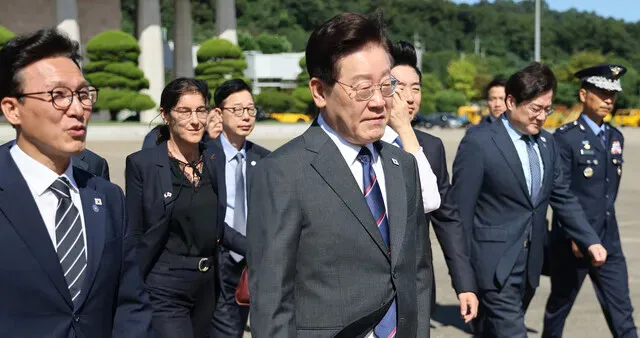
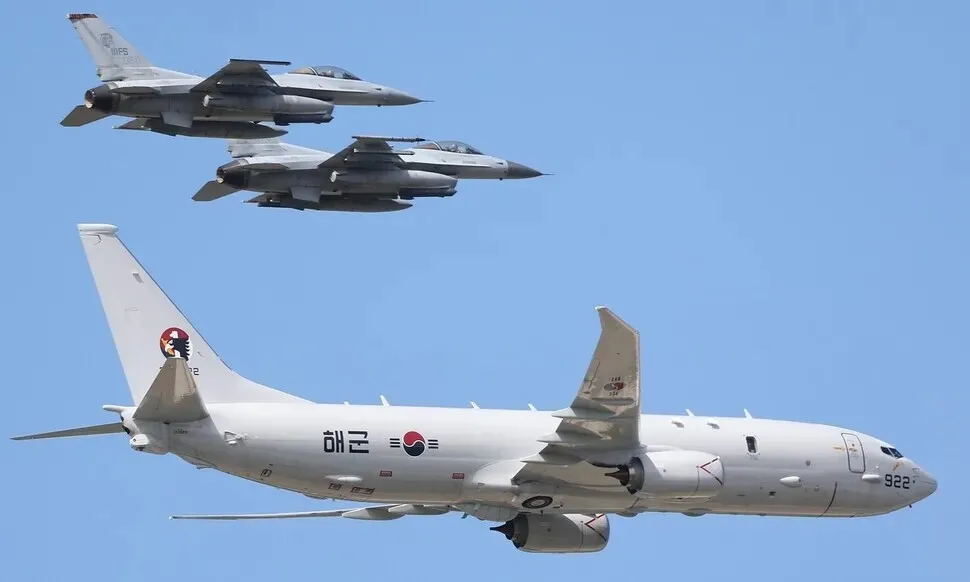
News broke on Tuesday that Korea’s Ministry of National Defense sent a team to assess the situation on the ground in the Strait of Hormuz, fueling speculation that Seoul may be leaning toward acceding to US demands for troop deployments.Current and former foreign affairs and security officials said that compared with past overseas deployments like those to Vietnam and Iraq, sending soldiers this time would be harder to justify and entail significantly greater risks. They warned that deploying troops would carry substantial military and political costs for the Lee administration.The ministry said it dispatched a fact-finding team to Hormuz but added that “nothing has been decided on troop deployment.” Though it clarified that the investigation “is not premised on actual troop deployment,” Seoul is believed to have proceeded with the operation with possible deployment in mind, given Washington’s persistent requests.Experts say US President Donald Trump’s unilateral use of social media to publicly pressure Korea to deploy troops goes against diplomatic conventions and common sense.“This is considerably different from how the US approached Korean troop deployment to Vietnam by the Park Chung-hee administration in the late 1960s and to Iraq by the Roh Moo-hyun administration in 2003,” said Kim Jong-dae, a military expert and former member of the National Assembly with the minor progressive Justice Party. “The US has had a long-standing diplomatic custom of keeping requests to Korea for troop deployment confidential in consideration of Korea’s sovereignty in decision-making,” he said. The Korean military has sent troops to United Nations peacekeeping operations and multinational forces, a method that provides justification for taking part in and contributing to global efforts while preserving credibility.A combined 466 Korean military personnel serve in peacekeeping operations, including the Dongmyeong Unit (185 members) in Lebanon and the Hanbit Unit (261) in South Sudan, while 270 are deployed to multinational forces like the Cheonghae Unit (257) near Somalia. In addition, the Akh Unit (141) in the United Arab Emirates is there under the pretext of “defense cooperation.”But chances are slim of a UN peacekeeping force or multinational coalition being formed for the war with Iran because the US and Israel unilaterally started the conflict, with Washington waging it on its own. Even major American allies such as Britain and France have hesitated to send warships in response to Trump’s call and just want the fighting to stop.