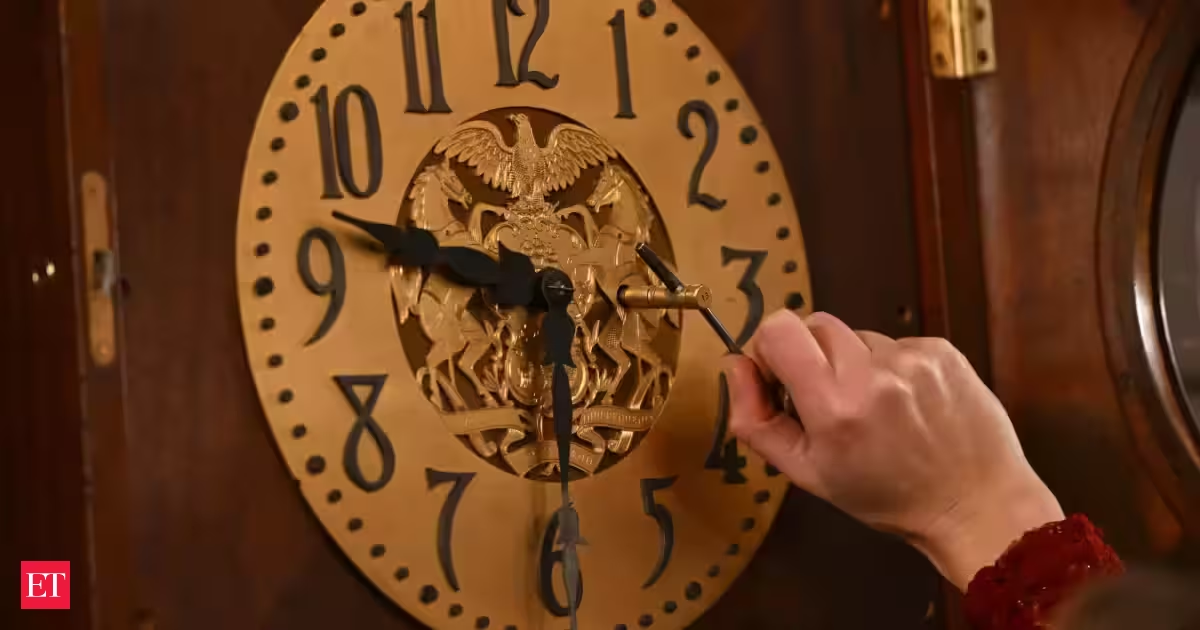
For decades, global time experts have mapped atomic clock time to the earth’s rotation, periodically adding a second (aka a leap second) as rotation slowed. But the planet’s rotation has now slightly sped up, which could mean that a negative adjustment will be required.
The problem is that computer systems have not been programmed to do that.
To avoid this issue, the General Conference on Weights and Measures (GCWM) in October will vote on a proposal to maintain the Coordinated Universal Time (UTC) as a continuous time from May 20, 2027, without adjustment via leap seconds, allowing UT1, the measure of time based on the earth’s rotation, and UTC to drift apart by up to one hour.
It pointed out, “a negative leap second has not previously been applied, and it is considered to pose a high risk of causing anomalies and disruption to critical infrastructures that are largely unprepared, and the preparation would create, for the industries that rely on time synchronization, a need for financial investment, whose amount is estimated to be similar to their preparations for the millennium bug.”
The group said that a 2025 workshop which included experts on Earth rotation estimated that the probability of a negative leap second will increase rapidly in the near future, reaching 30% by 2035. Acceptance of the proposal, it said, will ensure the long-term continuity for UTC for several centuries.