In brief
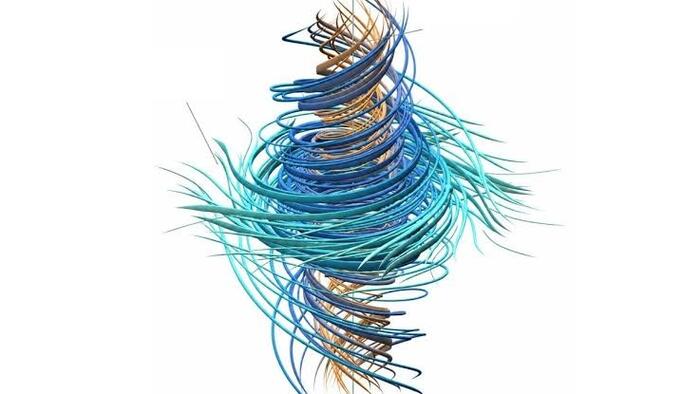
OpenAI said Tuesday its internal AI model produced a Lean-verified proof that the Navier-Stokes fluid equations can "blow up," using 10,000 coordinating AI agents over 88 hours.
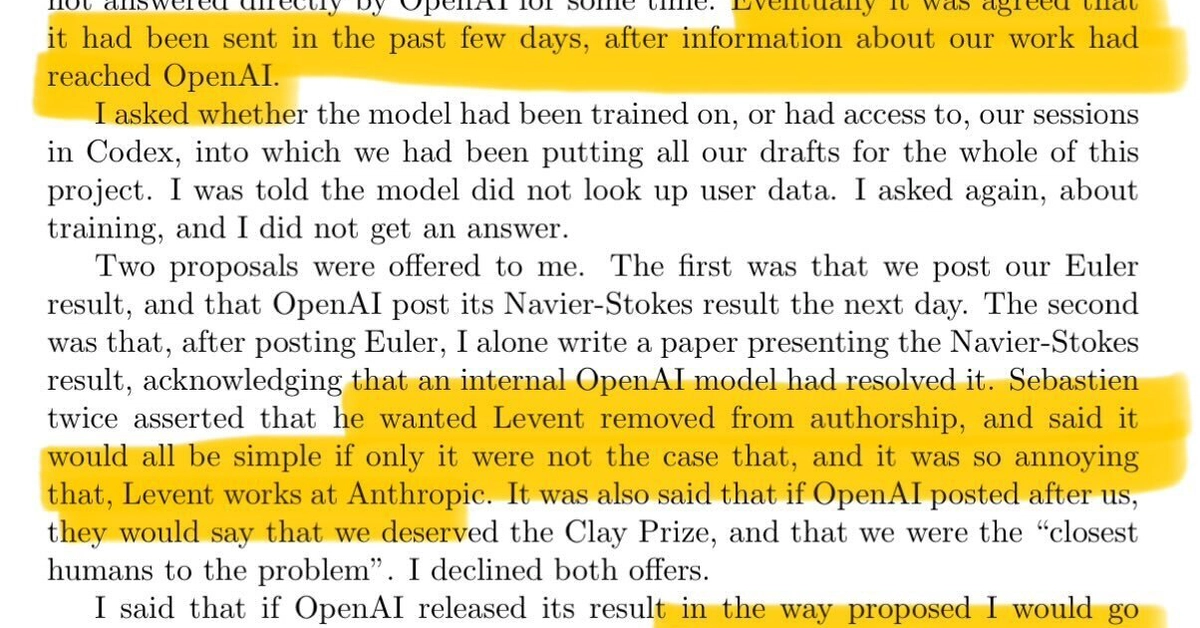
Hours earlier, NYU mathematician Tristan Buckmaster accused OpenAI's Sébastien Bubeck of learning about his and Anthropic researcher Levent Alpöge's unpublished, related proof and pressuring them over credit before the announcement.
OpenAI, Bubeck, and CEO Sam Altman deny the account; Bubeck posted texts he says prove he offered Buckmaster's team the option to publish first.
OpenAI said Tuesday its internal AI model just solved one of the biggest questions in math research—but the celebration was met with sharp criticism after claims surfaced from an NYU mathematician that the company played dirty.OpenAI said it proved the Navier-Stokes equations, which describe how fluids move, can "blow up"—a point where the math predicts infinite speed, which can't happen in nature.Myriad: Which companies will IPO before 2027? Click to make your prediction.It's one of seven Millennium Prize Problems, each worth $1 million from the Clay Mathematics Institute.OpenAI says the result took 88 hours and roughly 10,000 coordinating AI agents—copies of its models working the proof in parallel—checked with Lean, software that verifies a proof step by step.