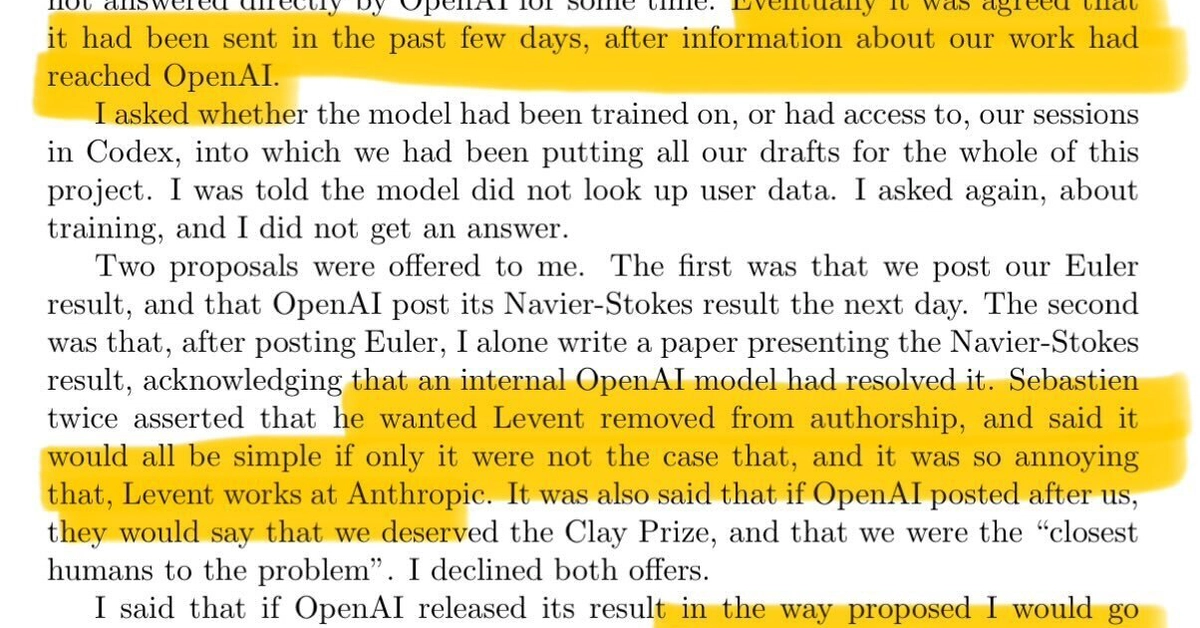
He said the real significance of this breakthrough is that a single mathematician working with AI can now do in weeks what once took years, a shift, he said, that will force the field of mathematics to rethink how it trains students, assigns credit and checks results.But the announcement has been overshadowed by a bitter dispute: Buckmaster says he and a colleague reached a closely related result first, and has accused OpenAI of chasing the problem only after learning of their work and then pressuring him over who gets the credit.What is the puzzle, and why it matters
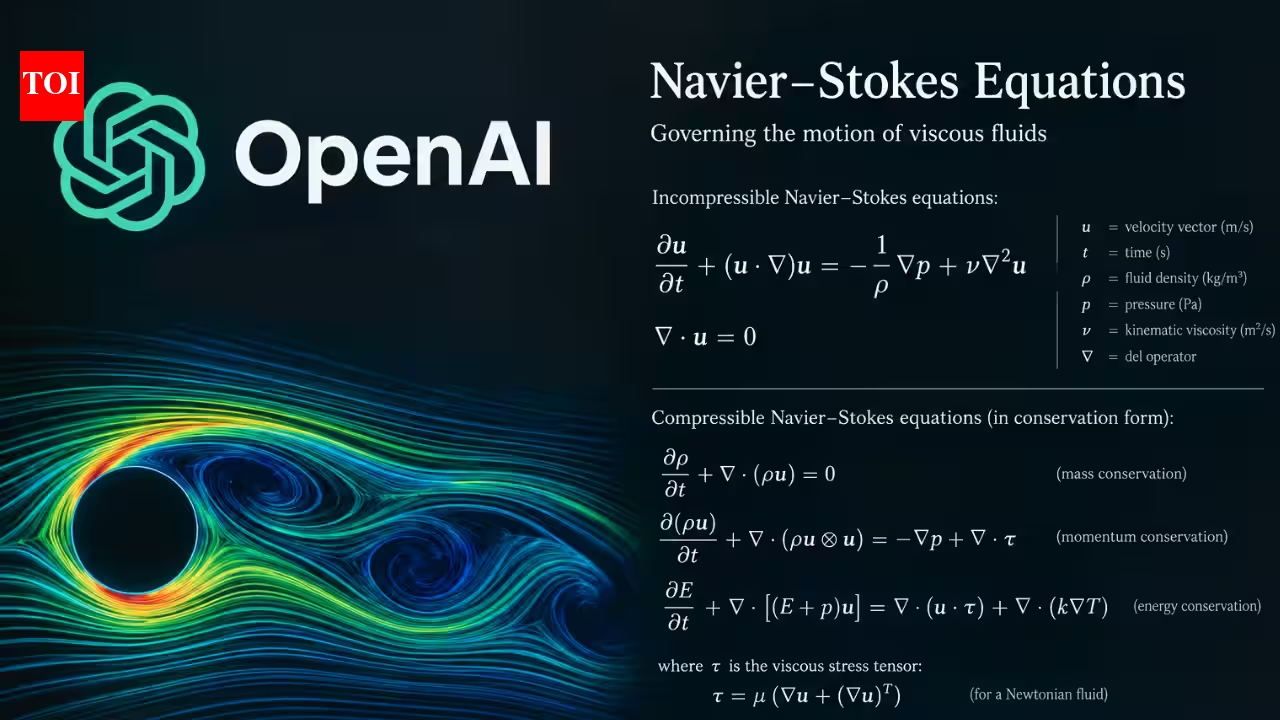
The problem is simple to state but has proved fiendishly hard to solve. The Navier-Stokes equations, written in the 19th century, are the rulebook for how fluids move, whether water, air or oil. Scientists and engineers rely on them every day to design aircraft and ships, forecast the weather, model ocean currents and simulate blood moving through arteries. When a computer predicts how air will flow over a wing, it is solving these equations.The unsolved question is about how far that rulebook can be trusted. If a fluid starts out in a smooth, calm state, will the equations always keep producing sensible, finite answers no matter how long the fluid keeps moving? Or can they, at some moment, produce what mathematicians call a “blowup”, a point where the calculation says the fluid’s speed becomes infinite?Real water in a real pipe never reaches infinite speed. If the equations throw up infinity, it means the equations themselves have broken down and stopped describing reality at that moment. The question is not whether a tap will suddenly explode, but whether the mathematics that sits underneath vast areas of science and engineering is sound, or whether it hides points where it fails.These equations underpin weather and climate models, aircraft and engine design, and the study of turbulence, one of the oldest unsolved puzzles in physics. Knowing whether they can break down, and under what conditions, would tell scientists where their most important tool can be relied on and where it cannot. Settling the question either way has long been seen as one of the deepest challenges in mathematics, which is why the Clay Institute announced a $1-million prize for it.What OpenAI announced