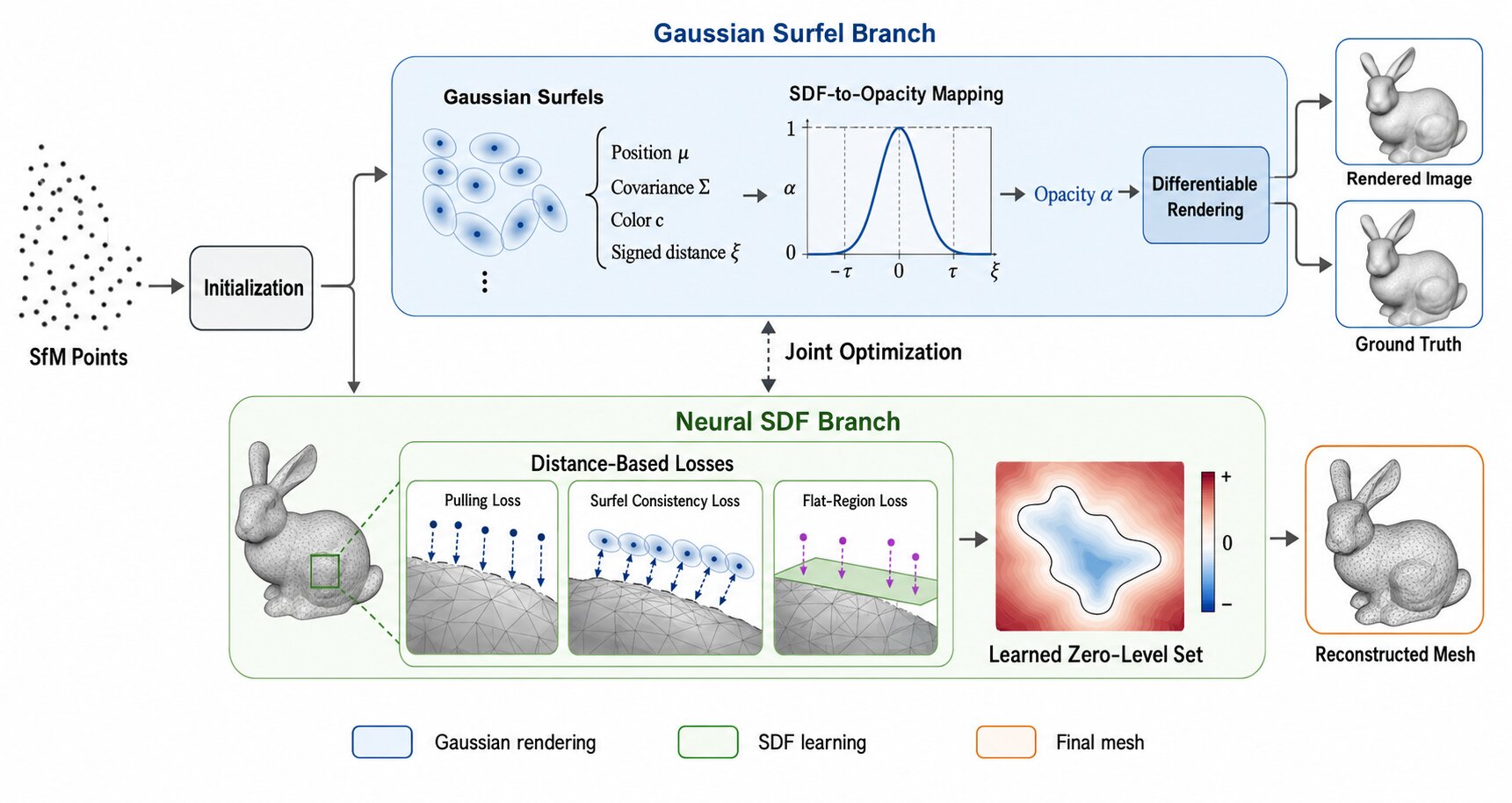
The figure presents GauSDF's two jointly optimized components: a Gaussian surfel branch for SDF-guided opacity and differentiable rendering, and a neural SDF branch using three distance-based losses to learn the zero-level set and reconstruct the final mesh. Credit: Sejong University
Reconstructing a three-dimensional object or environment from multiple photographs is a central problem in computer vision. The resulting models support applications such as robotics, augmented and virtual reality, digital twins, and cultural heritage preservation. An effective reconstruction system must represent both the visual appearance of a scene and the geometry of its surfaces. Achieving these goals simultaneously, however, remains challenging.
Recent methods based on 3D Gaussian Splatting (GS) can render complex scenes in real time by representing them as collections of Gaussian primitives. These primitives can be optimized efficiently to reproduce the colors and appearances observed in input photographs.
Although this approach produces high-quality images from new viewpoints, it often prioritizes visual appearance over geometric accuracy. Reconstructed surfaces may contain blurred boundaries, floating artifacts, incomplete regions, or distortions around thin and sharply defined structures.