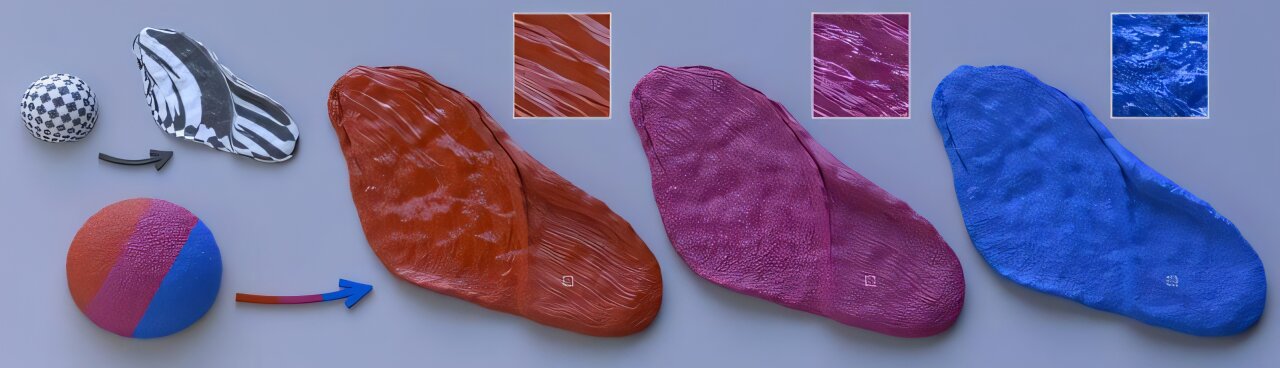
Extremely deformable surfaces: realistic and cheap to compute. Credit: Kalinov et al., ACM Transactions on Graphics
Researchers from the Institute of Science and Technology Austria (ISTA) presented two papers at SIGGRAPH in Los Angeles. One paper introduces new methods for texturing highly deformable surfaces, and the other proposes a faster, more precise way to compute geometric properties of shapes. Both show how to boost graphics accuracy while cutting computational cost, with potential applications across video gaming, visual effects and simulation. The studies have been published in ACM Transactions on Graphics.
Representing extremely deformable surfaces
To create realistic movies, producers often use 3D modeling to build reusable digital representations of objects. The artistic challenge is to make these digital models look lifelike. In animated models, objects without a distinct shape at rest are particularly challenging to represent.
Doctoral student and first author Aleksei Kalinov and colleagues from Chris Wojtan's group at the Institute of Science and Technology Austria (ISTA) sought to represent extremely deformable surfaces more realistically while cutting computational costs. To do so, they took inspiration from nature.