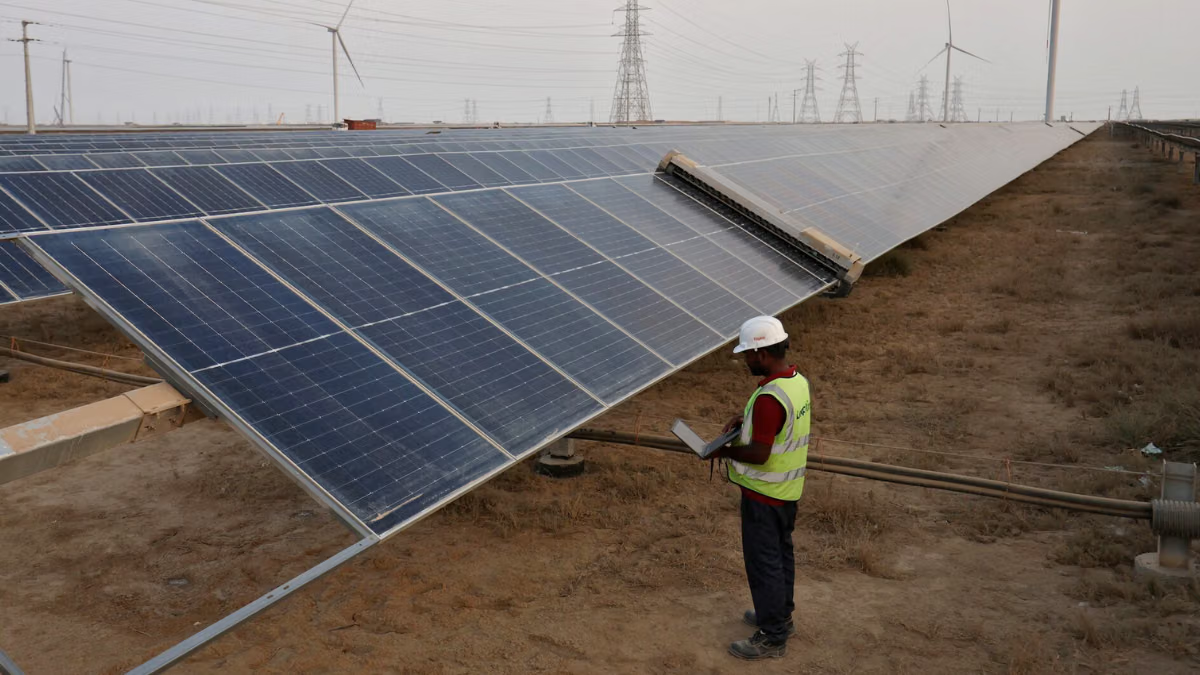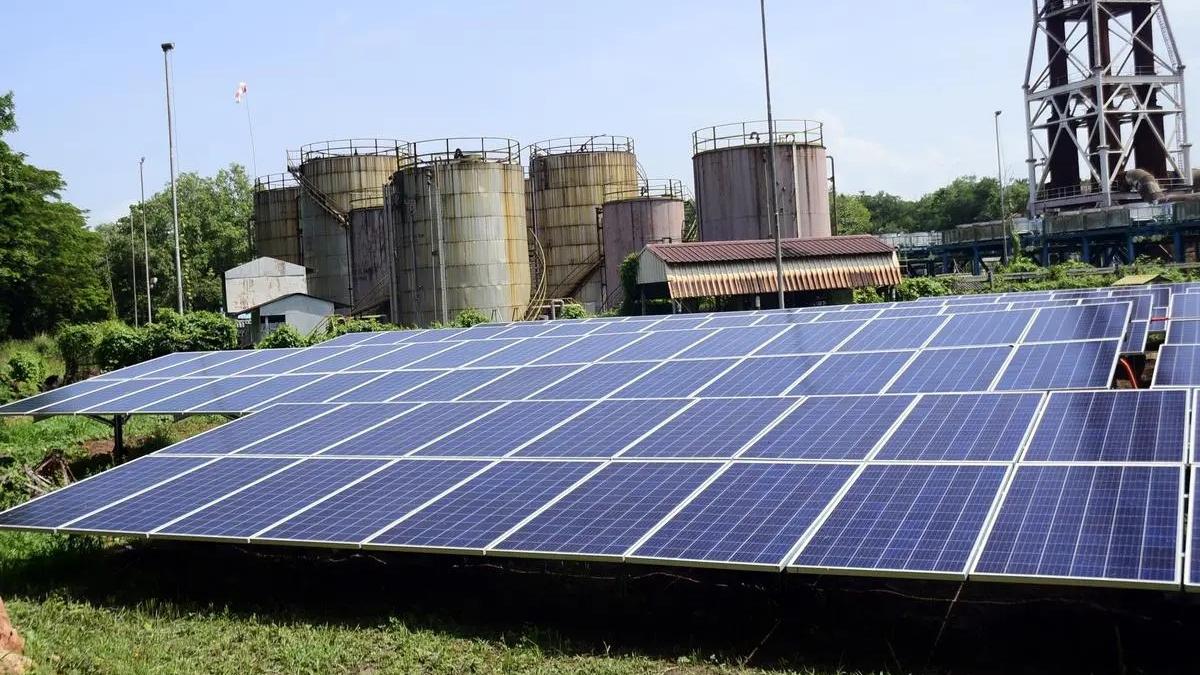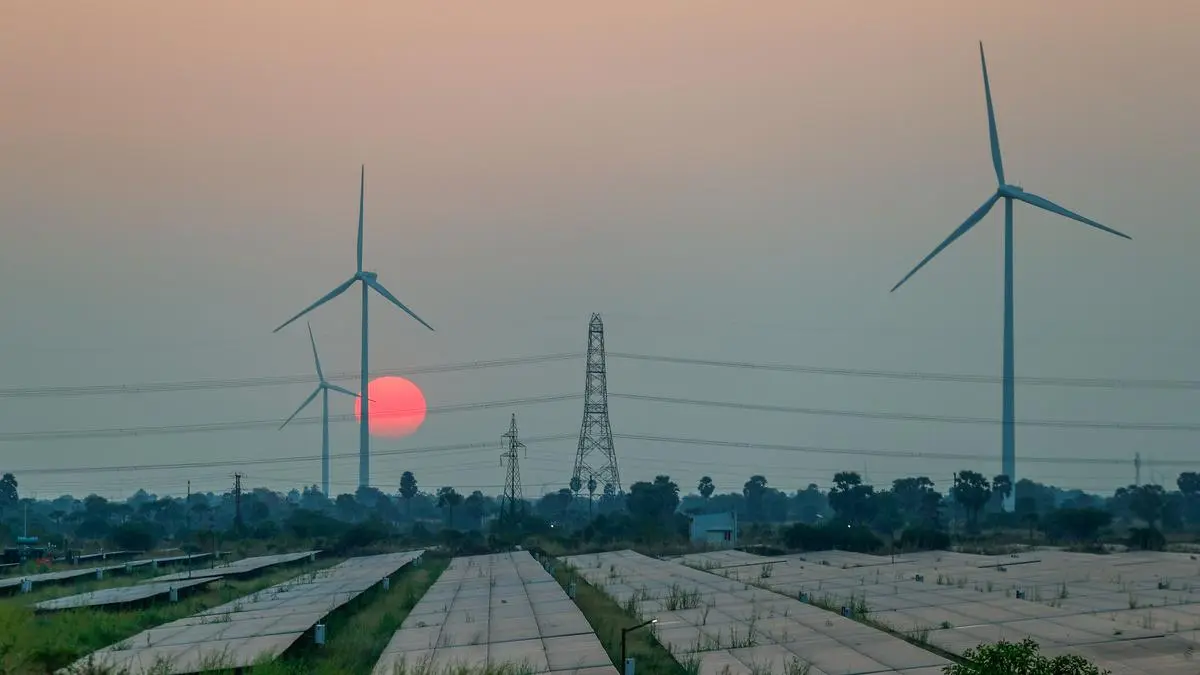
New and Renewable Energy Minister Pralhad Joshi never misses an opportunity to dilate on how great things are with the country’s renewable energy industry — even though statistics show otherwise.As at end of July, solar installations stood at 164 GW, wind at 58 GW, and total renewable energy capacity at 240 GW. Last year, solar and wind saw record capacity additions, at 45 GW and 6 GW, respectively.We learn from the Central Electricity Authority that 151 GW of solar, wind and hybrid capacities are at various stages of construction.Solar manufacturing capacity expansion, meanwhile, seems to be at a frenetic pace, with an estimated ₹1 lakh crore of announced investments.But scratch the surface and a very different picture emerges.What is being commissioned today is largely the result of decisions taken 12–24 months ago. Current tendering provides a better indication of tomorrow’s utility-scale demand. And here the numbers are disquieting.Large-scale solar tenders fell from around 79.5 GW in 2024 to 44 GW in 2025. In the first two quarters of 2026, tender volumes were only 5.7 GW and 5.4 GW, respectively. Thus, while installations are breaking records, the pipeline feeding future installations appears to be thinning.As for wind, India added 1.35 GW in the first quarter of this financial year — 18 per cent less than the 1.64 GW added in the same period last year. And 58 GW of installed capacity means that the country would need to add another 48 GW in the next four and a half years to meet its 2030 target — or about 10 GW a year.But ‘right of way’ issues, mostly due to extortionate demands by vested interests, are hampering fresh capacity additions.Solar manufacturingIndia has solar module manufacturing capacity of about 210 GW. Though the effective operating capacity is much lower — perhaps about half of the nameplate capacity — it is still far higher than annual demand.Even if solar installations this year reach 60 GW, domestic manufacturers cannot assume that all of this will translate into demand for their modules. Projects outside the domestic-content requirement can buy cheaper imported modules, while the effective domestic market remains far smaller than the industry’s 200-plus GW nameplate capacity.A recent paper produced by industry expert and RERTC Infra Director Bhupesh Trivedi estimates that annual solar additions may settle in the 30–40 GW range during 2027–30. Even allowing for the fact that module requirements exceed AC capacity additions, the arithmetic is uncomfortable: at 250 GW of manufacturing capacity, utilisation could fall to just 14–22 per cent.The situation in the case of cell manufacturing capacity is more complex. Cell capacity is about 32 GW, with effective operating capacity estimated at 16–18 GW. In June, Reuters reported that roughly one-third of small and medium module manufacturers had halted production, with domestic cell shortages and lead times of up to eight months. Given the announced manufacturing plans, cell capacity will go up. But the plans could again take total capacity well beyond demand, as in the case of modules.The irony is that while module manufacturing capacity threatens to outrun demand, domestic cell shortages are simultaneously raising costs. Rating agency ICRA has cautioned that the combined effect of domestic cell sourcing, rupee depreciation and higher commodity prices could raise the cost of utility-scale solar projects by 20–25 per cent in the near term, putting further pressure on the economics of newly awarded projects.The obvious hope is that exports will absorb the surplus. But that escape is far from assured. The US has been the principal market for Indian solar exports, yet tariff and trade remedy uncertainties have made dependence on that market increasingly risky. Europe has its own manufacturing and traceability priorities, while other markets are intensely price-sensitive. Indian manufacturers cannot simply assume that the rest of the world will absorb whatever they produce.And then comes, perhaps, the most serious problem of all: the grid.Curtailment woesIndia may build renewable generation faster than it can move the electricity to consumers. Nearly 11 GW of wind and solar capacity in Rajasthan and Gujarat has reportedly faced extremely high curtailment in some circumstances.Nationally, 8.13 billion units of solar generation was reportedly withheld during April-June 2026, against actual solar generation of 57.4 BU. The curtailed energy was equivalent to about 14 per cent of actual solar generation during the quarter, or about 12.4 per cent of potential generation, if the curtailed output is added to what was actually generated.But curtailment is not uniformly spread across the country — it happens in pockets.For developers caught in these pockets, curtailment is not a national statistic but a direct blow to project economics. CleanMax Solar said in a recent investor call that it is likely to bear a loss of ₹170 crore due to curtailment at one of its Rajasthan projects.And there are the capacities waiting to be connected. According to one estimate, about 60 GW of renewable capacity in Rajasthan awaits transmission connectivity.Transmission capacity additions are falling short. Going by the CEA’s resource adequacy plans, the country needs to set up 25,000 circuit-km of transmission lines annually between now and 2032. In the last three years — 2023-24 to 2025-26 — the additions were 14,200 ckm, 8,800 ckm and 12,100 ckm, respectively. Transformation capacity additions are similarly well below requirement.One way of extracting more value from the existing grid is through market mechanisms such as time-of-day tariffs and demand response — for which smart meters are essential. Against the target of installing 20.33 crore smart meters by the revised deadline of March 2028, only 5.73 crore had been installed.India’s renewable energy industry is, therefore, facing an unusual moment: record installations alongside weakening forward fundamentals; spectacular manufacturing expansion alongside the prospect of factory underutilisation; abundant generating capacity alongside an inability to evacuate power; and ambitious storage tenders whose commercial viability is yet to be fully demonstrated.Published on August 31, 2026
There’s a lot wrong in Indian RE sector
India's renewable energy sector faces significant challenges with capacity underutilization, manufacturing surplus, and grid curtailment despite record installations.
970 words~4 min read