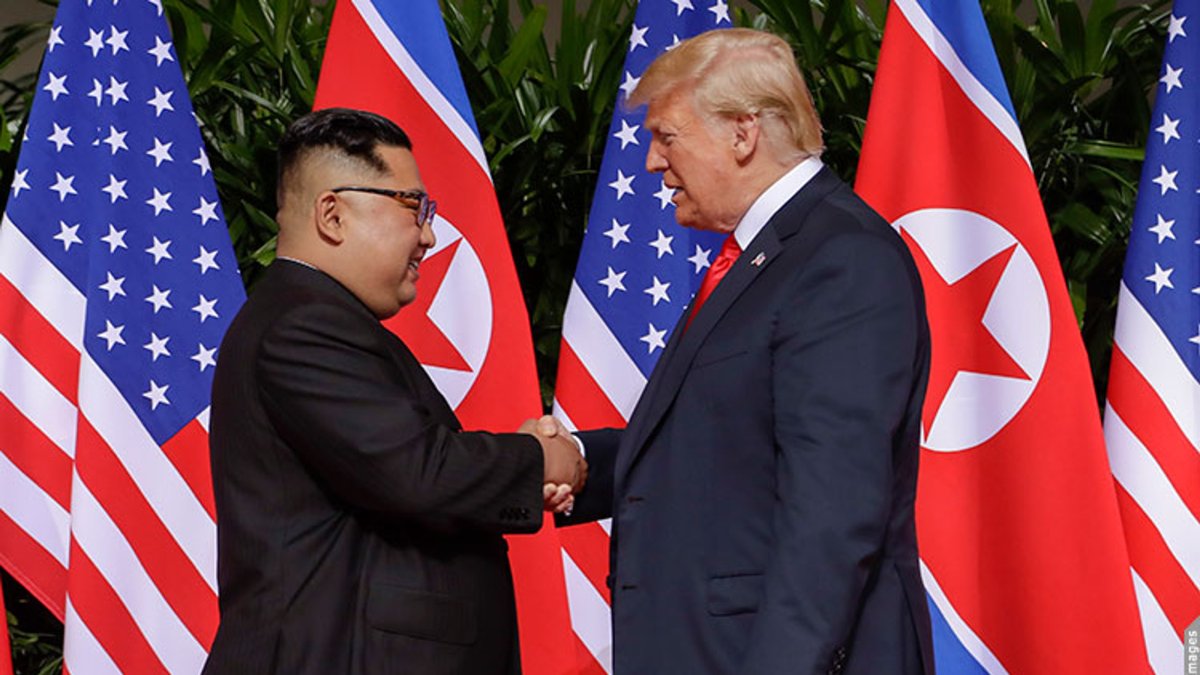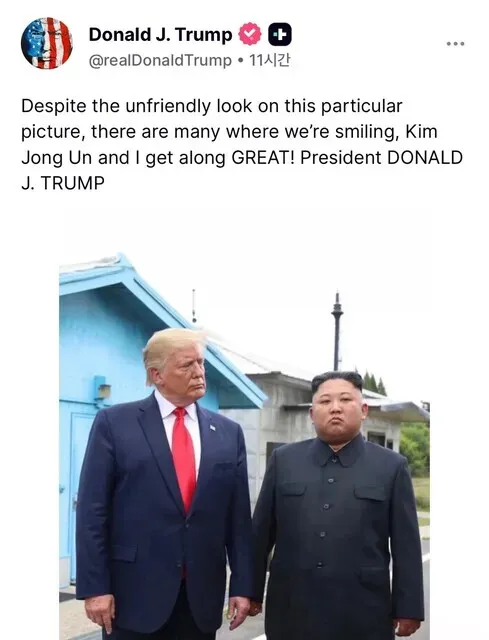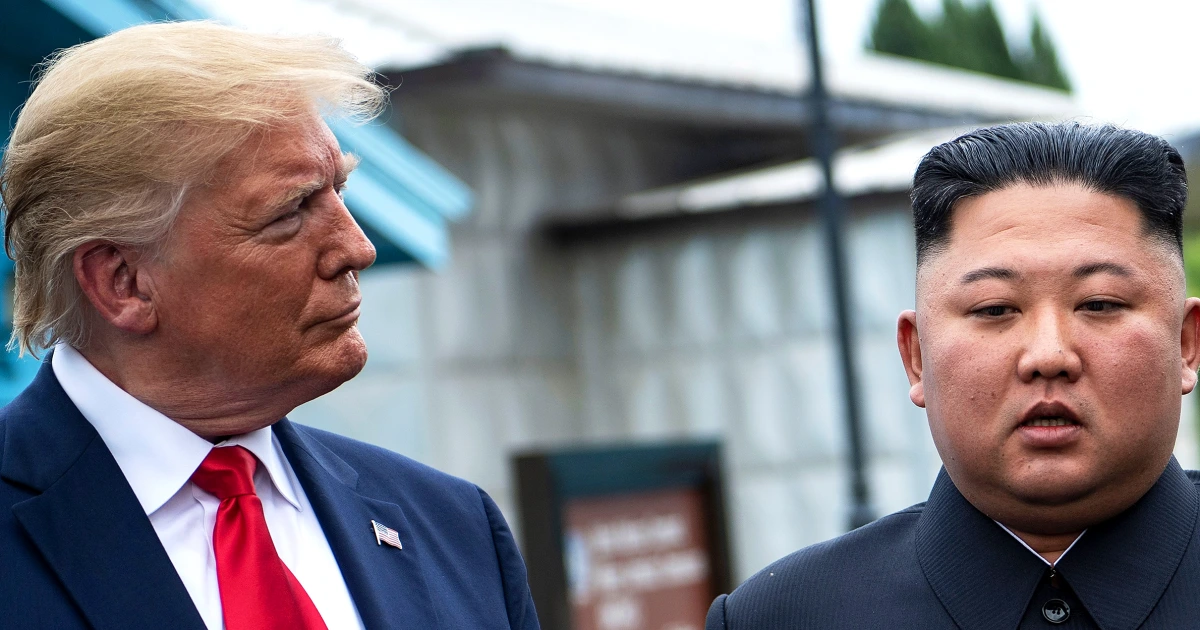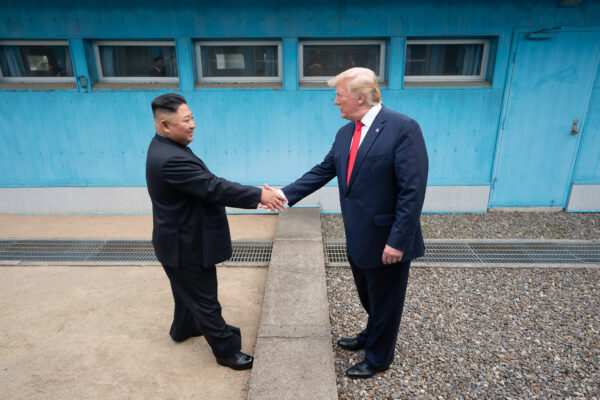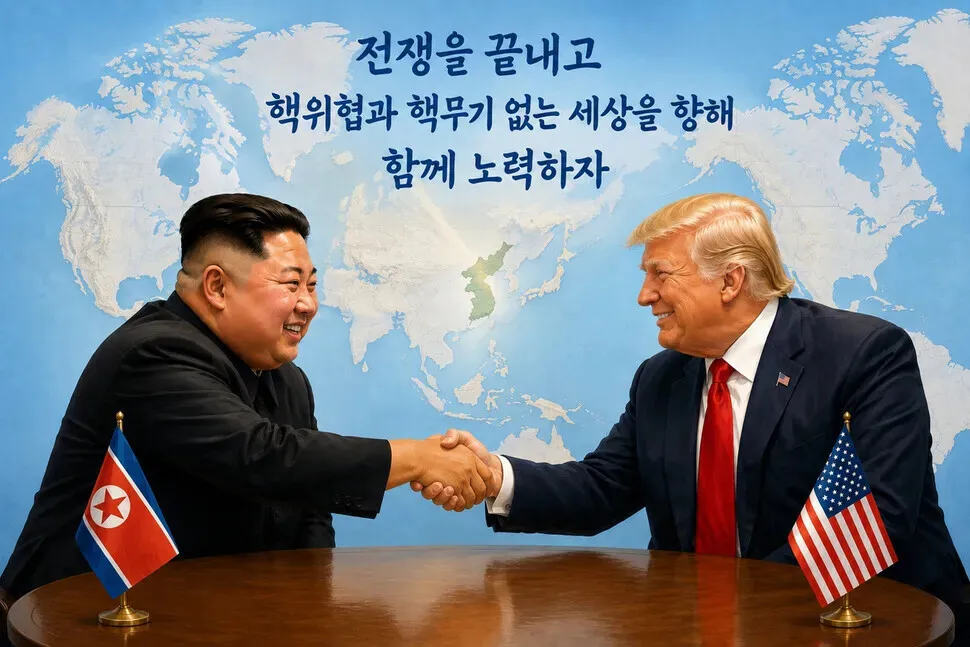
Image generated by ChatGPT. The Korean reads: “Let’s end the war and endeavor to build a world free from nuclear threats and nuclear weapons.”
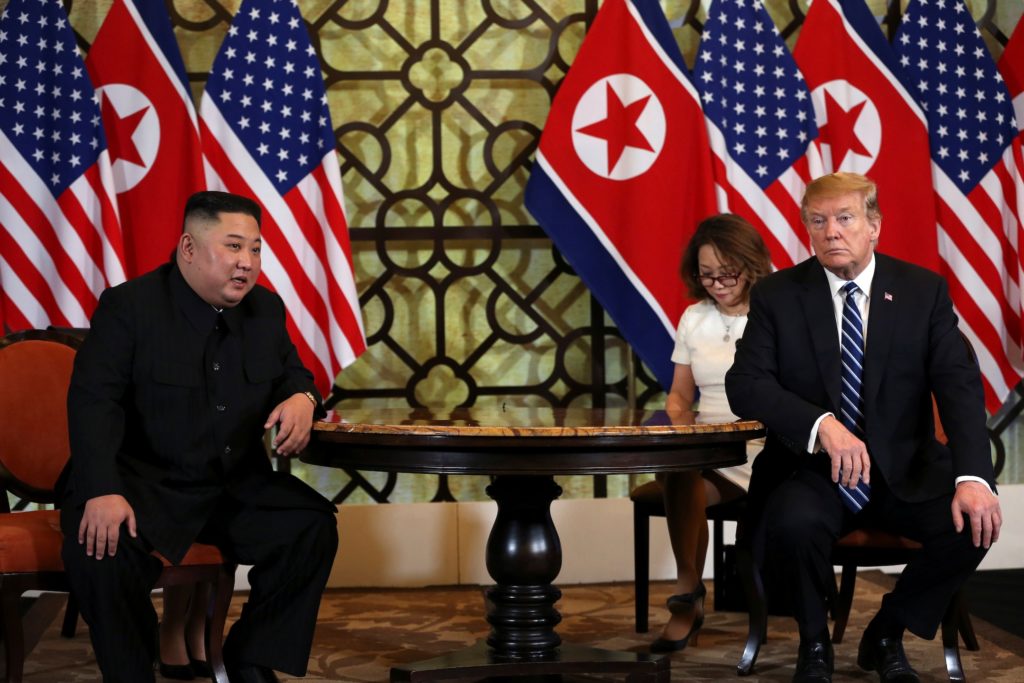
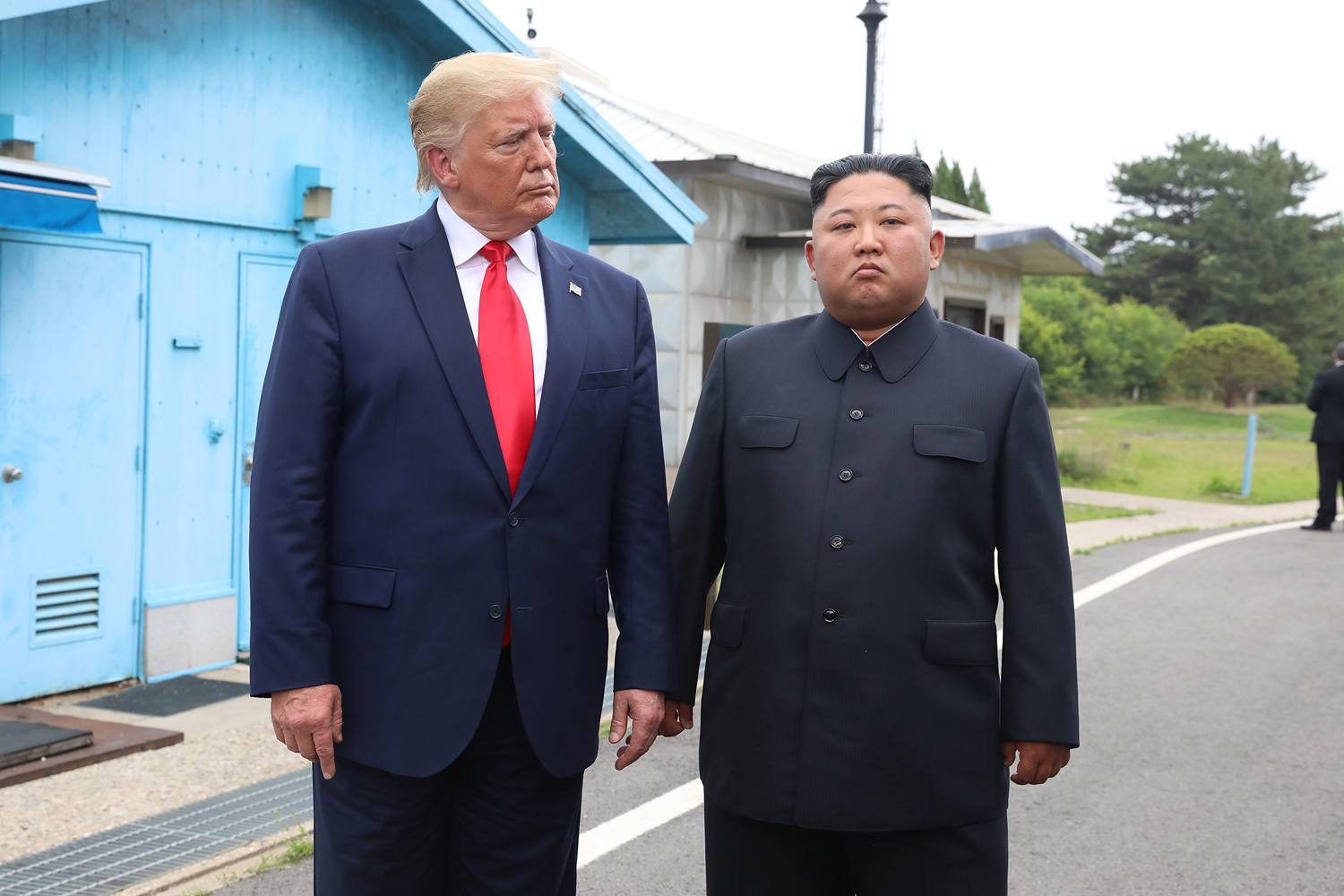
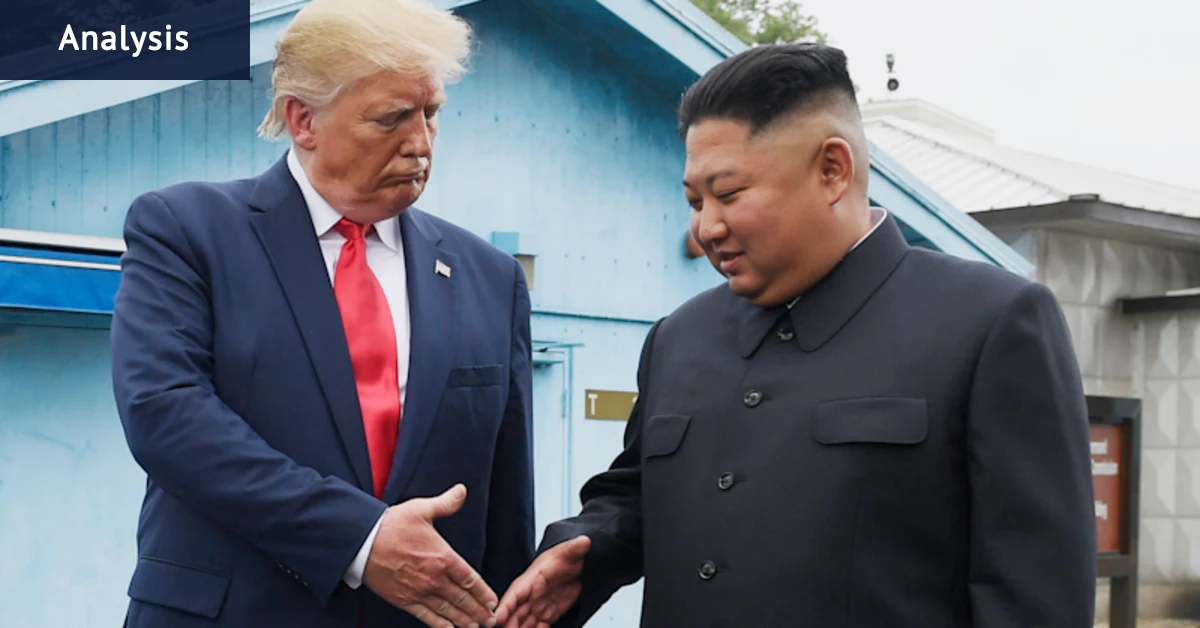
Will US President Donald Trump realize his dream of meeting DPRK leader Kim Jong-un before the end of the year? It’s too early to tell. In either case, however, we should give some thought to the possible outcomes of a meeting between the two leaders. We all know that there is little to be gained from pondering what might have been. However, speculating about future events matters because our projections about the future can have a profound impact on the choices we make in the present. When the two leaders held three meetings in 2018 and 2019, there was an undeniable pecking order in the relationship. Now, in 2026, Kim believes that he has formidable leverage of his own and expects to be treated with the same level of respect as the US. It would not be an exaggeration to say that Kim has earned this position through his deepening engagement with Russian President Vladimir Putin and Chinese President Xi Jinping. Russia has basically acknowledged the DPRK as a nuclear power, and China has decided to turn a blind eye. Now, it is time for it to go after the US. However, the DPRK is currently reckoning with two distinct Americas. One America is symbolized by its hostile policy against the DPRK, while the other America is evident in the figure of Trump, who has a “good relationship” with Kim. During Trump’s first term in office, Kim’s regime was incapable of differentiating between the two. Kim believed that his rapport with Trump would have enough magical power to shift hostile bilateral relations. Having been burned by misplaced trust in the past, the DPRK is now determined to draw a clear distinction between the two Americas. It is also making clear to Trump that he must prioritize the removal of hostile US policies toward the DPRK if he wants another meeting with Kim.The hostile policies the DPRK refers to encompass the US’ joint military exercises with South Korea (and Japan), the deployment of strategic assets to the peninsula, sanctions, refusal to sign a peace treaty or to establish diplomatic relations, and the insistence on the DPRK’s denuclearization. However, the DPRK’s calculus has changed significantly, making it impossible to lump all those issues together. The joint military drills have always been among the hostile US practices singled out by the DPRK. Previously, denuclearization was not included in the list but has since become an important issue as the DPRK pursues its goal of becoming an “irreversible” nuclear state. As such, it regards pressure for its denuclearization as a prime example of hostile policy and demands that it be abandoned. The new DPRK no longer mentions sanctions, the signing of a peace treaty, or the establishment of diplomatic relations with the US — all of which were urgent issues touted by the “old” the DPRK. Wary that voicing those unspoken wishes could invite demands for denuclearization, the DPRK has chosen to keep them to itself.So how does this new dynamic affect Trump? He set the process in motion in mid-August by ordering that US-Korea joint military drills be reduced drastically, claiming that the DPRK is “unthreatening and respectful.” Trump also commented on how he is “not happy with the fact” that the US is participating in joint military exercises targeting the DPRK. By making these comments, Trump is attempting to curry favor with the DPRK to secure a summit. If Trump does meet Kim, what will happen to Korea and the US’ joint military exercises? At the very least, Trump will likely promise that large-scale joint military drills will not take place as long as he is president.If this happens, it will complicate the return of wartime operational control (OPCON) to Korea. The return of OPCON depends on the Korean military’s capabilities, which were to be verified through these joint drills. We could say that this is the first challenge we must face if the DPRK and the US hold a bilateral summit. What about the more important issue of denuclearization? When asked on Aug. 19 if the goal of US-DPRK dialogue was the pursuit of denuclearization, Trump deflected by saying, “I don’t want to talk about that.” He added that he had a “very good relationship” with Kim, and that getting along with a country that possesses “57 very powerful nuclear weapons” is a “good thing.” From Pyongyang’s perspective, Washington may have lowered the volume, but it has not changed the message: the demand for denuclearization remains. Until that demand is taken off the table, the DPRK is unlikely to believe that the US has truly abandoned its old approach. However, Trump has previously mentioned a bigger vision: countries with large nuclear arsenals — the US, Russia, China and others — should take the lead in nuclear disarmament before bringing the DPRK on board. This suggests the possibility that, if a US-DPRK summit takes place, the two countries may issue an agreement along the lines of, “The two nations have agreed to work together toward a world free of nuclear threats and weapons.” Sanctions against the DPRK could be eased, provided that it agrees to stop building its nuclear arsenal and halts the testing and development of intercontinental ballistic missiles. How should Seoul come to terms with such developments? There is yet another problem we ought to focus on. For years, the easing of sanctions, the signing of a peace treaty, and the establishment of diplomatic relations between the DPRK and the US were understood as concessions Washington would offer in return for Pyongyang's pursuit of denuclearization.That equation made sense largely because Pyongyang itself strongly desired these outcomes. But the new DPRK no longer appears to place the same emphasis on them. At the same time, Trump does not seem to view these measures as “compensation” to be offered to North Korea, but rather as steps that could serve US interests as well. If the two leaders meet for a summit, Trump may be the first to bring up these issues. Out of all those issues, it is highly likely that Trump will mention ending the Korean War and establishing a peace regime. In the US-South Korea summit held on Oct. 29, 2025, Trump commented that he knew that the Korean Peninsula was “officially at war,” and that he would “work very hard with Kim Jong-un and with everybody on getting things straightened out.”Since then, we could say that Trump’s motivation to achieve that goal has strengthened. The protracted Russia-Ukraine war, which he confidently boasted would end quickly, the chaos surrounding the US-Israel-Iran conflict, which never should have happened, and the confusion in initiating peace in the Gaza Strip have converged, leading him to believe that he needs to bring the Korean War, the longest war in US history, to an end. If denuclearization becomes an issue that recedes to the background and bringing about peace takes center stage, how should South Korea react? Of course, events may unfold in a way that bears little resemblance to the scenario outlined above. But that possibility is no reason to neglect the need to prepare for it. As I detailed in my book, “The Cost-effectiveness of Self-reliant National Defense,” the most beneficial course of action is to prioritize efforts to establish a peace regime. As we have already met most of the conditions for the return of OPCON, we must now shift our focus to create the environment necessary for its return by building a system of peace. Instead of fixating on whether we have met the conditions, we should prioritize “when” OPCON will be returned to us. We must bring a plan to handle denuclearization silently and place the DPRK nuclear issue within the context of establishing a peace regime and achieving global nuclear disarmament. This approach will likely increase the likelihood of a US-DPRK summit while reducing the risk of South Korea being left on the sidelines.By Cheong Wook-sik, director of the Hankyoreh Peace Institute and director of the Peace NetworkPlease direct questions or comments to [english@hani.co.kr]