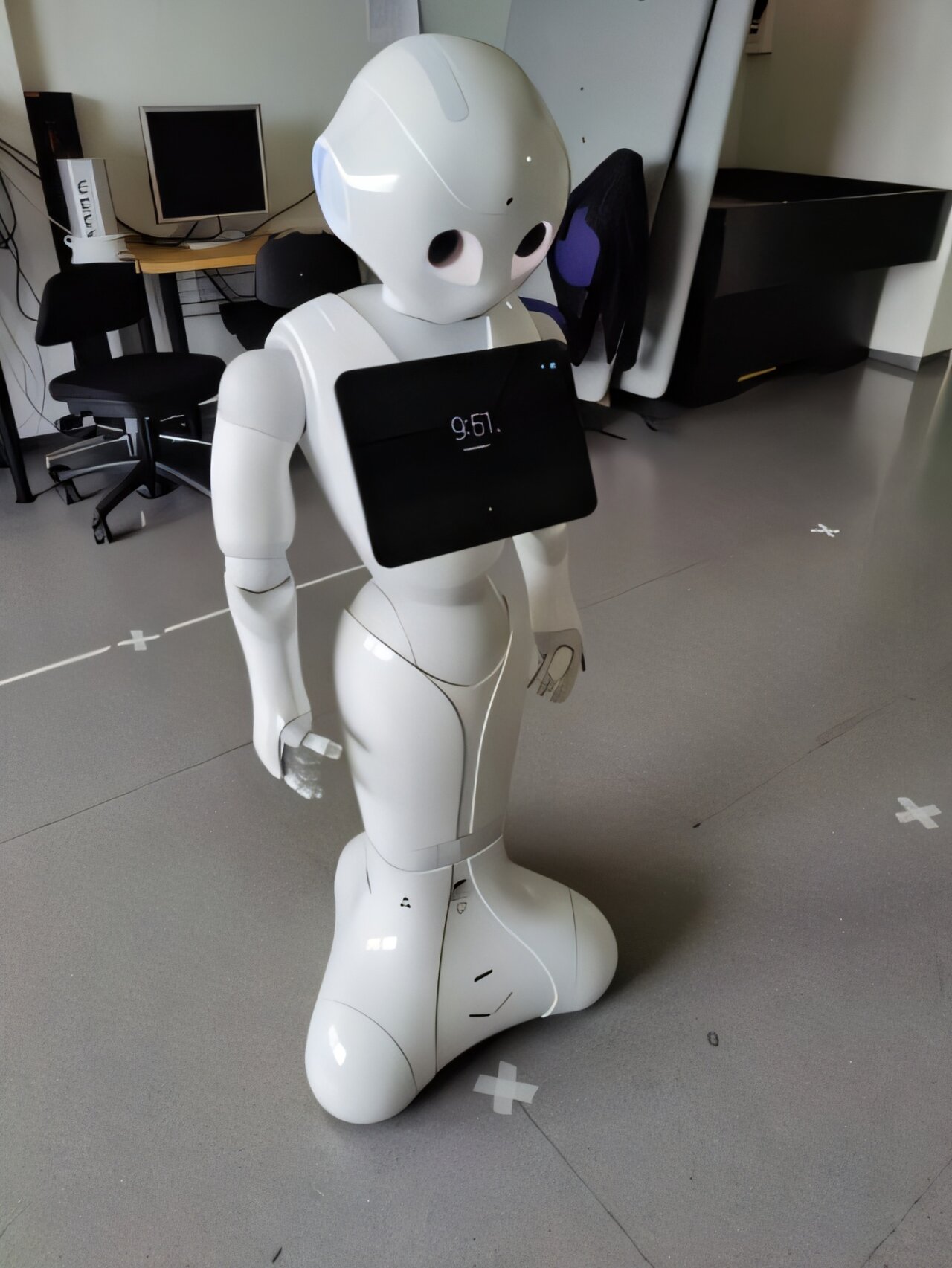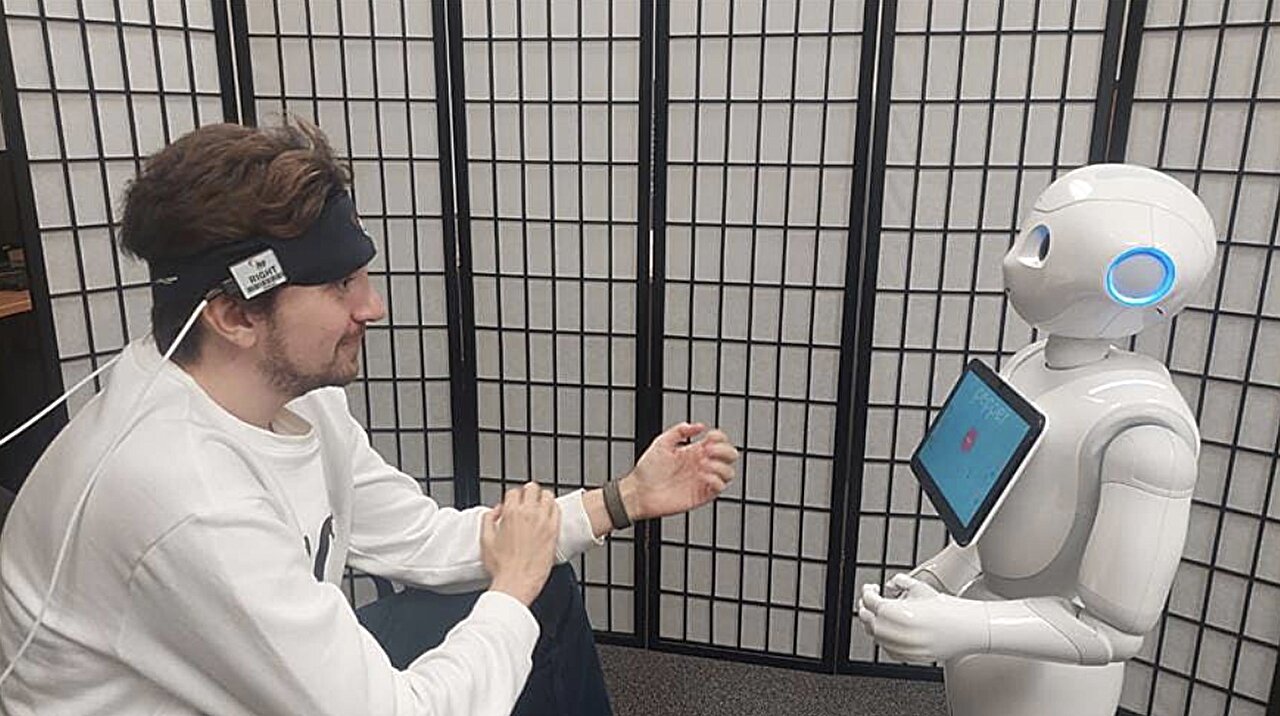
One of the study participants interacting with the semi-humanoid Pepper robot. Credit: Drexel University.
For robots to be successfully deployed in real-world environments, humans should trust them enough to cooperate with them. Some roboticists have been trying to determine whether users perceive robots that exhibit socially expressive behaviors, such as gestures, eye contact and nodding, as more trustworthy.
Researchers at Drexel University recently carried out a study investigating how people's trust in humanoid robots (i.e., robots with a human-like body shape) is influenced by whether they remain stationary or perform socially expressive movements. Their findings, published in Science Robotics, suggest that socially expressive movements can elicit stronger engagement in some brain regions, but they could also make a robot's mistakes particularly damaging to users' trust.
"Robots are moving out of factories and into homes, clinics, classrooms, and service settings, and the central question for that transition is not whether a robot can perform a task but whether people will trust it enough to work with it," Hasan Ayaz, senior author of the paper, told Tech Xplore.
"The difficulty is that trust research in human-robot interaction has typically measured one thing at a time: a questionnaire, or a behavioral choice, or occasionally a brain signal. Trust is not a single quantity that any one of those captures. It is a process that unfolds simultaneously in the brain, in the body, in what people say they feel, and in what they actually do, and those levels do not always agree with one another."