Skip to content
Giving machines the ability to communicate nonverbally has real value, and [Drew Smith] clearly thinks your robot deserves better than an emoji. He shared a very interesting approach with his project Kindalive.
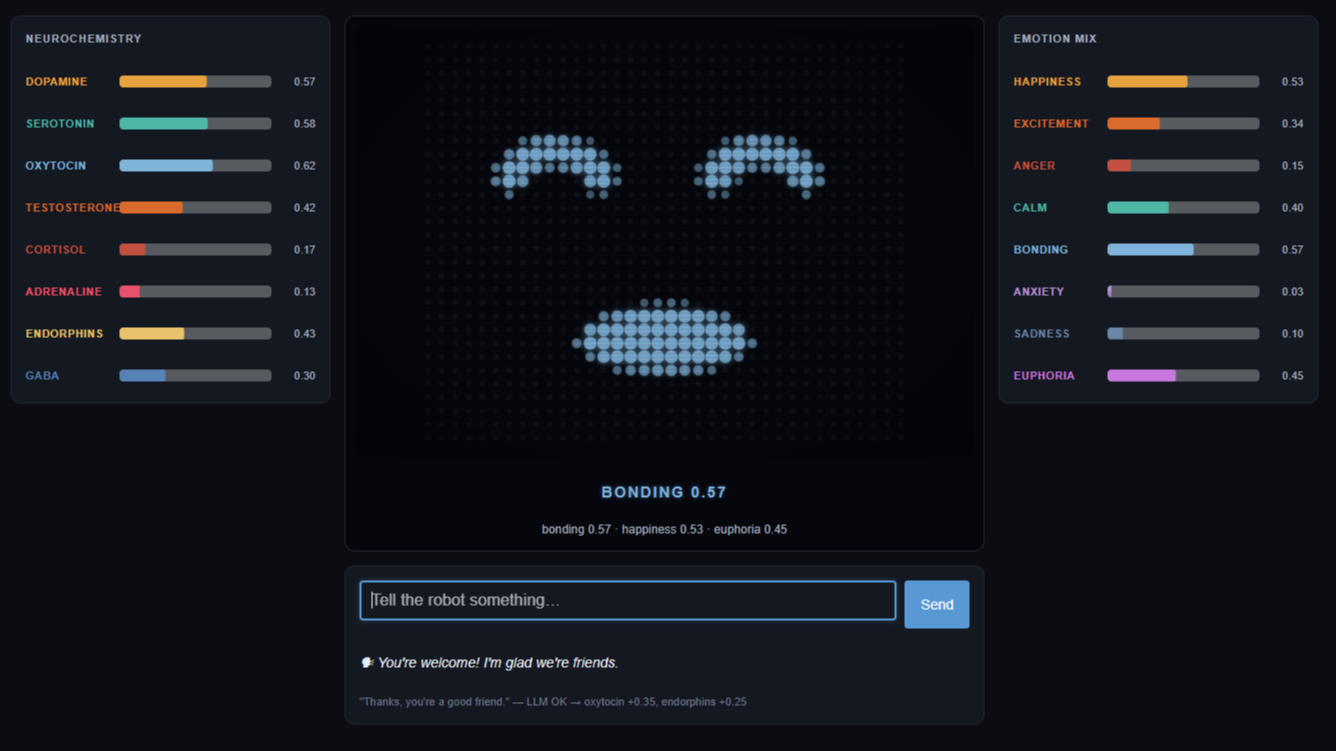
Kindalive is a simulated dot-matrix robot face that responds believably to input text, modeling and expressing both short-term and long-term moods. It’s pure Python and modular enough to invite using it elsewhere, but that’s not the really interesting part.
What sets [Drew]’s project apart is the way he models eight key neurochemicals (including dopamine and cortisol) as the foundation from which to derive emotional states. That’s an approach we certainly haven’t seen before.
Conventional sentiment analysis uses a large language model (LLM) to apply discrete labels to communication, but Kindalive doesn’t do that. It even goes so far as to model the decay and interplay between its simulated neurochemicals to derive emotional states on the fly. It’s more fluid and organic, and reflects both short-term and long-term mood changes.