When power trips during critical watering and sowing windows, months of upfront agricultural investment are completely erased.
| Photo Credit:
K_ K_ Mustafah
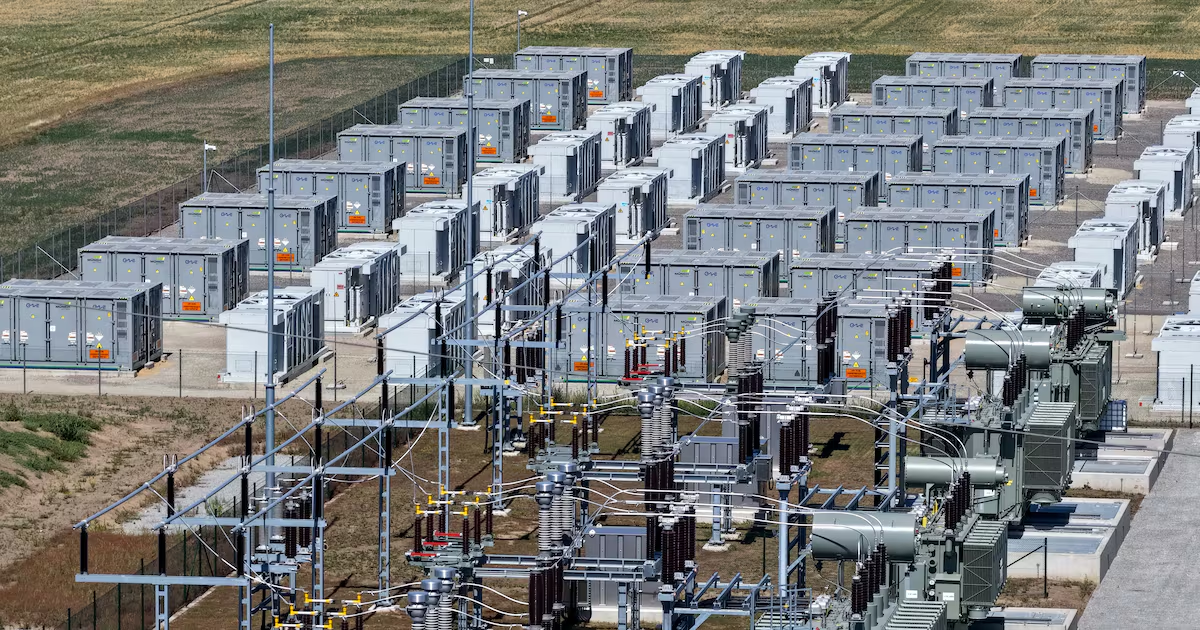
A recent real-world case from E-Foods, a hydroponic farming enterprise in Rajasthan, highlights a sobering reality facing modern agriculture: the farm missed its annual production target by a staggering 62 per cent. Projected to yield 12 tonnes of produce, it managed to harvest only 4,582 kilograms. The primary driver behind this severe shortfall was an erratic power supply, with the facility facing 12 to 14 hours of daily grid outages during peak summer months. Despite having 4.7 MW of on-grid solar installed, the system sat idle during power cuts due to mandatory grid-tied safety mechanisms. Heavy reliance on diesel generators operating in extreme 48°C to 51°C heat resulted in severe thermal overload and equipment fires.When power trips during critical watering and sowing windows, months of upfront agricultural investment are completely erased. Multiplied across thousands of rural enterprises nationwide, erratic power ceases to be an operational inconvenience and becomes a direct threat to national food security.The structural limits of conventional grid expansionExpanding or upgrading conventional transmission and distribution networks across remote rural feeders is prohibitively expensive and slow. For India’s agricultural economy, reliable electricity is not an optional convenience but a fundamental productivity enabler. Irrigation pumps, cold-storage facilities, grain processing units, and post-harvest supply chains all depend heavily on energy predictability. Yet, power fluctuations and peak-demand constraints continue to disrupt farm operations, increase dependence on diesel generators, and erode rural incomes. Relying solely on centralized grid expansions leaves these critical rural assets vulnerable, necessitating a shift toward localized, resilient energy architectures.Decoupling rural economies through decentralised storageBattery Energy Storage Systems (BESS) offer a practical mechanism to decouple rural economic growth from centralised grid limitations. Rather than viewing batteries merely as emergency backup equipment, localised energy storage must be recognised as core infrastructure for rural economic development. By pairing local solar generation with battery storage, intermittent daytime solar is converted into a dependable, round-the-clock power supply. This dual functionality allows decentralised microgrids to dispatch power directly at the point of consumption—securing time-sensitive irrigation and temperature-sensitive cold storage—while injecting stored energy back into local distribution feeders during peak hours to stabilize voltage and prevent local blackouts. Managed through intelligent edge software and digital controls, storage optimises real-time power dispatch and automated load management without overloading the primary grid.Demonstrated proof across field deploymentsThis storage-backed microgrid architecture is already demonstrating its operational viability through scalable field deployments. Initiatives alongside the Maharashtra Energy Development Agency in Amravati, as well as collaborative programs with Smart Power India and The Rockefeller Foundation in Uttar Pradesh and Bihar, illustrate how smart microgrids can deliver clean, dependable power directly to rural communities. Protecting temperature-sensitive cold chains, securing irrigation schedules, and stabilizing local micro-economies requires an energy architecture built specifically around local demand. Taking energy storage closer to the farms, cooperatives, and rural enterprises that depend on reliable electricity is an essential step toward building a productive, resilient, and sustainable agricultural future for India.The author is Co-Founder & CEO of AmpereHour EnergyPublished on August 29, 2026