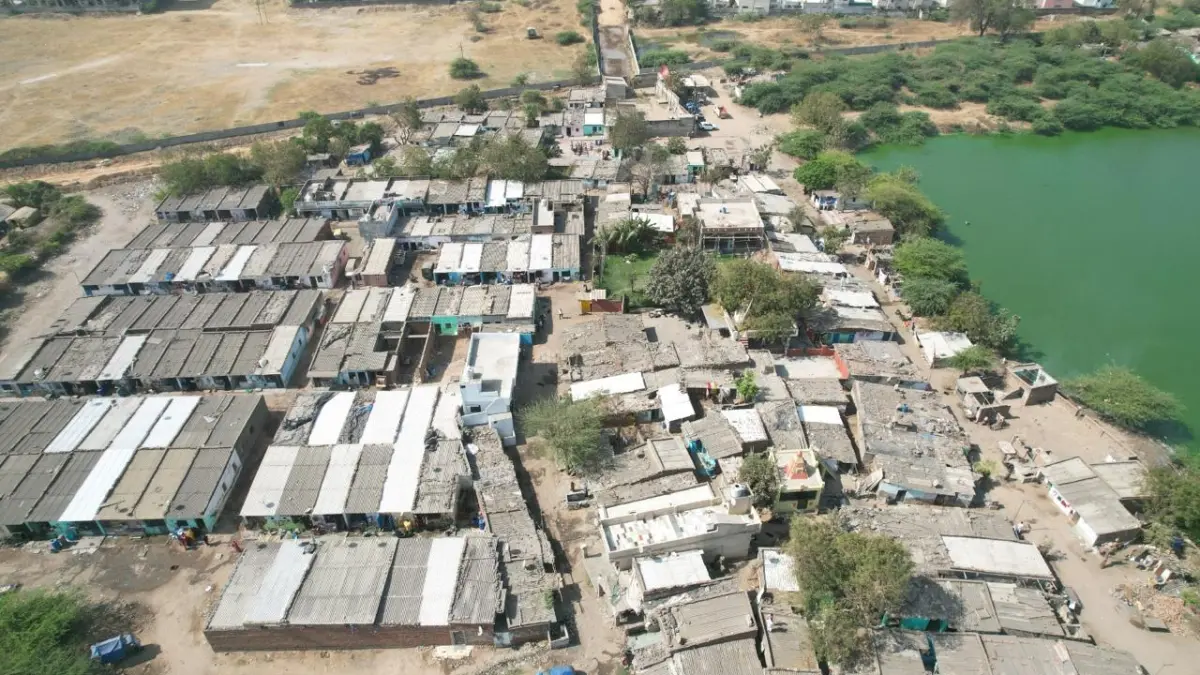
Public radio’s longest-running daily global news program.AboutContactDonateMeet the TeamPrivacyTerms of use©2026 The World from PRXPRX is a 501(c)(3) organization recognized by the IRS: #263347402.Indian cities looking to beat the heat get innovativeThis summer, the combined impact of climate change and El Niño has led to erratic monsoon rains and intense heatwaves across India. Since roofs are the primary way heat enters a building, several organizations have been developing “cool roof” programs to reduce indoor heat. Two of those organizations, SEEDS in Delhi and cBalance in Chennai, have very different climate solution models, but the same end goal: to give Indians respite from the stifling heat. 6:48A small shop selling water on a street corner in Chennai.In northwest Delhi, the informal settlement of Shahbad Dairy is home to tens of thousands of people. Clotheslines stretch across the makeshift neighborhood, homes connect via winding footpaths, and workers at small food stands offer cold drinks on street corners. Residents of Shahbad Dairy, an informal settlement near Delhi, collect water from a tanker truck to carry to their homes. Justin Nisly/The WorldOn a sunny morning in July, a woman in her 60s, Savithri Sharma, climbed carefully up a ladder to the flat, tin roof of her one-story home. She picked up a paint roller and a bucket of paint, and in just a few minutes, covered a patch of the roof with a white, reflective coating. On the street, her grandchildren raced around trying to catch a peek at what she was doing.Sharma is a vegetable seller who works all day outdoors and returns home by 11:00 p.m. each night. Recently, she connected with the Delhi-based organization SEEDS, which has worked for more than thirty years in disaster management. Sharma purchased a painting kit from them that included “brushes, a bonding agent, lime powder, and sandpaper.”While her grandchildren watch, Savithri Sharma prepares to cover the roof of her home in Shahbad Dairy in limewash paint.Justin Nisly/The WorldHoping to cool her home, Sharma followed the lead of friends and neighbors who painted their roofs white. “I saw them all around me. And I heard about them from this person and that person,” she said. Soon, she decided to try it too.Sharma’s roof (left) is covered in limewash paint that can lower indoor temperatures. Justin Nisly/The WorldA few Indian organizations currently use industrial, white reflective paint to reflect the sun’s rays away from homes in informal settlements. But SEEDS wanted a nature-based solution that wouldn’t add chemicals to the water supply. Also, it had to be affordable and accessible. Initial experiments, however, proved costly. SEEDS co-founder Manu Gupta recounts one homeowner confronting him about the price. “The owner said, ‘If you’re spending so much, why don’t you buy me an air conditioner?’”Taking the feedback to heart, SEEDS kept testing ways to make their solutions more affordable. Among their experiments, they tried paint made from cow dung and insulation made of wool. The organization finally landed on limewash paint, made from crushed limestone, water and natural minerals. Manu Gupta, co-founder of SEEDS.Justin Nisly/The WorldGupta estimated that it costs a bit more than $10 to cover a single roof. “Even if one rain washes them off,” he said, “[the family] could still do it again.”And that’s exactly what some residents have been doing.Meena Devi lives in a small home in Shahbad Dairy with her family and a dog named Cherry. She explained that she put three light coats of paint on her roof, per SEEDS’ instructions. But soon, “the rains came and washed it away.” Her family painted the roof again. “We feel cooler now,” she said.SEEDS has found that limewash paint can lower indoor temperatures by 6-7 degrees Celsius. And according to their founder, Manu Gupta, they are “seeing very clear impacts on health, better sleep at night.” Even though paint is an easily accessible and affordable option, climate solutions are rarely straightforward. Some experts say white paint isn’t practical in dusty cities like Delhi, where roofs don’t stay white for long. And although reflective roofs can bounce sunlight away from the occupants underneath them, that sometimes means neighbors living higher up catch the glare.Another concern is humidity – it’s hard for humid air to escape from the small, cramped homes in these informal settlements. Gupta said that this year they are working to create better ventilation in the homes, including by adding chimneys to expel humid air outside. SEEDS projects that if two million low-income households paint their roofs with lime wash, Delhi’s heat islands could become cooler on the whole – by an entire degree Celsius.So far, 1,400 roofs have been painted. It’s a start, but they hope an affordable, accessible solution will take on a life of its own and spread across millions of informal settlements in the city. SEEDS is now enlisting local young people as ambassadors for their heat mitigation efforts. Eighteen-year-old Sapna Kishoor helped lead a ‘street shading’ project that transformed old fabric into canopies. Kids now spend hours playing in the shade they provide.“I asked for scarves from others,” she said, “and hung them up. It feels really good to do this work.”Sapna Kishoor shows a photo of the street shading project she helped lead.Justin Nisly/The WorldWomen Entrepreneurs in ChennaiIn a working-class neighborhood in Chennai, along India’s southeast coast, eight women sat together on the floor in a brightly painted room. One woman, Vanita, grabbed a pair of scissors and a roll of plastic packaging material – the kind used to make bags of chips. Companies often discard this material when they find small cosmetic errors. For the women, however, the errors are irrelevant; the other side, made of shiny aluminum, is the side that matters.“We cut it into four-foot strips,” Vanita explained.They take these aluminum strips and melt them together using an iron. Soon, what used to be a pile of little metallic strips becomes a 4-foot-by-3-foot sheet.In Chennai, local women construct insulating roof panels from discarded packaging material. Justin Nisly/The World“We’ve been given a target of making 300 sheets total,” Vanita said. “We average about 50 per day.” These sheets will eventually be stuffed with organic materials, like forest grasses, and turned into reflective tiles that line the ceilings of people’s homes. These shiny surfaces have proven effective at trapping the sun’s rays and keeping homes cool. cBalance, the organization that designed these tiles, aims to create durable, reliable cooling solutions. “One of our core ethical principles is that we treat people in these informal settlements just like we would treat a middle-class client who comes to us with a design problem,” said cBalance founder Vivek Gilani.Their other goal is to hire and train local women to work on these cool roof designs. “We want to harness the immense economic potential that has been demonstrated: the women’s productive economy in the informal settlements,” Gilani said.Most of these women on their team have never worked outside the home. After receiving training on how cBalance’s cool roof products work, many of the women were excited to become entrepreneurs – and to earn wages for the first time. Vanita, who helps to construct cool roof panels, says she can now afford to buy a dress or something for her children. Justin Nisly/The World“Now, I can buy a dress, recharge my phone or buy something for my children,” Vanita said.Another worker, Arul Marie, said it has been nice to spend time with the other women while their children are at school. “We listen to music, take short breaks to eat snacks and drink tea, and talk about our lives. We feel free.”Arul Marie irons a piece of plastic packaging material to form a liner for a roof panel. Justin Nisly/The WorldThe women marketed the cool roof designs to their friends and neighbors and are now conducting maintenance checks to ensure the products are working as advertised. During one visit, Vanita met with a woman, Velankanni, who purchased the indoor tiles. They’ve made a big difference in her daily life. “Before we installed this solution,” Velankanni said, “I would sit outside for most of the day and only came inside around 4 or 5 p.m.” Now, she can come inside and rest, even during the hottest times of the day.Velankanni (right) tells visitors from the panel workshop that her new roof lining makes it possible for her to work inside throughout the day. Justin Nisly/The WorldOther designs have been less popular, such as a movable roof design that extends over the roof. In theory, a plastic sheet unfurls over the roof during the day, like a curtain, and then closes back up, like an accordion, at night. cBalance believes this will result in cooler indoor temperatures at night, specifically.One woman, Kalai, bought the movable roof and said sometimes it’s tricky to operate. “During rainy days,” she said, “it can be a bit hard to shut.” The sheet gets weighed down with rain or leaves. Moveable roof designs offer better cooling at night, but can be difficult to operate in monsoon rains. Justin Nisly/The WorldcBalance plans to tackle these kinds of problems soon. They recently won a grant to help with research and development, and Vivek Gilani said they’re also partnering with a college to access testing machines. These will put different cool roof designs through more rigorous trials. “Throwing rain on it through spray machines, [or] having wind blown on it to see what parts come off, and at what speeds,” Gilani said.It could take a few years for cBalance to refine these designs, but ideally, there will be a payoff: durable, affordable heat solutions for marginalized communities.Women sew together old fabric to make shade canopies. Justin Nisly/The WorldMeanwhile, the women making the tiles are thinking about ways they could manufacture the parts themselves to save on costs. It may not happen right away, but they have ideas they’re excited to test and implement.It’s the kind of energy that Vishwas Chitale, an expert on climate adaptation at the Council on Energy, Environment, and Water, said should be harnessed. He believes Indians should be asking questions like: “What is the local talent — where local entrepreneurs can get a chance to establish some of these solutions and be proud?”
Indian cities looking to beat the heat get innovative - The World from PRX
This summer, the combined impact of climate change and El Niño has led to erratic monsoon rains and intense heatwaves across India. Since roofs are the primary way heat enters a building, several organizations have been developing “cool roof” programs to reduce indoor heat. Two of those organizations, SEEDS in Delhi and cBalance in Chennai, have very different climate solution models, but the same end goal: to give Indians respite from the stifling heat.
1,695 words~8 min read